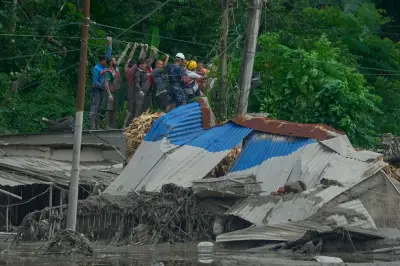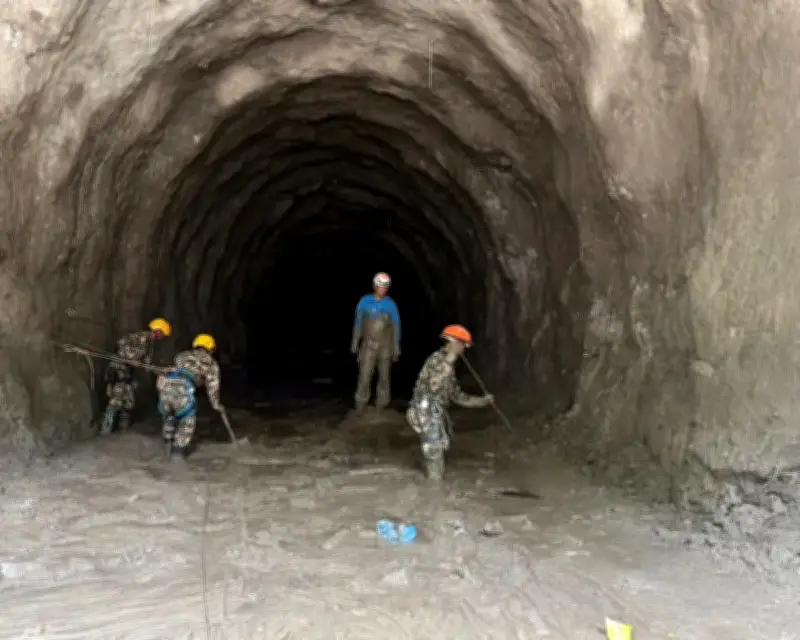
A senior official with Nepal's electricity authority has said there is a high chance that dozens of workers trapped for a week in an underground chamber at the Rasuwagadhi hydropower plant after deadly flash floods may be found alive.
Amhsu Kiran Shahi, a board member of the Nepal electricity authority, told Reuters on Wednesday that 46 people are believed to be trapped in a room-like structure in the tunnel. "We are very confident that they must be alive after one week because ... they have food and water over there in the building," Shahi said.
Rescue efforts at hydropower tunnels
So far, Nepali authorities have rescued 279 people from hydropower projects swamped by the unprecedented deluge of ice, rock, mud and debris, triggered by the collapse of a glacier. At least 639 more were still missing, some of whom are believed to be trapped in tunnels linked to the hydropower projects, where Nepali, Indian and Chinese rescue teams are digging to find survivors.

The flood, triggered by the glacial collapse near Nepal's border with Tibet, devastated towns and valleys across the mountainous region. At least 1,204 people have been confirmed dead and more than 4,200 remain missing.
Four projects targeted in rescue operations
Major rescue operations were under way or planned at four hydropower projects. Two sites, where about 90 people are missing, offered the strongest prospect of finding survivors because of the presence of air inside the tunnels, Shahi said. The Rasuwagadhi hydroelectric project, a 111-megawatt facility located in the hard-hit Rasuwa district about 5km from the border, was one site rescuers were trying to access on Wednesday.
"This is the only project where it's possible to walk through the tunnel," Shahi said. "The army tried doing that three days ago, but they didn't find the room. We are going in again." Rescuers are also looking for survivors believed to be trapped inside tunnels at other locations, where powerhouses have spaces and rooms for people to stay, according to Nepali army spokesperson Raja Ram Basnet.
Challenges and debris estimate
At the Upper Trishuli 3A facility, another project hit by the floods, it took rescue workers almost six days to find the tunnels because of thick mud, Shahi said. "We are expecting [survivors] in there because we are told there is a dry space inside. We are trying to break into the tunnel now," he said. "We are using every technology available in Nepal right now, and we are taking help from the Indians, Chinese, Koreans. We have experts from Australia too."
The disaster created at least 2.2m tonnes of debris, according to a preliminary estimate by the UN Development Programme (UNDP), including parts of buildings, rocks and sediment – the equivalent of six Empire State Buildings.
The chance of finding survivors elsewhere was fading, authorities said, but there was no let up in rescue operations as teams scoured the mountainside along the border with China where floods tore through towns and valleys. "The hope of finding survivors is decreasing," Phanindra Paudel, a senior official at Nepal's national emergency operation centre, said on Wednesday. "We pray and are hopeful. Hope is hope."