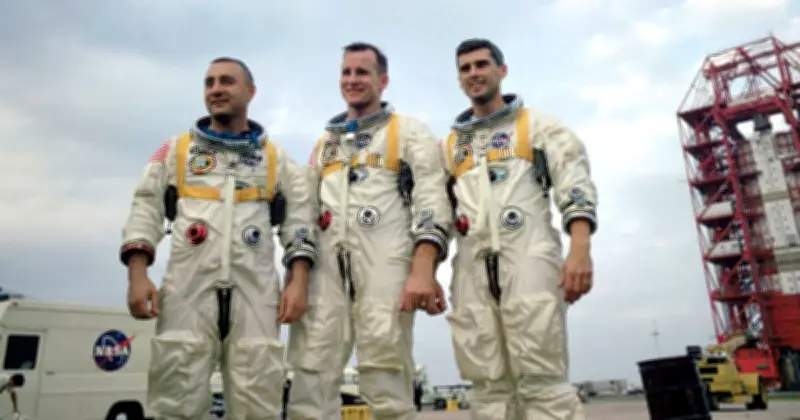
The three astronauts who died in the Apollo 1 fire during a ground test at Cape Kennedy on 27 January 1967 uttered a chilling final statement before being engulfed by a catastrophic fireball moments before their spacecraft was due to launch.
In 1967, the space race claimed three lives during a test flight for the maiden Apollo mission. NASA engineers were working to get people on the moon and had recently built a new rocket designed for crewed spaceflight.
Hasty development and combustible cabin
Yet several experts suggested the development had been hasty, and during the tragic rehearsal disaster unfolded, with one astronaut saying desperately: "We've got a fire in the crew deck".
NASA had planned to dispatch a three-person crew into low Earth orbit, piloted by the astronauts themselves. The command module was a compact, cone-shaped vessel for three crew members, measuring merely 3.9 metres at its base and 3.65 metres in height, according to America Space.
Apollo mission 1 featured two of America's most legendary astronauts: Command Pilot Virgil 'Gus' Grissom, the second American in space who harboured ambitions of being the first man on the moon, and Senior Pilot Ed White, the first American to conduct a spacewalk, reports the Daily Star.
Final words and the fire
They were scheduled to be accompanied by spaceflight newcomer, 31-year-old Pilot Roger B. Chaffee, the youngest individual ever selected for a NASA mission. The launch was set for 21 February 1967.
During early preparation for the mission, the crew expressed reservations about the extremely confined spacecraft, chiefly concerning the volume of combustible nylon materials within the cabin.
A number of experts also contend that the enormous pressure of John F Kennedy's lunar deadline drove NASA and contractor North American Aviation to cut corners, ultimately compromising the safety of the crew.
One such decision involved opting for the lighter, single chamber gas system over the heavier dual chamber alternative. This meant the module would be filled with 100 percent oxygen for the crew to breathe, creating a highly combustible environment.
Another controversial choice was the installation of an inwardly opening hatch, along with the decision to omit explosive bolts to secure it — devices specifically designed to release during an explosion or under extreme pressure.
Further concerns were raised by other team members on the project, who reported damaged wiring and electrical faults throughout the spacecraft's cabin. Despite these alarming issues, the February launch schedule pressed ahead.
Four weeks before the crucial date, the rocket and spacecraft were given the green light for what became known as a 'plugs out test' — a rehearsal during which the crew would board the command module in preparation for the actual mission.
On January 27 1967, the three Apollo 1 astronauts stepped into the cramped spacecraft at Cape Kennedy Air Force Station Launch Complex 34. It would prove to be their tragic final act.
Upon entering, the trio immediately detected an unusual odour emanating from the oxygen tank.
Moments later, a chilling alarm sounded, indicating excessive oxygen flow within the cabin. They battled to establish reliable radio communication, with one asking: "How are we going to get to the moon if we can't talk between two or three buildings?".
The rehearsal pressed on, and just as they readied themselves to begin the simulated launch countdown, eight chilling words rang out from their capsule: "We've got a fire in the crew deck".
Within moments the blaze ripped through the vessel, transforming it into a raging inferno. The emergency evacuation protocol demanded a minimum of 90 seconds, yet in under 30 seconds, the flames and lethal fumes had consumed the spacecraft.
Notwithstanding the frantic ground crews' valiant attempts, a full five minutes elapsed before they could wrench open the hatch, which had become sealed by the pressurised cabin atmosphere.
When they ultimately succeeded in forcing the door ajar, they discovered only the bodies of the crew.
Aftermath and accountability
All three astronauts died almost immediately, with post-mortem examinations confirming they succumbed to asphyxiation caused by carbon monoxide and other poisonous gases emitted by the blaze.
The Apollo space programme was halted for more than a year while inquiries were carried out into the catastrophic conclusion of the mission.
NASA flight director Gene Kranz accepted accountability for himself and the agency concerning the Apollo 1 tragedy, delivering a heartfelt address just a week later in which he admitted the team had failed the astronauts. He stated: "Spaceflight will never tolerate carelessness, incapacity, and neglect. It could have been in design, build or test. Whatever it was, we should have caught it. Somewhere, somehow, we screwed up."
Kranz acknowledged that "every element of the program was in trouble" and that the team was wholly unprepared for the mission to proceed. He went on: "We were rolling the dice, hoping that things would come together by launch day, when in our hearts we knew it would take a miracle."