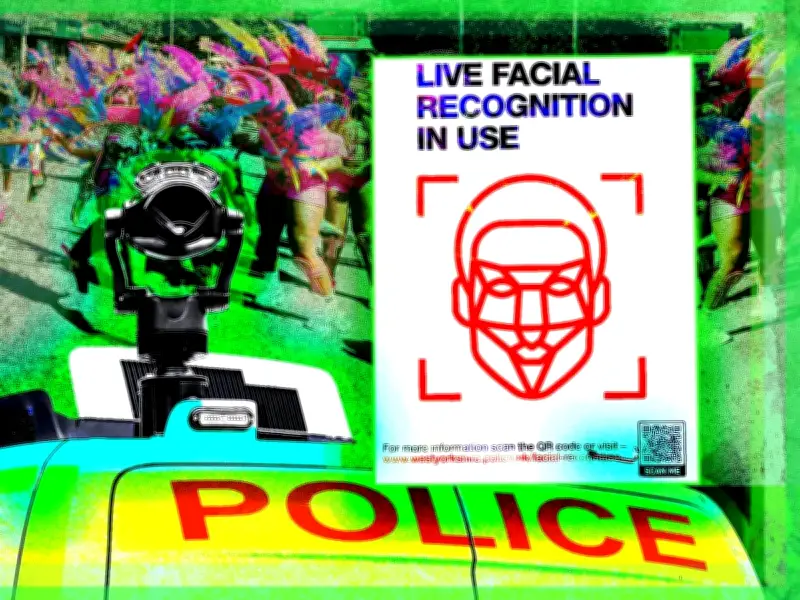
Greater Manchester Police (GMP) used live facial recognition (LFR) technology at the Manchester Caribbean Carnival in August, scanning the faces of tens of thousands of revellers and generating 34 alerts, which resulted in 11 arrests. The force had told the Manchester Evening News before the event that the technology would be deployed to 'provide an extra layer of security'.
The arrests were for offences including breach of a sexual harm prevention order, fraud, failing to appear at court, and theft. Among the remaining alerts were 11 registered sex offenders and five people known to regularly carry knives, the force said. A missing child was also identified.
Privacy concerns at cultural event
For critics, the deployment raises questions about how much surveillance is acceptable in a public space, particularly at a cultural event, when the vast majority of people being scanned are not suspected of committing a crime. A sign near the police presence warned visitors that LFR was being used, stating: 'We take your privacy very seriously.'
Jasleen Chaggar, senior legal and policy officer at Big Brother Watch, said: "The burden of policing is being put on innocent members of the public and the police are saying, in order for us to keep you safe, all of your rights have to be infringed." She added: "It is especially cynical that Greater Manchester Police are targeting an event which originated as an act of resistance and freedom with Orwellian facial recognition technology."
Cross-party coalition demands halt
The issue has reached Parliament. Rebecca Long-Bailey, Labour MP for Salford and Eccles, joined a cross-party coalition of 65 parliamentarians and over 30 civil rights groups demanding an immediate stop to facial recognition surveillance by both UK police forces and private companies. The signatories argued that mass public scanning alters the relationship between citizens and the state, treating the public like a 'constant police line-up' without democratic oversight. Unlike passwords or ID cards, a person's face can't be changed if a database is hacked or compromised, creating lifelong security risks.
There are no specific laws or regulations governing the use of facial recognition technology in the UK, unlike the European Union, which has imposed restrictions on real-time public facial recognition but allows it under strict, narrow exceptions such as targeted searches for missing people or preventing imminent terrorist threats.
GMP's use of LFR
Since October 2025, LFR has been deployed on 101 occasions across Greater Manchester, scanning over 1.3 million faces. GMP says this has led to 126 arrests, and at least 53 subsequent charges, including the imprisonment of two sex offenders. Its LFR vans, funded by the Home Office and fitted with fixed cameras and biometric software, have previously been used at high-profile events such as the Brit Awards, the MOBOs, football matches, and various town centre operations.
The system used by GMP relies on the NeoFace algorithm, developed by the Japanese company NEC Corporation. The force maintains that its use is strictly governed and subject to rigorous oversight. GMP said that of the faces scanned to date, there has only been one false alert – a white female runner at a marathon. "With any alert generated, there is always an officer who makes the decision to arrest," the spokesperson said. "The decision to arrest is not based on an alert, and numerous checks are made to ensure that any arrest is necessary, proportionate, and lawful."
Regulatory and legal challenges
An audit by the Information Commissioner's Office (ICO) in May found gaps in the way GMP governed the technology. The ICO gave GMP's LFR operation a 'reasonable' assurance rating, but found that staff use of the system was not being recorded or monitored, and that generic user accounts meant there was no record of who had accessed the information. The regulator said these weaknesses created a risk of inappropriate access going undetected.
There is also retrospective facial recognition (RFR), where officers search already-captured images against a database of known faces. Home Office-commissioned research found that, in certain settings, false-positive rates were considerably higher for black faces (5.5pc) and Asian faces (4pc) than for white faces (0.04pc) when using RFR. In its May 2026 audit, the ICO gave GMP's RFR use a 'limited' assurance rating, compared with 'reasonable' assurance for LFR, and identified 'considerable scope for improvement'. Of the 21 recommendations for RFR, 18 were classed as either 'urgent' or 'high'.
There are real-world consequences when a facial recognition search goes wrong. In February, Thames Valley Police arrested 26-year-old Alvi Choudhury for a burglary, after face-scanning software confused him with another person of south Asian heritage. Officers had used automated facial recognition software which matched Choudhury with footage of a suspect 100 miles away in Milton Keynes. A subsequent ICO report in August found that weaknesses in governance and oversight were not unique to GMP. Across five audited forces, the ICO identified problems including inadequate logging, incomplete or outdated records, gaps in staff training, and weaknesses around retention of biometric data.
Legal history and future deployments
In 2020, the advocacy group Liberty won a landmark case which ruled that South Wales Police's (SWP) use of automated LFR violated privacy rights, data protection laws, and equality legislation. Liberty claimed the technology would 'always be used disproportionately against communities of colour'. SWP paused its use of LFR, but resumed following a report commissioned in conjunction with the Metropolitan Police, which found that there was no statistically significant demographic bias based on race or gender.
Ruth Ehrlich, interim director of external relations at Liberty, said: "The police's use of live facial recognition is expanding rapidly despite the continued absence of a clear legal framework governing how and when this technology can be used. Scanning people's faces as they go about their daily lives represents a serious intrusion into privacy and risks undermining fundamental rights and freedoms. Without proper safeguards and oversight in place, the police should be pausing their use of this powerful technology—not rapidly expanding it."
The debate on facial recognition is not simply about its capability in theory, but also where it's used in practice. The Manchester Caribbean Carnival is traditionally a peaceful community event, but serious crimes have taken place at after parties. In 2022, Javell Morgan was stabbed in the back with a samurai sword. Jacob Doughty and Deontay Crosfield, both of Huddersfield, were found guilty of murder following a trial at Manchester Crown Court in 2023 and jailed for 21 and 20 years respectively.
GMP has not used LFR at Parklife, despite the event attracting around 80,000 people and recording dozens of arrests in recent years. A spokesperson for the force said: "Any future deployment at the festival would be appropriately assessed in-line with event and resource needs."
Several carnival-goers told Big Brother Watch that they were unaware they were being watched. "It feels like an invasion of privacy now," said one young man. "That feels pretty scary to be honest," said another. Chaggar said it risked changing the way people were viewed by police. "You can see how dehumanising it is to treat community members as pieces of data whose faces have this square around them to see if they're suspects or not," she said. "That's not how we do policing in this country. We don't treat people like they're potentially a suspect until the computer says otherwise."
The force, however, says LFR is intended to help officers identify wanted offenders and vulnerable missing people. But the details behind those figures are harder to establish. The Manchester Evening News sent a Freedom of Information request to GMP, asking for a detailed breakdown of alerts, how many arrests it had led to, and if the force had any reports, tests, reviews or assessments concerning the accuracy of its LFR system, with a further breakdown by age, sex and ethnicity. While the force provided the total number of arrests, it said breaking down the further requested data would require officers to go through all the alerts using multiple systems and would take more than 18 hours.
GMP said not all officers use LFR, adding: "The Live Facial Recognition team is staffed by specially trained officers who operate and access its systems. All officers have been extensively trained in the technology, its use, and the appropriate legal and ethical guidance."
GMP clearly sees LFR as an increasingly important part of its policing toolkit. The debate is no longer about whether the technology works. It is about where it should be used, whose face should be scanned, what safeguards should apply – and, more importantly, who gets to decide them. "The question I'd ask is, would it make you feel better if I said that police rounded up everyone on the high street and took a fingerprint off you, and compared it with a list just in case, and then you can go about your day?" said Jasleen Chaggar. "I think a lot of us would still feel uncomfortable. The idea that just because it's happening remotely or that it's our face instead of our thumb, is not that reassuring."