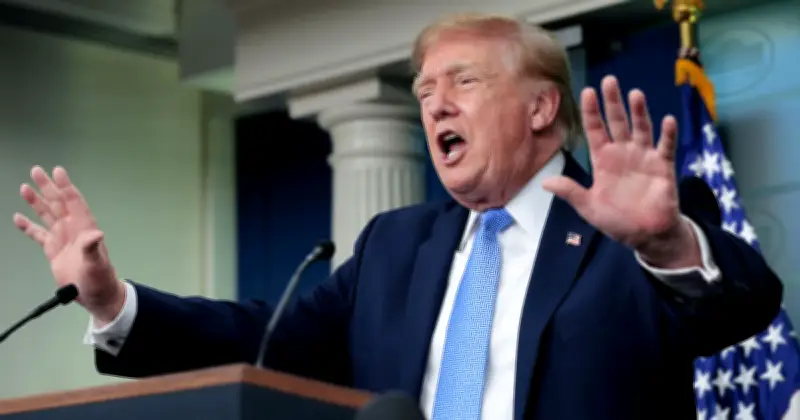
A federal judge has ruled that Donald Trump's £7.5bn defamation lawsuit against the BBC can proceed, partially blocking the national broadcaster's motion to dismiss the case. Federal judge Jeffrey T Kuntz, who was appointed by Trump, made the decision on Tuesday.
Trump is seeking substantial damages over the editing of a 2024 Panorama documentary about the US Capitol riots. The documentary faced criticism for giving the impression Trump had encouraged his supporters to storm the Capitol building on January 6 2021 after he lost the 2020 White House race to Joe Biden.
Trump's response to the ruling
In a statement on Truth Social, the president hailed the decision, saying: "A Huge Victory against Fake News BBC, a terrible abuser of the truth, just handed down by highly respected District Court Judge, Jeffrey T. Kuntz, of the Southern District of Florida."
He added: "In his powerful ruling, Judge Kuntz wrote, 'Here, the news entity created the story. BBC admitted as much by confirming it had edited a video to make it appear as though President Trump made a statement he never made. We will continue fighting against, and defeating, all of those who try to deceive the American People! Thank you for your attention to this matter. President DONALD J. TRUMP'"
The BBC's response
The BBC responded to the ruling, saying: "We are surprised by this decision but respect the Court's authority and note the case will now proceed to the next stage. We remain confident in our position and will continue to respond through the proper legal process."
The broadcaster had been seeking to have the case thrown out, warning of the "chilling effect" it would have on "robust reporting on public figures and events".
The judge's reasoning
Judge Kuntz wrote in his ruling: "Accepting the allegations in the complaint as true, the Court finds Trump plausibly pled damages where Trump alleges a defamatory documentary released toward the election caused reputational harm.
"It would be difficult for the Court to accept a different framing without completely negating the significance and fragility of political elections."
The ruling did not decide whether Trump's claims were proven. The judge said: "Editing is often required. However, given the time disparity between the two statements, the distance itself tends toward a plausible inference that BBC knew or should have known that the segment they were creating would not and could not have been a truthful statement.
"This was not trimming around the edges but creating something different than what was stated in the speech."
The judge noted past errors in the broadcaster's coverage and wrote that "such examples can be said to be probative of BBC's state of mind as it pertains to recklessness in light of BBC's non-action toward false statements about Trump. Thus, Trump paints a picture that demonstrates the BBC has a record of allowing the publication of false statements in their portrayal of Trump."
Judge Kuntz also wrote that "Trump's allegations regarding BBC's departure from journalistic standards are more than enough to plausibly alleged more than mere negligence".
Next steps in the case
While the judge determined that Trump had "sufficiently pleaded" that the BBC acted with actual malice, the legal standard for a public figure to win a defamation case, he will have to actually prove they did so at trial. The judge also dismissed Trump's claim that the BBC violated Florida's Deceptive and Unfair Trade Practices Act.
Judge Kuntz decided that the president will have to prove that he suffered "actual damages" from the airing of the documentary, which was not broadcast in Florida. In late October, a Florida magistrate judge ruled that Trump will have to sit for a deposition conducted by lawyers for the BBC by December 11, or be hit with sanctions.