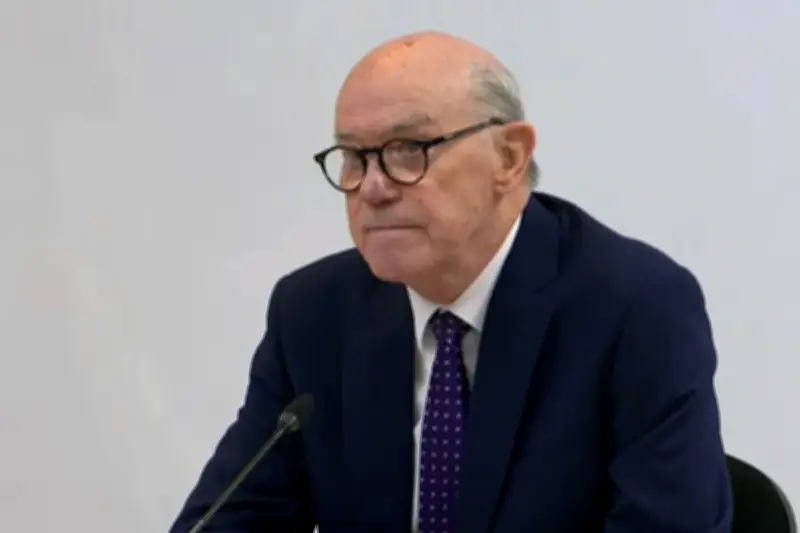
Former RUC chief constable Sir Ronnie Flanagan has told the Omagh Bombing Inquiry that he is ashamed of comments he made in 2001, when he said he would publicly commit suicide if criticisms by a police watchdog into the force's Omagh bomb investigation were true.
Sir Ronnie described the remarks as "crass and insensitive" and said they should never have been made. However, the retired officer also said he believes he kept his promise to leave "no stone unturned" in the police investigation into the dissident republican attack.
Evidence to the inquiry
Sir Ronnie was giving evidence at the public inquiry into the car bombing in Omagh on August 15 1998, which killed 29 people, including a woman who was pregnant with twins. It was the worst single atrocity of the Troubles in Northern Ireland.
The inquiry, chaired by Lord Turnbull, is holding evidential hearings in Belfast. The current phase focuses on the period before and after the bombing, examining how it was carried out and who was responsible. The inquiry was set up by the previous government to establish whether the explosion could have been prevented by UK authorities.
Apology over 2001 comments
On Monday afternoon, Sir Ronnie was questioned about the critical report delivered in 2001 by former police ombudsman Baroness Nuala O'Loan into the original RUC investigation. Baroness O'Loan told the inquiry last month that Sir Ronnie had said in a one-to-one meeting that year that her report could have destroyed the peace process in Northern Ireland.
Responding to this, Sir Ronnie said: "I never felt that for a second and wouldn't ever have said that." He was then asked about comments made at a press conference in December 2001, when he said he would publicly commit suicide if the criticisms in the ombudsman's report were true.
Sir Ronnie said: "I regretted it instantly I made it. It was crass, it was insensitive. Too many of my own police families have been afflicted by that curse. And I was so ashamed if I caused hurt to the families similarly affected. I apologised then. I apologised at the beginning of the inquiry, and I apologise now. A terrible comment that should never been made."
Investigation commitment questioned
Counsel to the inquiry Paul Greaney KC asked Sir Ronnie about his determination after the bombing. Sir Ronnie said: "That the people responsible, in whatever capacity, be brought to justice." Mr Greaney noted that this had not happened, and Sir Ronnie said: "It has not happened and that is a source of the most deep regret to me."
Sir Ronnie told the inquiry he was in his office in Belfast in August 1998 when he first heard about the explosion and immediately travelled to Omagh, wanting to show "how much these things mattered".
Questioned about the subsequent RUC investigation, Sir Ronnie was asked whether it had kept faith with his 1998 comment that "no stone would be left unturned". He said he had open lines of communication with the senior investigating officer (SIO) and had made clear that if any resources or help were needed, the SIO should contact him directly. He said no such request for additional resources was ever forwarded to him.
Mr Greaney asked whether, with the knowledge he now has, Sir Ronnie considered the investigation kept faith with that promise while he was chief constable. Sir Ronnie said: "That's my feeling. Yes."
Mr Greaney then showed the inquiry an RUC policy log indicating that, in the month following the bomb, the SIO decided to reduce the manpower and hours of work in the incident room investigating the explosion. Sir Ronnie said he was not aware of the reduction, which occurred six weeks and two days into the investigation. He said he would have sought assurance from the SIO that the incident room could be managed effectively under the new measures.
Mr Greaney also showed a log entry from November 1998 showing further reductions in the size of the inquiry team. Sir Ronnie said he was not made aware of this at the time, 15 weeks and two days after the bombing.
Anonymous call to army camp
Earlier, Mr Greaney told the inquiry he was confident the Irish Government would answer questions about an anonymous call to an army camp the day before the Omagh bombing. Last month, the inquiry heard the call was made to Finner army camp in Co Donegal on August 14 and that Omagh had been mentioned.
Mr Greaney said: "Drawing the strands together, the current evidential position appears to be this, there was an anonymous call to Finner Camp on the night of the 14th of August. This referred to a need for security forces, including in Northern Ireland, to pay attention to the road that was the main route from Lough Melvin to Enniskillen, Irvinestown and Omagh. The sergeant who spoke to the caller did not take the content seriously at the time and made no report upwards at any stage prior to the Omagh bombing. Accordingly, the content of the call did not come to the attention of UK state authorities prior to the Omagh bombing."
The barrister said Garda intelligence reports had concluded the call was not a warning about Omagh, but the same report included a comment indicating Omagh had been mentioned three times in the call. The call was traced to a bar in Bundoran, and there had been four other calls from the bar to the camp earlier the same day. Mr Greaney said the relevance of the earlier calls is "unclear".
The inquiry legal team has posed written questions to the Government of Ireland seeking clarity on the issue, particularly around the apparent tension between Garda conclusions about the call's significance and whether any information was passed to UK state authorities. Mr Greaney said it was unsurprising the Irish Government had not yet answered the questions, adding: "We are confident that they will do so."