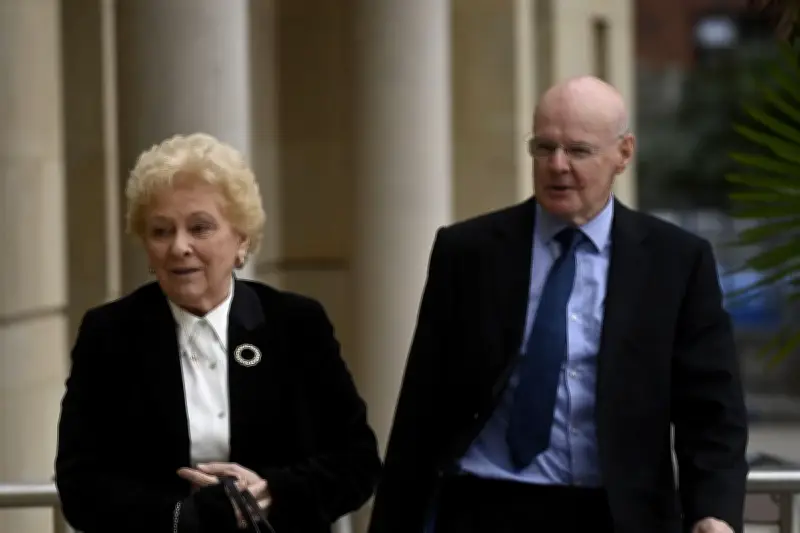
Baroness Nuala O'Loan has said former RUC chief constable Sir Ronnie Flanagan told her that her report into the Omagh bomb investigation would “destroy the peace process”.
The former police ombudsman also told the Omagh Bombing Inquiry that during the controversy over her report in 2001, she was described on TV as a “suicide bomber who had outlived my usefulness”.
The witness said she now believed there was a “very cogent argument” for stating that “something could have been done” by authorities to stop the bomb in the Co Tyrone town.
Evidence to the inquiry
Baroness O'Loan was giving evidence in the public inquiry into the dissident republican car bombing in Omagh on August 15 1998 which killed 29 people, including a woman who was pregnant with twins, in the worst single atrocity in the Troubles in Northern Ireland.
The inquiry, chaired by Lord Turnbull, is holding evidential hearings in Belfast. The latest phase of hearings, which will last for several weeks, is concentrating on the period before and after the bombing and will examine how it was carried out and who was responsible.
The inquiry was set up by the previous government to examine whether the explosion could have been prevented by UK authorities.
Investigation into the RUC
Ms O'Loan, who was Northern Ireland's first police ombudsman, launched a probe into the original RUC investigation into the atrocity following a report in a Sunday newspaper in 2001.
The article in the Sunday People had contained claims that undercover agent Kevin Fulton had told his RUC handlers that a car bomb was being prepared three days before the attack in Omagh.
Baroness O'Loan told the inquiry that she wanted to ensure that her investigation did not cause more trauma to the Omagh victims and their families.
Lead counsel to the inquiry Paul Greaney KC asked if the investigation needed to be progressed as a matter of urgency. She said: “It needed to be done as a matter of urgency, but it needed to be done properly.”
Mr Greaney said: “Why, in your judgment, did it need to be dealt with as a matter of urgency?”
She said: “We were not investigating the Omagh bomb, but the work which we were doing was related to the investigation of the Omagh bomb, and when you're investigating a criminal offence, the further you get from the date upon which the offence was committed, the more likely you are to lose witnesses, to lose investigative opportunities, to lose forensic opportunities.”
Difficulties with police and officials
Asked if she felt supported by the Northern Ireland Office, Baroness O'Loan said: “Not particularly, no.” Asked about support from politicians in Northern Ireland, she said there was a “significant amount of outrage among certain members of the unionist parties”.
She said her investigation team spoke to Kevin Fulton and there was “nothing to indicate he was unreliable”. Baroness O'Loan said she had understood that “all relevant material” would be made available by the RUC. She agreed with a suggestion that the information initially provided to her team was incomplete.
Mr Greaney said: “When you discovered that it was incomplete, was that a source of disappointment for you?” She said: “Yes.”
Baroness O'Loan said her team received information in September 2001 that the RUC had previously ordered a review of its investigation into Omagh which had been carried out by Chief Superintendent Brian McVicker. She said she later became aware there was also a separate Omagh intelligence report.
The former ombudsman told the inquiry that when she sought a copy of the McVicker review, she was told there was only one copy, it was in the safe of a senior officer and was not likely to be made available.
Mr Greaney said: “Did you regard that as an acceptable state of affairs?” Baroness O'Loan said: “No.”
Mr Greaney referred to the use of the word “astonishment” in her statement to the inquiry. She said: “We were now nearly six weeks into an inquiry. We had asked for all the intelligence, and we haven't even been told about this very significant document. So, astonishment was the appropriate word.”
Baroness O'Loan said a copy of the McVicker review was later delivered to her personally by then RUC chief constable Sir Ronnie Flanagan.
Mr Greaney asked if she continued to “experience certain difficulties”. Baroness O'Loan said: “When we received intelligence in the beginning, it was redacted, and really you can't conduct an inquiry on the basis of redacted intelligence. And then we couldn't get access to the police database for handling intelligence, so there were arguments about that. That was eventually granted.”
She added: “I have to say that it really was profoundly difficult… we were trying to almost draw teeth in terms of getting information out of the police.”
The RUC was replaced by the Police Service of Northern Ireland (PSNI) in November 2001.
Report publication and aftermath
Baroness O'Loan said she published her draft report into Omagh on November 28 2001 and her final report on December 12.
She told the inquiry there had been “intervention” by the Northern Ireland Office in the period before she published the report. She said she had had a “long and difficult” meeting with a senior NIO official in October, who told her relations between her office and the police were “breaking down”.
She said: “He said to me that I needed to understand that anything I said to the Secretary of State was said to the Northern Ireland office as a whole, and that to me was a huge, almost red flag.”
Baroness O'Loan said after she had delivered her draft report, its contents were leaked to the Sunday Times and she received a call from then NIO minister Jane Kennedy to say journalists had been “briefed extensively” on the report. She said it had been subsequently confirmed by journalists the leak had not come from her office.
She said ahead of the delivery of the final report she had called then Northern Ireland Secretary John Reid to say there should be no leaking of it, and he became “quite angry”.
Baroness O'Loan said she went to an event at Hillsborough Castle on December 10 where she had a private meeting with Sir Ronnie Flanagan ahead of the publication of the final report.
She said: “He, among other things, told me that I was going to destroy the peace process, that my office would never recover.” She said the then chief constable also told her she had destroyed her relationship with the police.
Baroness O'Loan said: “I said to him, 'All you have to do, Ronnie, you have to admit there's a problem with the Omagh Bomb investigation, and really get it going and resourced, and you have to set up systems for the dissemination of intelligence', and that was it.”
Baroness O'Loan said she was “shocked” after the meeting. She told the inquiry Sir Ronnie had subsequently called her and urged her not to publish the report, the day before it was due to be delivered.
Mr Greaney referred to attacks on the former ombudsman at the time of a “personal nature”. She said: “Well, a very serious attack, and I was called a suicide bomber, and it was said that I'd outlived my usefulness, which was dangerous.”
Mr Greaney said this referred to comments made by Lord Drumglass, the former Ulster Unionist MP Ken Maginnis, on Newsnight on December 6 2001.
Could the bombing have been prevented?
The ombudsman report was published and concluded that even if reasonable action had been taken in respect of the Fulton intelligence, it was unlikely that the Omagh bombing could have been prevented.
It also found that an anonymous telephone call had been received but not acted upon by police on August 4 1998 containing detailed information that an attack would be made on police in Omagh on August 15.
Mr Greaney asked the witness if she now believed the Real IRA bombing of Omagh could have been prevented.
Baroness O'Loan said: “I think that is now a matter for the inquiry to decide. My understanding is that the individual bombs before the Omagh bomb were individually investigated. There was no linking of them, no handling of them by a single SIO to determine common factors and common suspects.
“I think if that had happened, it is possible the activities of the Real IRA at this stage could have been hindered, very definitely. Because of what we know about the telephone numbers that were being recorded and all that sort of thing, the analysis of the calls between one another.
“When you put all this together, it seems to me that there is a very cogent argument for saying that there must be something that could have been done.”