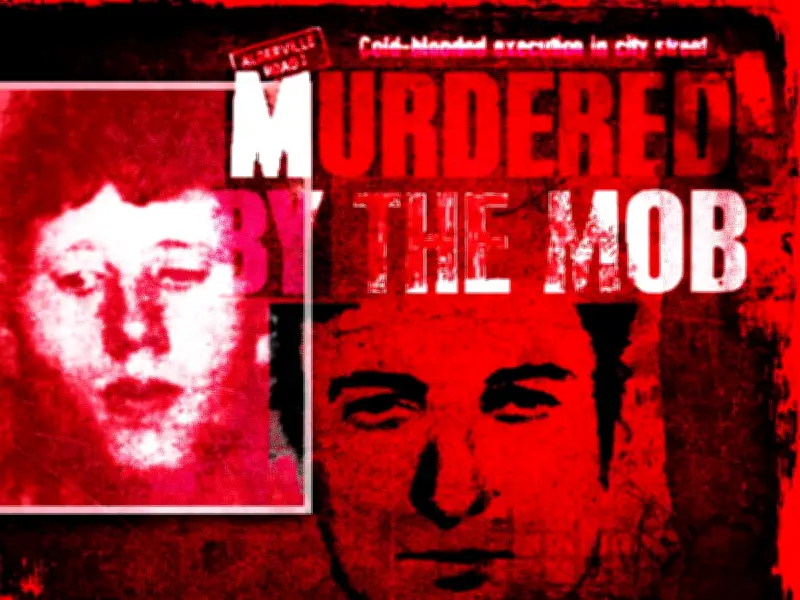
The murder of James Gibson in 1988 was "planned with military precision and ruthlessly executed," according to a court later told of the crime. A single shotgun blast on a quiet residential street in Walton instantly ended the life of the 23-year-old, bringing gangland violence to a family neighbourhood. Residents initially mistook the loud report for a leftover Bonfire Night firework, but the next evening the Liverpool ECHO carried the stark headline: "Murdered by the mob."
A quiet young man caught by surprise
James Gibson was an unemployed 23-year-old who lived just 100 yards from where he was shot. He was commonly described as a quiet, well-mannered young man. At age 11, his mother died, leaving him and his father in their terraced home on Baythorne Road, Walton. Two weeks before the murder, his father's health deteriorated, and he was admitted to a hospice, leaving James alone in the house.
On Tuesday, November 15, 1988, at around 8pm, James was walking back to his empty home on Alderville Road with his hands in his pockets to warm them from the November chill. Without warning, an assassin approached him in the dark. James never knew what hit him. When his body was found slumped on the pavement, his hands were still inside his coat pockets. The gunman had shot him at point-blank range with a shotgun before escaping in a stolen getaway car.
Moments after the blast, a mystery red "A" reg car pulled up beside the body. The driver stepped out, peered at the bleeding victim, and drove off without calling emergency services or speaking to police.
Terrified witnesses and a police investigation
Harrowing witness accounts revealed the full horror of the scene. An 11-year-old schoolgirl was among the first to reach James. She recalled seeing him lying on his back with his eyes open, an image that left her deeply shaken. "I wanted to be sick but I couldn't stop looking at those eyes," she said.
A neighbour who rushed out to help described how her five-year-old grandson "ran back into the house crying." She said: "We heard the bang followed by a screech of tyres, but I didn't think it was anybody being shot. It sounded more like a small explosion – you know, a gas blast or something like that." Another resident assumed the shotgun blast was a firework. "I never dreamed someone would be killed just a few feet from my house," she added.
The motive was a mystery, but police, residents, and the press had no doubt the brutal killing bore all the hallmarks of a gangland assassination. Police cordoned off Alderville Road and erected an incident tent over the crime scene. Forensic examination confirmed James had died instantly from a single shotgun blast. The getaway car had been stolen from Chester and was found a mile-and-a-half away in Clubmoor, its registration plates burned and hidden in the boot to destroy evidence.
Detective Superintendent Tony Bailey initially explored potential drug links alongside other possibilities. Another potential motive would emerge not from the streets of Walton, but in a Lancashire courtroom the following year.
The £500,000 bank heist
Until then, James had been regarded simply as a polite young man caring for his sick father. A darker side was exposed during trial proceedings at Preston Crown Court following one of the region's most high-profile crimes: a £500,000 bank robbery. The raid on the National Westminster Bank in Fishergate had taken place two months before James Gibson was murdered. The court heard it was "planned with military precision and ruthlessly executed."
Hooded gunmen abducted bank manager Roger Ball along with his wife and 13-year-old daughter, holding them hostage overnight. The following morning, Mr Ball was forced at gunpoint to open the bank. As staff arrived, they were systematically taken hostage. Sixty-two employees had then been herded at gunpoint into the vault before the raiders escaped.
Police were led to the door of one of the raiders, Leonard Newsham, after he was seen digging up £11,900 in the grounds of Fazakerley Hospital, not far from his home. The Crown alleged that Newsham was one of two men involved in kidnapping Mr Ball and his family. The other was a "great friend of Leonard Newsham," prosecutor Brian Leveson QC told the court. He added: "That man is now dead. His name was James Gibson."
Was James silenced to prevent him from talking?
If so, the assassination had the unintended side effect of drawing heat onto Newsham. Detectives investigating the murder had already been keeping Newsham under close surveillance. Officers watched as he dug up the stolen loot at Fazakerley Hospital. Police then did their own digging and uncovered two balaclavas that forensic scientists linked to the kidnapping and the robbery. Newsham pleaded guilty to six charges, including armed robbery, kidnapping Mr Ball, and holding his family hostage. He was sentenced to 13 years in prison.
Newsham and his friend Gibson were characterised in court as "minnows," foot soldiers recruited to shoulder most of the risk of the robbery while a syndicate of ringleaders remained shielded in the background. Police were convinced at least four other men were involved in planning and executing the robbery, but Newsham refused to name names. The ECHO speculated that Newsham feared he would be killed next if he spoke.
When the formal inquest into James Gibson's death was held in 1990, Detective Superintendent Tony Bailey revealed further details. Had James survived the shotgun blast, he would have faced charges not only for his role in the £500,000 National Westminster heist, but also for a string of unsolved burglaries along the south coast. It also emerged that on the very night he was executed, James had been at Leonard Newsham's home shortly before walking back toward Baythorne Road.
Det Supt Bailey said his death could have been connected with either crime or "a million and one other things." Addressing the theory of a hired contract hit, the detective was skeptical. He questioned whether a professional hitman would operate at 8pm in a densely populated residential estate with a high risk of witnesses. Instead, he advanced the theory that James Gibson either knew his killer personally, or was taken completely off guard by someone he didn't perceive as a threat.
Recording a verdict of unlawful killing, coroner Roy Barter said: "The evidence I have heard establishes beyond any doubt that this was a ruthless killing carried out in cold blood for which no clear motive can be found." In the wake of Newsham's conviction, a massive £50,000 reward was offered to anyone who could help identify the criminal masterminds behind the National Westminster heist.
Still at large
In an open appeal to the public, Detective Superintendent John Ashton said: "There are people involved in the robbery who are still at large, and as long as that remains the case then the file on the Preston bank robbery remains open."
A photofit of the assassin was issued following the shooting. He was described as in his late 20s at the time, about 5ft 10in with a muscular build. Yet the £50,000 bounty went unclaimed. The single shotgun blast on Alderville Road had done its job: it bought the total, terrified silence of everyone involved.
Nearly four decades later, James Gibson's murder remains unsolved. The file sits with Merseyside Police's Serious Case Review Unit, where cold-case detectives regularly review the physical evidence and witness statements in the hope that shifting loyalties will finally break the silence.