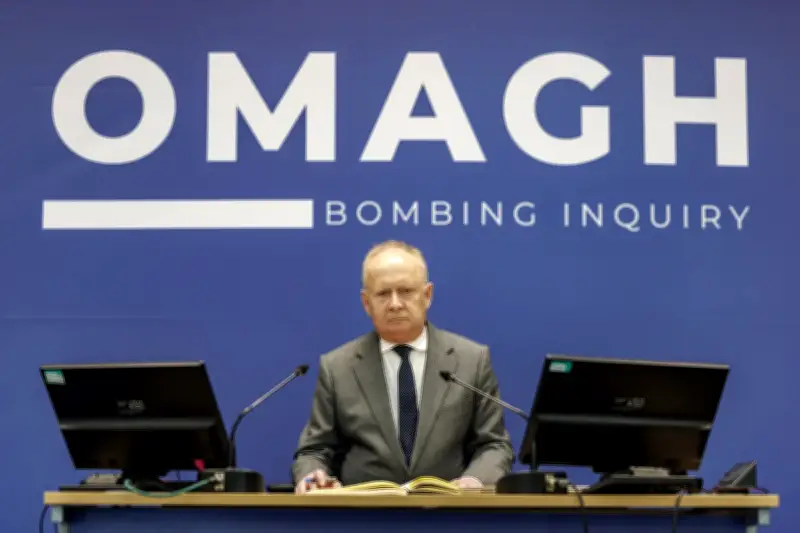
Baroness Nuala O’Loan resisted “high level” political pressure from the then Northern Ireland secretary not to publish her critical report into the Omagh bombing investigation, the public inquiry has heard.
Martin Bridger was an investigator for the Police Ombudsman of Northern Ireland (PONI) at the time of its establishment in 2000 and gave evidence to the inquiry on Thursday.
Background to the Omagh bombing
The dissident republican car bombing in Omagh on August 15 1998 killed 29 people, including a woman who was pregnant with twins, in the worst single atrocity in the Troubles in Northern Ireland.
In 2001, an article was released containing claims from undercover agent Kevin Fulton that he had told his RUC handlers that a car bomb was being prepared three days before the attack in Omagh.
The inquiry heard that Mr Bridger was involved in initial inquiries that led the then police ombudsman Baroness O’Loan to launch a full investigation into the claims.
Pressure and credibility concerns
He said he met Mr Fulton once as part of those initial inquiries and a number of times later when carrying out work to persuade the UK state to establish a public inquiry into the Omagh bomb.
Asked about Mr Fulton’s credibility, Mr Bridger said: “On the intelligence that Kevin Fulton gave just prior to the Omagh bomb, I considered it credible, yes.”
The ombudsman’s report, published in December 2001, examined wider intelligence handling and aspects of the murder investigation, and was ultimately critical of RUC leadership.
Mr Bridger confirmed he was informed by Ms O’Loan that the then Northern Ireland secretary John Reid sought to discourage the publication of the ombudsman report.
He also agreed when Paul Greaney KC, counsel for the inquiry, asked if the chief constable of the PSNI Ronnie Flanagan was “extremely angry about her findings”.
Ombudsman’s resolve during difficult period
He said during that period everyone at the Ombudsman’s office was “under pressure”.
“I think we went to about one, two o’clock in the morning, going through it piece by piece by piece,” he said.
“And she said to me, to all of us, ‘you need to be clear, if we’ve got this wrong, if you’ve got it wrong, then I would have to consider my resignation’.
“The Ombudsman’s office would lose the little credibility – when I say the little credibility we hadn’t been in existence for too long – credibility would go out the window. We’ve got to get this right.
“And piece by piece by piece, before she made that public statement on the 12 (December), that’s what we did.”
He agreed when Mr Greaney asked if pressure was coming “from a high level politically”, as well as from the police and the media.
“Ultimately, was the pressure that was felt resisted by the ombudsman, and by you and her team?” Mr Greaney asked.
Mr Bridger replied: “Yes, I think particularly by the ombudsman, it was a very, very difficult period for Baroness O’Loan, and she did resist it and if I may, I think her strength of character that she displayed through those few days was immense.”
Mr Greaney then referred to a statement made by the chief constable, where he said if the ombudsman’s reports finding were true: “I would not only resign, I would publicly commit suicide”.
Mr Bridger agreed that he and Baroness O’Loan had found the statement “striking”.
Meetings with Garda detective and cooperation concerns
The former ombudsman investigator then discussed his meetings with John White, who was a detective in An Garda Síochána who claimed to have an informant by the name of Paddy Dixon who stole cars for use in terrorist attacks in Northern Ireland.
Mr White claimed that he passed information from Dixon to his superior officer Dermot Jennings about real IRA bomb preparations.
Mr Bridger said at their first meeting in 2002, Mr White was “not in a good way” and “was very nervous”.
“My thoughts at the first were that he’s an officer that stepped out of effectively one country into another, is effectively, as I would describe it, whistleblowing about the behaviour of officers in the Republic of Ireland,” he said.
“He said, definitely on our first meeting because I remember asking, ‘have you brought these matters to the attention of the authorities in the Republic of Ireland?’
“And he said he had tried to, he had been to members of the government there and various other individuals, I can’t remember the exact detail, and nobody, these were his words – ‘nobody would listen to me’.”
Mr Bridger added: “What happened quite early on, from my recollection, is that Paddy Dixon was telling John White ‘the boys are back in town, these are the vehicles they’re looking for’.
“He named the individual that the vehicles were for, he then went and reported that in broad terms to Dermot Jennings, and then Dermot Jennings made the decision as to how that investigation, how that intelligence, would be developed, and what they would do as a collective.”
Mr Bridger said on previous occasions there had been “an operational response” as a direct consequence of information from Dixon where cars loaded with bombs were intercepted.
“So on the one hand, when I was first told this, I thought ‘that’s a pretty good operation there, they’ve done well there, they’ve interrupted people who were hell bent on moving those bombs to Northern Ireland or mainland UK’,” he said.
But he added that Mr White also told him that on two occasions in the months prior to the Omagh bomb, vehicles to be used for terrorist purposes had been allowed to move from the Republic of Ireland to Northern Ireland.
Asked if he believed Mr White to be credible, Mr Bridger replied: “Credible, particularly because of the corroborative material that he could provide as to what had been happening over the months before the Omagh bomb.”
Mr Greaney referred to a 2000 review by RUC chief superintendent Brian McVicker that found collaboration between police forces in the island of Ireland was “minimal” and that tensions between them had made progress into the Omagh bomb investigation “disjointed”.
Asked if he had concerns about the sharing of information, Mr Bridger replied: “There’s a lot of views been expressed I know since the time I’ve written (the Bridger report) about the co-operation between An Garda Síochána and the RUC.
“And it may well be – and I accept this – it may well be that I’m proved wrong that there was good daily co-operation, joint enterprise, if I can put it that way, to stop terrorist attacks taking place.
“But I have to say, everything I’ve visited, everyone I’ve spoken to, every document I’ve looked at, are still of the view I’m not sure that is the case.”