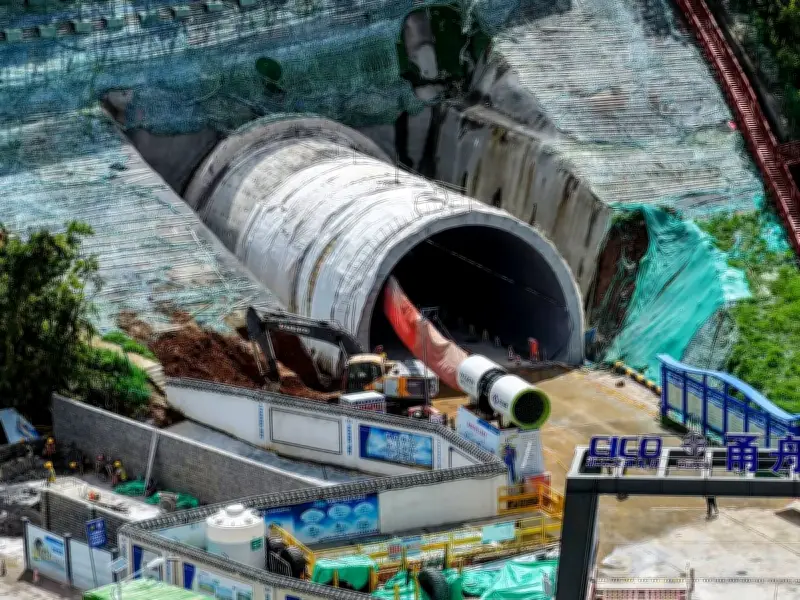
The £3.2bn Yong-Zhou Railway will connect the Chinese coastal city of Ningbo with the Zhoushan archipelago, cutting a two-hour bus journey to a 26-minute train ride. Completion is expected in 2028, with trains capable of reaching 250 kilometres per hour.
Project details and journey times
For passengers travelling between Ningbo and Zhoushan, the rail journey will take just 26 minutes, compared with two hours by bus or up to 90 minutes by car. The connection will also shorten trips from Hangzhou, the capital of Zhejiang province, to Zhoushan, with that journey expected to take 77 minutes by rail rather than the current four-and-a-half hours by bus or two-and-a-half hours by car.
Running for 47.8 miles between Ningbo East Station and Zhoushan (Baiquan) Station, the railway will include a 10-mile subsea section. Seven stations are planned: four new ones and three that will be redeveloped. A bridge will also be built to link parts of the archipelago.
Construction history and tunnelling work
The scheme has been years in the making. First proposed in 2005, it received approval from Beijing in 2018, before construction began in November 2022. Investment totals 27bn yuan, approximately £3.2bn.
Beneath the seabed, a 135-metre-long tunnel-boring machine called Yongzhou is carrying out the excavation. Dong Bing, the project's chief mechanical engineer, said in an update that the machine was working approximately 93 metres below the seabed.
Advanced machinery and safety features
Its creators say the large-diameter machine is "more sensitive than humans" at spotting irregularities during excavation. It is designed to drill through mountainous terrain and underground landscapes.
Dong Bing said: "Some problems are impossible to detect through human inspection. You might walk by and everything seems fine, but a second later, a problem arises. The system can also collect data, identify related conditions, and analyze potential causes. This is a huge help for safety."
The machinery can also be adapted to the conditions it encounters, according to Hao Weiqi, deputy director of the High-End Equipment Industry Technology Research Institute at China Railway Construction Corp. He told Global Times: "We can tailor the machines to specific underground environments, while simultaneously providing integrated solutions that combine equipment, intelligent systems, and technical services throughout the entire construction process."
Once Yongzhou has completed 83% of the excavation, it is due to meet a second tunnel-boring machine, Dinghai. That meeting will bring the tunnel beneath the Ningbo seabed close to its final stage.