

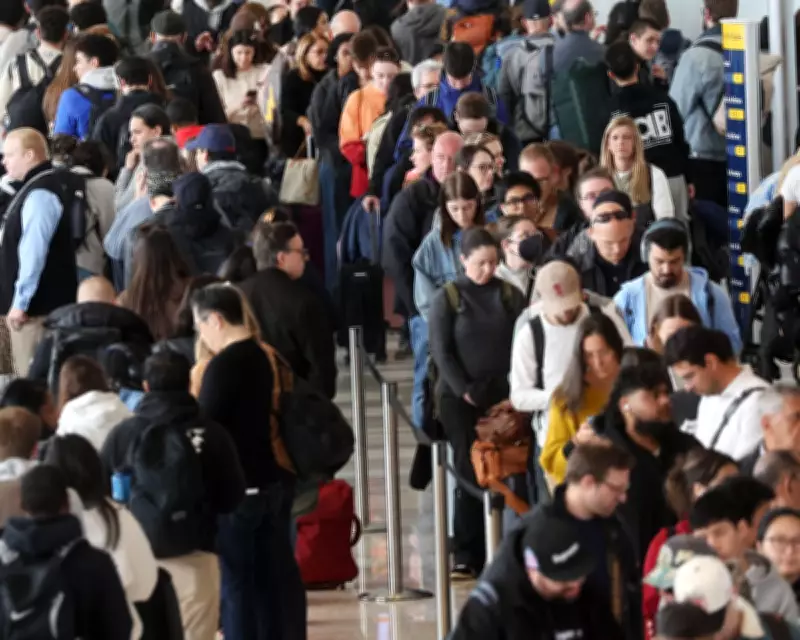
The acting head of the Transportation Security Administration (TSA) has issued a stark warning that airports across the United States are facing unprecedented delays, with wait times reaching the highest levels in the agency's history. This crisis comes as a partial shutdown of the Department of Homeland Security (DHS) enters its sixth week, severely impacting operations and employee morale.
Staffing Shortages Reach Critical Levels
During a House homeland security committee hearing, acting TSA administrator Ha Nguyen McNeill revealed that her agency has been effectively shut down for 50% of the fiscal year to date. This period includes last year's record-breaking 43-day lapse in federal funding, which has had devastating consequences for TSA workers.
"By Friday, TSA employees will have missed $1 billion in paychecks as a direct result of these closures," McNeill told lawmakers. She described heartbreaking scenarios where workforce members have missed bill payments, received eviction notices, had vehicles repossessed, and seen utilities disconnected.

Personal Hardships Among Security Personnel
"Some are sleeping in their cars, selling their blood and plasma, and taking on second jobs just to make ends meet," McNeill testified. "Many have drained their retirement savings, defaulted on loans, damaged their credit lines, and lost childcare arrangements."
Before the shutdown began, the TSA's absence rate typically hovered around 4%. McNeill reported that figure has skyrocketed to between 40% and 50% of staff calling out, primarily because they cannot afford to work without receiving regular paychecks.
World Cup Threatens to Exacerbate Crisis
McNeill emphasized that the situation represents a "dire" scenario that could escalate into a "perfect storm" when combined with the upcoming 2026 FIFA World Cup. With less than 80 days remaining before the tournament begins, airports face the prospect of handling millions of additional passengers while operating with severely depleted staff.
"Because it takes four to six months to properly train transportation security officers, any new hires we make now will not be ready to work checkpoints until well after the World Cup concludes," McNeill explained. This training pipeline limitation means the staffing shortage cannot be quickly resolved even if funding were restored immediately.
Political Impasse Deepens Operational Challenges
As Republicans on the committee continued to blame Democrats for the funding impasse, Democrats pressed McNeill about the transfer of Immigration and Customs Enforcement (ICE) agents to several U.S. airports to assist the TSA.
Committee ranking member Bennie Thompson expressed frustration with this arrangement: "These agents cannot do TSA's job, nor should they, and they aren't trained to do it. We see images of ICE agents standing around or walking through terminals, doing nothing to reduce security checkpoint lines, while TSA personnel continue working without pay because Republicans refuse to vote for legislation to fund TSA."
Despite these criticisms, McNeill maintained that the transferred ICE agents have been "incredibly helpful" in performing "non-specialized screening functions" that alleviate some burden on the struggling TSA workforce.
Funding Negotiations Remain Stalled
Negotiations on Capitol Hill continue to be deadlocked after Democrats rejected the latest Republican proposal. The GOP plan would fund much of DHS—including TSA, the Cybersecurity and Infrastructure Security Agency (CISA), the Coast Guard, and the Federal Emergency Management Agency (FEMA)—while excluding ICE and placing its funding in a separate budget bill they hope to pass through reconciliation.
The Republican proposal also omits immigration enforcement reforms that Democrats have demanded following the fatal shootings of Renee Good and Alex Pretti during the Trump administration's immigration crackdown in Minneapolis earlier this year.
Democratic representative Seth Magaziner emphasized at the hearing: "ICE needs to act like every other law enforcement agency, with warrants, with badge numbers, with standards of conduct."

Counteroffers and Continued Stalemate
Senate Majority Leader Chuck Schumer stated that Democrats presented a "reasonable, good faith" counteroffer on Wednesday, but Republicans quickly rejected it. Senate Majority Leader John Thune responded: "They're asking for things that have already been turned down. So it just seems like they're going in circles."
Since ICE received $75 billion through former President Trump's sweeping policy bill last year, it has been largely insulated from the funding lapse affecting other DHS agencies.
Other Agencies Face Similar Pressures
Thomas Allan, the vice-commandant of the Coast Guard; Nicholas Andersen, the acting director of CISA; and Victoria Barton, an associate administrator at FEMA, also testified before the House committee alongside McNeill.
Barton warned that while some FEMA staff can continue working thanks to the Disaster Relief Fund (DRF), the fund has only $3.6 billion remaining. She cautioned that if another major storm hits, the DRF could be depleted "pretty rapidly," further straining emergency response capabilities during an already challenging period for homeland security agencies.
The combination of historic staffing shortages, unprecedented wait times, and the impending passenger surge for the World Cup creates what McNeill described as a "perfect storm" that threatens to disrupt air travel across the nation unless a funding solution is reached promptly.





