

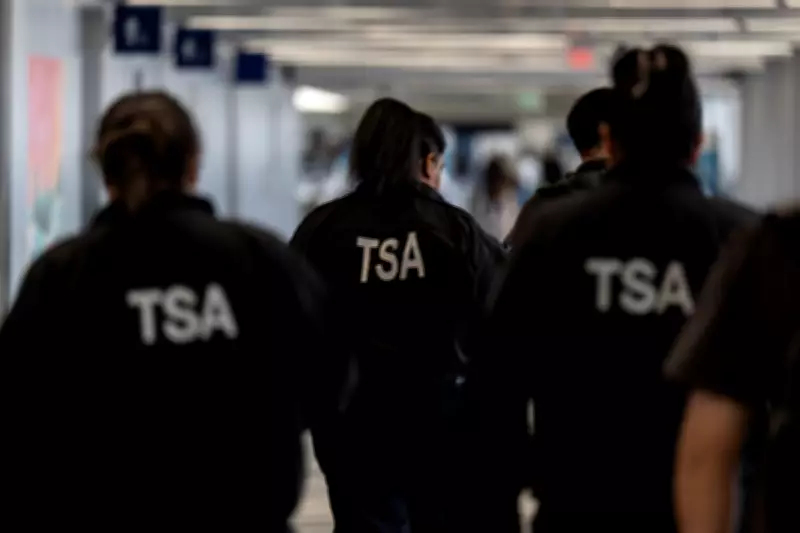
TSA Workers to Receive Paychecks Monday, But Airport Chaos May Continue
Transportation Security Administration officers could receive their first full paychecks in over six weeks as early as Monday, following President Donald Trump's executive order on Friday directing the Homeland Security secretary to pay them immediately. However, travel experts and labor leaders warn that massive security lines at numerous U.S. airports may not vanish overnight and could extend into next week or longer.
This delay is attributed to TSA workers awaiting back pay, airports evaluating staffing levels, and ongoing congressional disputes over funding the Department of Homeland Security. Eric Rosen, director of travel content for The Points Guy, a travel information website, noted, "Until checks are actually in hands, we might still see some of these staffing issues. But the executive order is a bit of good news for both TSA officers and the flying public. Hopefully, the money starts flowing quickly and people can get back to work."
Background of the Pay Dispute and Travel Impact
TSA personnel have worked without pay since February 14, when Department of Homeland Security funding lapsed due to a congressional disagreement over federal immigration operations. During the record-long partial government shutdown, some officers screening passengers and bags called out of scheduled shifts, with several thousand absences daily causing hours-long wait times and closed express lanes at airports in Houston, Atlanta, New Orleans, New York, and other locations.

President Trump signed the executive order after House Republicans rejected a Senate-passed bill early Friday that would have funded the TSA, U.S. Coast Guard, and Federal Emergency Management Agency, but not Immigration and Customs Enforcement and Border Patrol. Caleb Harmon-Marshall, a former TSA officer who runs the travel newsletter Gate Access, explained that officers are eager for full back pay to address financial struggles, including unpaid bills, accumulating debt, late fees, and interest charges.
Harmon-Marshall emphasized that airport staffing may not improve significantly until officers are confident in consistent pay without future suspensions due to congressional gridlock. He stated, "Hopefully, with this executive order, the relief does come. They just want to know how long, because if it’s only for a pay period, that’s not enough to bring them back. It has to be extended pay for them to come back or want to stay." He estimated travelers should plan for longer security lines for another week or two, adding, "This back and forth about decisions changing is confusing TSA officers, so they’re possibly thinking, 'OK, are we getting paid or are we not?'"
Staffing Shortages and Operational Challenges
Airports that experienced clogged check-in areas and early passenger arrivals must decide whether to reopen checkpoints or expedited service lanes closed or consolidated due to inadequate staffing. Some airports saw daily TSA officer callout rates reach 40%, with nationwide absences hitting over 11.8% on Thursday, the highest so far, according to the department. Nearly 500 of the agency's approximately 50,000 officers have quit since the shutdown began, as reported by DHS.
TSA Acting Administrator Ha Nguyen McNeill informed lawmakers on Wednesday that some officers who missed shifts recently might also leave. She highlighted that hiring will likely be more difficult post-shutdown, stating, "Not only is the shutdown decreasing the number of interested candidates, but for those we are able to hire, they require four to six months of training before certification to work at checkpoints."
Aviation security expert Sheldon Jacobson, whose research contributed to TSA PreCheck design, reassured travelers that panic is unnecessary, noting that extreme wait times in Atlanta, Houston, and New Orleans were outliers. He said, "At many airports I look at, the delays are pretty typical." Jacobson also pointed out that the number of TSA officers quitting since mid-February is not much higher than the normal attrition rate of around 8%.

Financial and Political Implications
The White House indicated that funds to pay TSA employees would come from a major tax cut bill signed by President Trump last year, which allocated billions in extra funds to Homeland Security. This money has maintained payments for ICE officers during the DHS shutdown. Johnny Jones, secretary-treasurer of the TSA worker division of the American Federation of Government Employees union, welcomed the pay starting Monday but stressed that Congress must agree on a bill to end the DHS shutdown.
Jones remarked, "I guess the action is good for the president, but on the flip side, we have a lot of people that don’t have anything, and I don’t know if this is gonna fix it." With school districts and colleges approaching spring breaks and travel increasing around holidays like Passover and Easter, the situation remains critical for both workers and passengers.





