

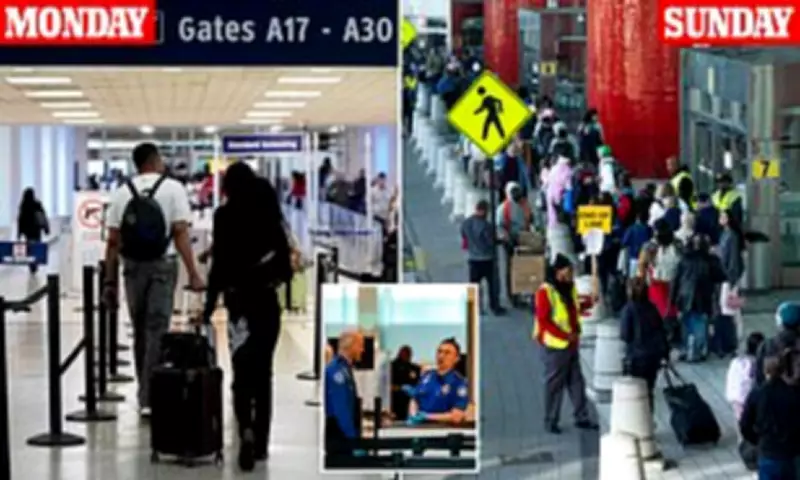
Passengers traveling through American airports experienced a significant and welcome improvement on Monday, with security lines shrinking dramatically as Transportation Security Administration officers finally began receiving backpay for their work during the ongoing partial government shutdown. Checkpoint queues that had stretched to four hours at Houston's George Bush Intercontinental Airport over the weekend were reduced to just ten minutes or less, while other major trouble spots like Baltimore-Washington International Airport and Atlanta's Hartsfield-Jackson International Airport reported smooth, efficient passenger processing.
Immediate Impact of Backpay Arrival
The massive improvements coincided with TSA employees starting to receive paychecks covering several weeks of work. These federal workers had not been paid since Congress failed to renew funding for the Department of Homeland Security on February 14, forcing approximately 61,000 TSA employees to work without compensation since January 31. The financial strain led to severe staffing shortages, with more than 500 agents quitting their jobs and thousands more calling out from work during a spring-break travel surge that saw about five percent higher volume than the previous year.
Critical Staffing Crisis
On Friday alone, more than one-third of security agents failed to report for duty at critical airports including New York's John F Kennedy Airport, Baltimore-Washington International Airport, and Atlanta's Hartsfield-Jackson International Airport. The situation reached a crisis point at Houston's two airports, where nearly half of all TSA workers refused to show up for their shifts. Overall TSA absences peaked at 12.4 percent of all employees, amounting to 3,560 workers missing their scheduled shifts.

Facing this severe staffing shortage, President Donald Trump ordered Immigration and Customs Enforcement officers to provide security support at fourteen major airports. He then signed an executive action on Friday to restart payments to federal workers, just as Congress began a two-week recess. By Monday, most TSA officers had started receiving retroactive paychecks that included at least two full two-week pay periods, according to Department of Homeland Security announcements.
Financial Relief and Ongoing Struggles
For many TSA workers, the paycheck arrival brought immediate relief. Andrea Connolly and her husband, both employed at Phoenix Sky Harbor Airport, described the payment as lifting a "huge weight" from their family. They had been struggling to afford basic necessities including gasoline for commuting to work, while worrying about mortgage payments and feeding themselves and their pets.
However, not all workers experienced complete financial recovery. Johnny Jones, secretary-treasurer of the TSA chapter of the American Federation of Government Employees, noted that some workers reported incorrect backpay amounts, including missing overtime compensation. Jones, who works as a TSA agent at Dallas-Fort Worth International Airport, shared that one colleague's bank account had already returned to zero after covering car payments, housing costs, and accumulated late fees.
Union Concerns and Policy Changes
The union expressed serious concerns about the long-term impact on workers' finances. "None of my colleagues feel like they've been made whole," Jones stated. "Their finances are destroyed." Compounding these difficulties, the TSA updated its furlough policy on Sunday, removing guidance that had allowed officers to request furloughs if they couldn't report to work for shutdown-related reasons such as transportation or childcare issues.
Acting TSA Assistant Secretary Lauren Bis acknowledged that working without pay had forced more than 500 officers to leave the agency, with thousands more forced to call out from work. The union agreed with these numbers but emphasized that workers who couldn't afford to report for duty now face "disciplinary actions looming over their heads." Union representatives stressed that "backpay alone does not fix those problems."

Passenger Experiences and Political Context
The return of paid TSA staff brought immediate relief to travelers across the country. Passengers who had arrived hours early at airports found they didn't need to wait as long as anticipated. At Hartsfield-Jackson in Atlanta, currently ranked as the world's busiest airport, passengers spent just three to five minutes passing through security lines on Monday morning.
Some travelers expressed appreciation for the presidential intervention. Jeff Badders, 69, who arrived at George Bush Intercontinental Airport more than six hours early for a flight to Africa, applauded Trump for signing the executive order to pay TSA agents. "If Congress can't get done what needs to be done, we're glad that the president rose above politics to pay people who need a paycheck," Badders stated.
Ongoing Political Impasse
Despite these improvements, there were few signs on Monday that Democrats and Republicans would reach a deal to fund the Department of Homeland Security. Senators held a short session without considering a House bill to restore funding before resuming their two-week break. The political deadlock continues amid negotiations over ICE operations, with Democrats refusing to approve additional funding without restraints on immigration enforcement following recent controversies.
White House Press Secretary Karoline Leavitt announced that President Trump had offered to host an Easter dinner for members of Congress who return to resolve the impasse. She emphasized that "there has not been a change in policy" regarding immigration enforcement, stating that the administration remains focused on deporting "the worst of the worst illegal alien criminals."
In the meantime, ICE agents will continue checking passenger identification, patrolling airports, and directing traffic until normal operations resume. White House border czar Tom Homan indicated that how long ICE agents assist with airport security depends on how quickly TSA employees return to regular work patterns following their backpay receipt.





