
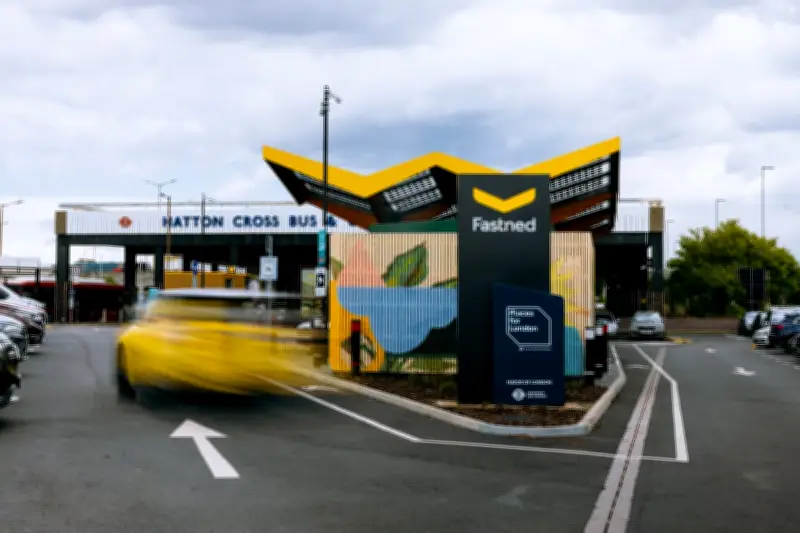
City Hall has vowed to drive down the price of owning an electric vehicle in London as it unveiled its first ultra-rapid EV charging hub. The facility, located at Hatton Cross Underground Station, is the first of 25 planned across the capital, aiming to accelerate the shift to greener transport.
First Hub at Hatton Cross
Developed by Places for London, Transport for London’s (TfL) property arm, in partnership with Dutch firm Fastned, the 12-bay hub is capable of delivering 100 miles of range with just a five-minute charge and is free to use this week. Further major EV hubs are planned for Hanger Lane in West London and East Finchley Underground station, with more sites currently in development.
While Mayor Sadiq Khan has overseen the electrification of much of TfL’s bus fleet, privately-owned electric vehicles still lag significantly behind petrol and diesel cars. City Hall has pledged to reduce the cost of EV ownership, though this initiative is slated for when zero-emission machines become widely adopted across the capital.
Supporting the Transition
Deputy Mayor for Transport Seb Dance said City Hall was on hand to make the transition to electric vehicles easier for all Londoners. “TfL, through its property arm, Places for London, is one of London’s largest landowners,” he told the Local Democracy Reporting Service (LDRS). “It makes sense that we cooperate with the provider of charging infrastructure like Fastned to ensure that we have a variety of ultra-fast, rapid charging centres across London.”
He added: “We know that people want to drive electric vehicles, they want to decarbonise their transport. Facilities like this make it easier for people and for public services like the London Ambulance Service. We’ve got to make it more and more affordable, of course. When you have a new technology it’s always often very expensive at the beginning for the early adopters and then as more and more people adopt that technology obviously it gets cheaper.”
UK Fastned Director Tom Hurst added: “The nice thing about this kind of infrastructure is that it’s scaling. The more people that use this facility, the more efficient it gets in terms of costs, the more we’re able to bring our costs down even more and more competitively. At the moment we’ve got memberships that enable you to charge more for free. If you are a regular user of the site, for example, there are all sorts of different ways to go about charging.”
Future Projections and Goals
The number of electric vehicles on the road in London is projected to rise to between 860,000 and 1,049,000 by 2030 from the current figure of 175,000, eventually making up 29 to 36 per cent of London’s car and van fleet. With the majority of Londoners lacking a driveway or garage – and the subsequent ability to charge their vehicle at home – accessibility to a charging hub is seen as a major factor in any attempted mass transition to EVs.
There are currently around 28,000 charging points across London, with the Mayor pledging in his 2024 manifesto to reach 40,000 by 2030. “We’re still absolutely aiming for that – this is another prime example of how TfL is taking the lead to try and enable that,” TfL Commissioner Andy Lord told the LDRS. “We have more charging hubs and EV points in London than anywhere else in the UK. We want to increase that. Places for London is a key enabler for doing that with all the developments that we’re doing, and we’ll always look to do that whenever the opportunity arises. I don’t see any reason why we won’t achieve that.”
TfL’s overall goal is for 80 per cent of all trips around London to be made by public transport, on foot or on a bicycle by 2041, with the remainder of journeys completed as environmentally cleanly as possible. Mr Lord noted: “There’s at least 20 per cent of other people who won’t be able to [make active journeys]. So using taxis, using private hire, using their own vehicles where they have no alternative – this is the type of facility that they can use and if they can transition to an electric vehicle, they now have a facility here that will give them really good, high-quality, rapid electric charging as well as some convenience facilities too. We think it’s affordable, we think it’s reasonable value and there are opportunities if you sign up to get a discount permanently as well.”
The announcement came just days before TfL unveiled their 3,000th zero emission bus – meaning a third of the overall fleet is now zero-emission. Deputy Mayor for Environment Mete Coban said: “These targets are about making sure that Londoners can get around in the city in a way that’s more affordable for them, but it also means that London can breathe much better air. This is fundamentally not just about our wider climate ambitions but it’s also about making sure that we have a city that everyone can thrive and live in a much more healthy living environment.”




