

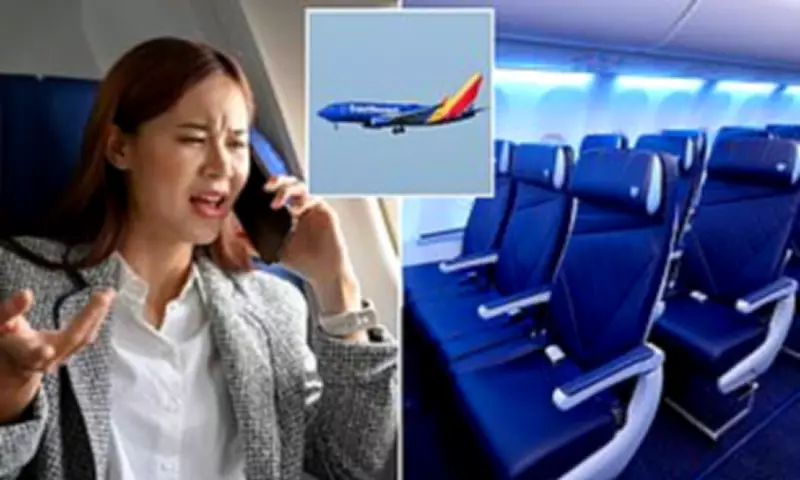
Fresh controversy has erupted at Southwest Airlines after an employee offered a perplexing explanation for why passengers are no longer permitted to swap seats freely under the carrier's newly implemented assigned seating system. The explanation, which cited aircraft balance and safety concerns, has been met with widespread skepticism and anger from travelers.
Reddit Post Ignites Passenger Backlash
In a Reddit post that rapidly gained traction on the Southwest forum, a user detailed an interaction where an airline employee stated that the prohibition on moving seats is directly linked to safety protocols and maintaining the aircraft's center of gravity. This claim prompted hundreds of incredulous responses from the traveling public, with many accusing the company of concealing a revenue-driven motive behind technical aviation terminology.
The original post elaborated that crew members allegedly perform calculations using specialized software before departure to determine where the center of gravity falls. However, numerous commenters expressed disbelief at this justification.

Passengers Dismiss Safety Claims as 'Gaslighting'
"Someone going from a middle seat to the window seat in the same aisle can't unbalance the center of gravity," one Reddit user pointed out sharply. Another respondent was even more critical, writing, "This is a gaslighting explanation cloaked in a little bit of aviation terminology."
In recent weeks, passengers have reported increasingly strict and often baffling enforcement of these new rules, even on flights with numerous empty seats. One traveler recounted an incident where a flight attendant ordered passengers back to their assigned seats before takeoff, despite rows being vacant, and warned that the plane would not depart otherwise.
Policy Shift and Passenger Frustrations
Southwest originally changed its seating policy in January, with assigned seats set to remain in effect as of March 2026. This marks a dramatic departure from its long-standing open seating model, where passengers boarded in groups and selected any available seat. The change, first announced last summer, aligns Southwest with competitors like Delta, American, and United.
Under the new system, passengers paying extra for premium options such as extra-legroom or preferred seats board first. Basic fare travelers are assigned to later boarding groups, spread across eight distinct tiers. This overhaul replaces the previous method where passengers received a boarding group (A, B, or C) and a number based on check-in time, then lined up at numbered gate poles to choose any open seat upon boarding.
Allegations of Revenue-Driven Enforcement
Many passengers believe the policy is being leveraged to push costly upgrades. One parent claimed their daughter was placed on standby despite checking in exactly 24 hours before departure, only to discover dozens of seats still available for an additional fee. "It felt like extortion," they wrote.
Southwest has stated that the changes reflect "customer demand" and are part of an "elevated travel experience" that includes premium seating options. The airline is one of the largest in the United States, alongside United, Delta, and American Airlines.
Broader Context of Recent Changes
In early March, Southwest customers received an email confirming the airline is still "refining how boarding groups are assigned" due to issues with overhead bin space. The email added, "We'll keep listening to feedback and keep you updated as we roll out additional enhancements."
This seat policy controversy follows other significant changes that have sparked passenger backlash. In May 2025, Southwest began charging for checked bags, ending its signature "bags fly free" policy. Customers now pay $35 for the first bag, $45 for the second, and a substantial $150 for a third checked bag.
A 2023 report highlighted that airlines including Delta, United, and American collectively pocketed a staggering $33.3 billion from baggage fees alone last year, representing a sharp 15 percent increase from $29 billion in 2022.
Furthermore, in February of last year, Southwest announced it was cutting 15 percent of its corporate staff, marking the first layoffs since the company's founding in Texas in 1971.

The Daily Mail has reached out to Southwest for comment on these latest developments, but as of now, the airline's explanation continues to fuel passenger discontent and skepticism across travel forums and social media platforms.





