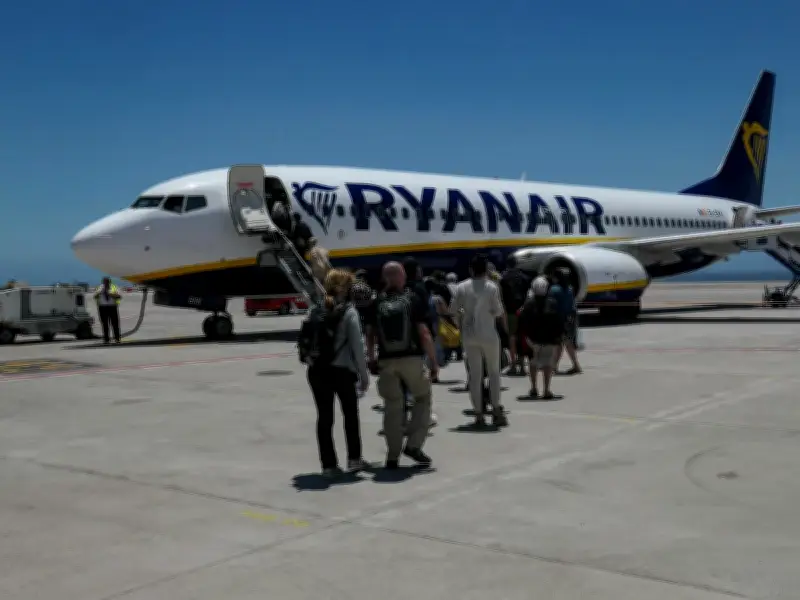
Ryanair has issued a stark warning about seven European airports it says are ill-prepared for the new EU passport control system, predicting 'needless chaos' for passengers as the summer holidays begin. The budget airline named Tenerife South, Palma, Alicante, Malaga, Milan Bergamo, Krakow, and Paris Beauvais as the worst-affected, blaming insufficient staff, kiosks, and system readiness for the Entry/Exit System (EES).
Ryanair calls for EES delay until September
With schools breaking up for summer, Ryanair urged European governments to postpone the full rollout of EES until September, when peak travel has passed. The airline warned that families with young children could face long queues and missed flights. Ryanair's Chief Operations Officer, Neal McMahon, said: 'As schools break up and Europe enters the busiest travel period of the year, it is clear that EES is still not ready for peak summer volumes. Passengers and families should not be used as guinea pigs for a half-baked passport control system that risks creating long queues, missed flights and unnecessary stress at airports this summer.'
EES requirements and airport disruptions
EES, fully rolled out in April, requires travellers from non-EU countries like the UK to provide fingerprints and a facial image when entering the Schengen Area. Ryanair advised passengers to arrive earlier at airports to account for delays, noting that the current infrastructure cannot handle high passenger volumes. The airline highlighted that airports such as Tenerife South and Palma are already experiencing major disruptions.
Port of Dover warns of severe congestion
Separately, the Port of Dover's chief executive, Doug Bannister, warned that the port will face 'repeated episodes of severe congestion' throughout the summer without more flexibility in EES. He predicted queuing cars 'spilling out of the port onto the public highway for miles' unless changes are made. During the May half-term, the port declared a 'critical incident' after waiting times reached four and a half hours, with daily traffic of about 8,500 vehicles. In the coming weeks, daily traffic is expected to exceed 12,000 vehicles.
Bannister noted that the port invested £40 million in a purpose-built facility to process passengers away from its main site, but this is not being used as intended due to 'inoperability of the EES kiosk technology', which is 'completely beyond the control of the port'.
Government response and political concerns
In the Commons, Labour MP Liam Byrne, chair of the Business and Trade Committee, said 'the modelling has been done' and 'we know the chaos that will follow', pressing Business Secretary Peter Kyle for action. Kyle replied: 'The Department of Transport is engaged in this, and also the relations that we have with the EU, thanks to being functional, thanks to being productive, these are issues which we are working with them on to make sure that the scenario that he outlines as worst case does not come to pass.'
A Government spokesperson added: 'While EES is an EU scheme, we recognise this is a significant change for British travellers. Our priority is to minimise disruption for travellers, hauliers and businesses, particularly at our busiest border crossings which is why we’ve boosted infrastructure with £10.5 million of Government funding to keep disruption to a minimum at the Port of Dover, Eurotunnel and Eurostar. We continue to work closely with French authorities.'