Qingdao Liuting International Airport in East China's Shandong province has stood empty for five years, with its runways unused since all commercial operations moved to a new facility. The airport, which cost an estimated £140 million to develop and expand, last handled a commercial flight in August 2021.
A Hub That Once Served Millions
Located in the Chengyang District, roughly 14 miles from the centre of Qingdao, the facility was once one of China's 12 major trunk airports. At its peak, it served as a vital operational hub for Shandong Airlines, Beijing Capital Airlines and Qingdao Airlines, and a major focus city for China Eastern Airlines.
Originally built in 1944 and opening to commercial flights in August 1982, Liuting Airport underwent significant growth over the decades. Between 2004 and 2006, officials invested heavily in expanding the terminal, adding parking spaces and extending its asphalt runway to 3,400 metres.
Rapid Growth and International Routes
The upgrades were initially designed to handle 5.2 million passengers annually, but demand quickly exceeded those projections. By 2018, Qingdao Liuting had become the 15th busiest airport in China, welcoming 24.53 million passengers in a single year.
It also became a key intercontinental gateway. In March 2016, Lufthansa launched non-stop flights connecting Qingdao directly to Frankfurt, Germany, followed by Beijing Capital Airlines introducing direct routes to Melbourne, Australia, and Vancouver, Canada.
Space Constraints and the Move to Jiaodong
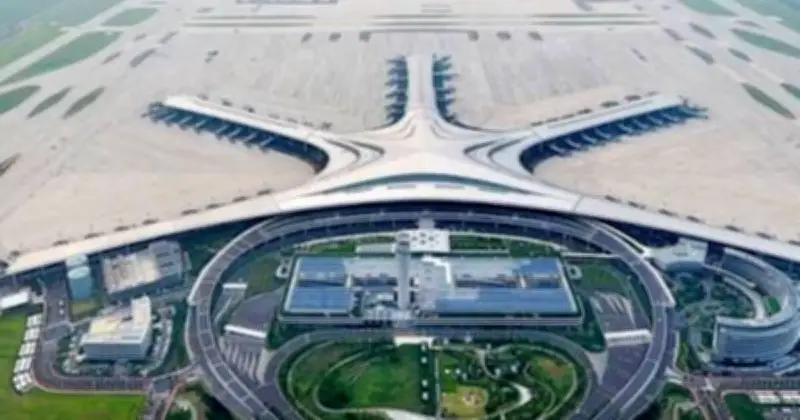
The airport's rapid success ultimately sealed its fate. Surrounded by dense urban sprawl, the site had run out of physical space to expand to meet booming passenger numbers. Recognising these constraints, the Chinese government approved the construction of a replacement facility, Qingdao Jiaodong International Airport, in December 2013.
Even in its final months of operation in 2021, Liuting remained a major transport hub, handling over 16 million passengers, more than 237,000 tonnes of cargo and nearly 140,000 flights. On August 12, 2021, all commercial operations and Liuting's TAO airport code were transferred directly to the newly opened Jiaodong Airport, leaving the terminal and its 11,155ft runway closed to air traffic ever since.
Regeneration Challenges and a New Era
Unlike smaller regional airfields that can be quickly demolished, Qingdao Liuting's scale has posed a major regeneration challenge for local planners. As the airport sits within the expanding Chengyang District, the enclosed site functions as a giant concrete island surrounded by residential neighbourhoods and commercial zones.
Urban planners have earmarked the land for future mixed-use development, including housing, tech hubs and green spaces, though the vast terminal buildings and miles of tarmac remain largely intact five years on. Meanwhile, passenger traffic has continued to boom at the successor, Qingdao Jiaodong International Airport, just 20 miles away. Built to solve Liuting's space crisis, the replacement was designed to handle up to 35 million passengers annually, featuring two parallel runways capable of accommodating the world's largest commercial aircraft.