
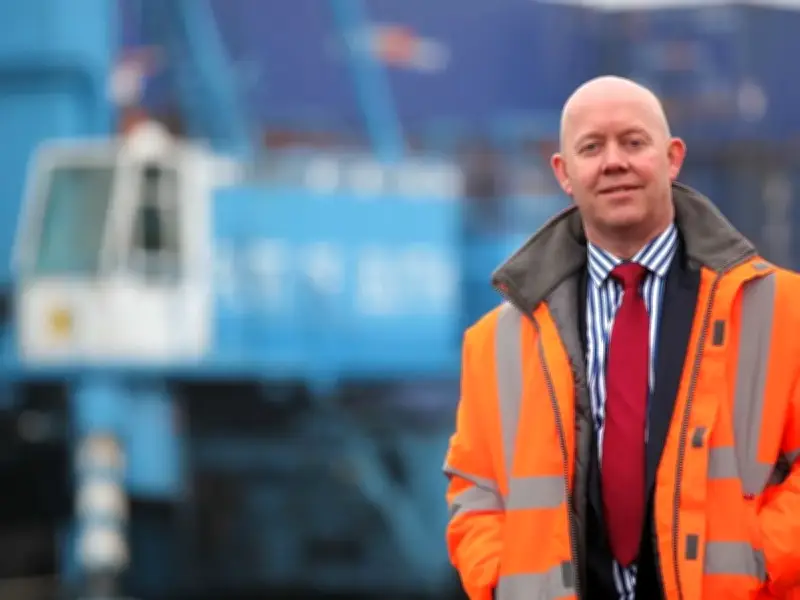
The chief executive of the Port of Blyth has said the Government's decision not to fund the town's relief road could slow growth in its nationally important clean energy sector. Martin Lawlor OBE said the £55 million scheme, which has already been granted planning permission, was designed to tackle congestion on key routes in and out of the town.
The Government confirmed last week that it would not be funding the long-awaited road, despite the planning permission being in place. The port has stressed its disappointment and said "reliable and efficient transport infrastructure" is important for the town's economic growth.
Relief road an 'essential element'
Blyth has become a hub for green energy in recent years, with the offshore wind industry enjoying a successful boom. There is hope that the Energy Central cluster around the Blyth Estuary, already one of the largest clean energy hubs in the UK, could attract further investment and create more jobs in the future.
However, the port has said the relief road was an "essential element" of that growth. Mr Lawlor, speaking to the Local Democracy Reporting Service, vowed to continue lobbying Government at both national and regional levels for the project.
He said: "We will continue to lobby Government, both nationally and regionally. We will keep the pressure on.
"Given the success of the Blyth Estuary and the growth in activity we have got, we perhaps assumed and hoped that this would be confirmed. Northumberland County Council were behind it as where the North East Mayoral Strategic Authority, and we had planning permission.
"There are some congestion issues in and out of Blyth which is why a relief road was put forward, but we were thinking more towards the future. There's a real opportunity for further growth.
"I wouldn't say it will cause an issue with what we're doing now, but the relief road would have accelerated that. I don't think it will put people off, because the facilities we have got in terms of offshore wind are still really good, but I think what it might do is limit the growth going forward.
"It is a nationally significant cluster here. We have been at the forefront of the clean energy sector for the last 25 years and we want to be there for the next 25.
"We have 50-plus organisations around Blyth in the energy sector – offshore wind in particular – that are really technologically innovative companies. They're all based around the port – what we don't want is anything that will slow the growth.
"If you go back some time, Blyth has suffered with the closure of the mines and all of that, but it has reinvented itself around this. We just want to maximise this opportunity.
"There's some really significant developments planned off the north east coast. We want as many of those opportunities to stay in the region."
Skills campus transport concerns
It was also pointed out that Blyth is looking to attract learners to gain new, clean energy-focused skills at the Energy Central Campus. When complete, the campus will be based across two sites – the already open Energy Central Hub and the Energy Central Institute, which is currently under construction. The relief road would have been an important aspect of a reliable transport system to get learners into the town.
Mr Lawlor added: "We are disappointed by the decision not to proceed with funding for the Blyth Relief Road. With a nationally significant clean energy cluster based around the estuary and major investment taking place in port infrastructure, clean energy initiatives and skills, Blyth has real momentum and potential for further growth.
"Reliable transport links are essential to supporting that ambition, and it is important that the town's road infrastructure remains a priority."
Responding to the comments, a spokesman for the Department for Transport said: "The previous government did not fund these projects. Given the challenging financial picture we inherited, we have had to make difficult decisions on a number of road projects and can only progress schemes that are good value for money for taxpayers."
It was also pointed out that 16 major road schemes are being taken forward at a cost of over £1 billion, although the relief road is not one of them. Those schemes were found to be the best value for money and will deliver the greatest benefits to local people. An additional £7.3 billion is also being spent to repair roads and tackle potholes across the country.




