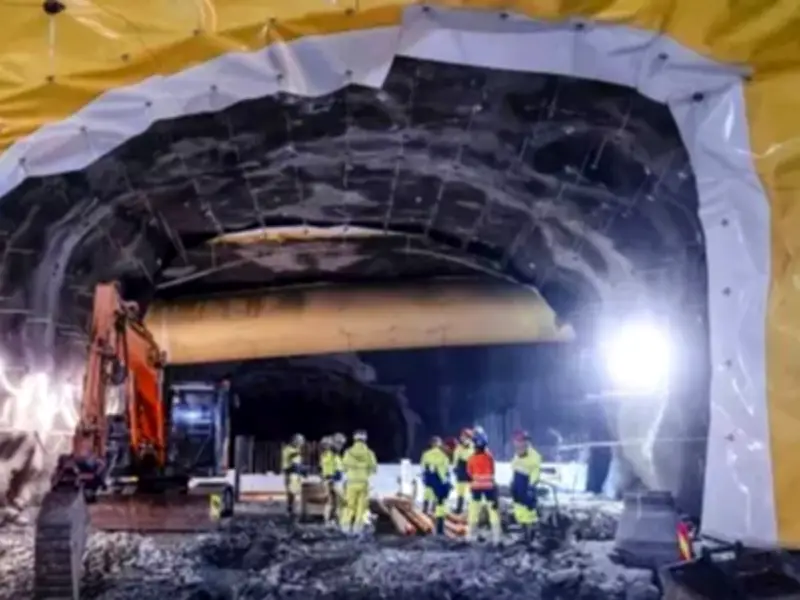
The Rogfast Tunnel in Norway, poised to be the world's longest and deepest undersea road tunnel, has secured a significant funding boost to maintain its construction timeline. The Nordic Investment Bank (NIB) approved a NOK 4 billion loan (approximately £307 million) earlier this month, with Norwegian toll operator Ferde AS acting as intermediary. This financial injection aims to keep the ambitious £1.8 billion project on track for completion in 2033.
Engineering Marvel Beneath the Sea
Stretching 27 kilometers (roughly 17 miles) and plunging 400 meters below sea level, the Rogfast Tunnel will connect the villages of Randaberg and Bokn in western Norway. It will be both the longest and deepest undersea tunnel in the world, with drivers descending deeper underground than the height of the Empire State Building. The tunnel includes a unique double roundabout deep beneath the sea, linking to the island of Kvitsøy.
Construction initially began in January 2018 but was suspended the following year due to soaring costs. Work resumed in 2021 after revised plans were adopted. The tunnel is part of a broader upgrade of the E39 coastal road connecting Trondheim and Kristiansand, which currently takes 21 hours and involves seven ferry crossings. The long-term goal is to replace all ferries with tunnels and bridges, reducing travel time to 11 hours by 2050.
Benefits and Challenges
Once completed, the Rogfast Tunnel will shave 40 minutes off the trip between Stavanger and Bergen while improving transport reliability. Around 4,000 vehicles are expected to pass through daily. Carlos Rodriguez, senior banker at NIB, stated: "Reliable infrastructure is essential for regional development and efficient transport links. Rogfast will improve connectivity in western Norway and support the long-term integration of labour and transport markets."
Construction giant Skanska, overseeing the northern section, faces significant challenges drilling 392 meters below sea level. Project manager Anne Brit Moen told Engineers Ireland: "Since we are going all the way down to 392m below sea level, we're focusing on finding the best methods to maintain safe and efficient working conditions for everyone. The tunnel will significantly improve connectivity along the Norwegian west coast."
Norwegian Public Roads Administration project manager Oddvar Kaarmo added: "About half a year after the last drill and blast, we have to deliver the project, so we have to get a lot of work done simultaneously. It's more about logistics than tunnelling."
Safety and Design Innovations
To prevent monotony and alleviate tunnel anxiety, an art installation will be placed inside the tunnel. Officials hope this measure will reduce accidents by keeping drivers alert. The project represents a major step in Norwegian infrastructure, with the entire E39 upgrade expected to be completed by 2050.