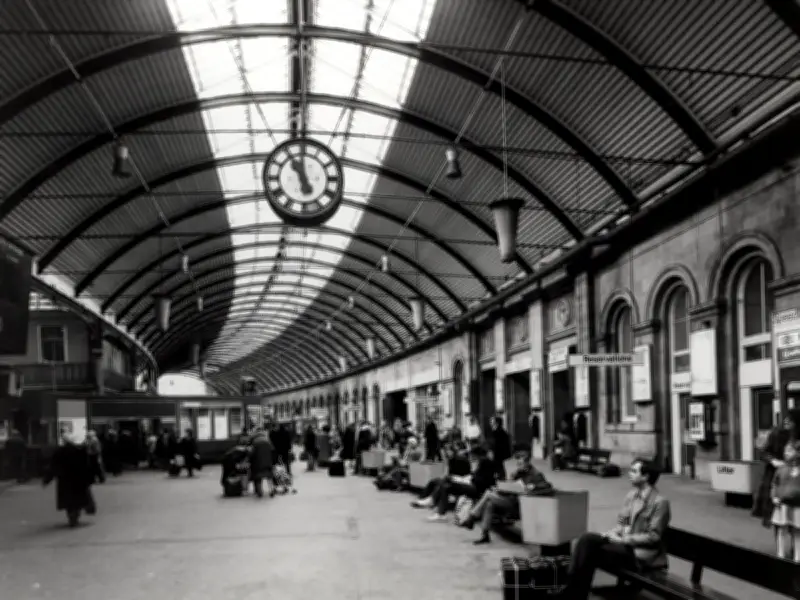
A busy morning at Newcastle Central Station in 1980 shows a typical working day, with the famous triple curved roof and Victorian-era concourse still recognizable today. Nearly five decades later, the same location in 2026 is brighter, more airy, and customer-friendly, with cafés, shops, and a large digital departure board replacing old waiting areas and mechanical boards.
1980: British Rail and InterCity 125
In 1980, the station was part of British Rail's sprawling network, marked by dark blue livery and long-term decline. Diesel Multiple Units (DMUs) served local routes, while the InterCity 125, with its aerodynamic profile, transformed East Coast Mainline travel, cutting Newcastle-London journey times to around three hours. There were 18 daily InterCity 125 services, with single tickets from £25.60, ordinary returns from £47.20, and weekend returns from £32.20.
130th Anniversary and Historic Design
Newcastle Central Station marked its 130th anniversary in 1980. Opened by Queen Victoria in 1850, it was designed in neoclassical style by architect John Dobson, built alongside the High Level Bridge to link London, Newcastle, and Edinburgh. At the turn of the 20th century, it gained global fame for its complex diamond crossing, celebrated as the largest railway crossing in the world.
Modern Transformations
In 1981, the adjacent Metro station opened, linking heavy rail with Tyneside's rapid transit network. The Metro took over several British Rail suburban lines, leading to the closure of old eastern bay platforms, later used for parking. More recently, a £9 million regeneration project enclosed the historic 19th-century front portico arches in glass, turning a draughty forecourt into a vibrant pedestrian space with retail and cafés. Interior tracks and platforms were modernized for LNER Azuma trains and digital systems.
Current Usage and Listing
Today, the station handles around 8.9 million passengers annually, according to the Office of Rail and Road (ORR). It is one of only nine Grade I-listed railway stations in the UK, sharing elite status with St Pancras and King's Cross.