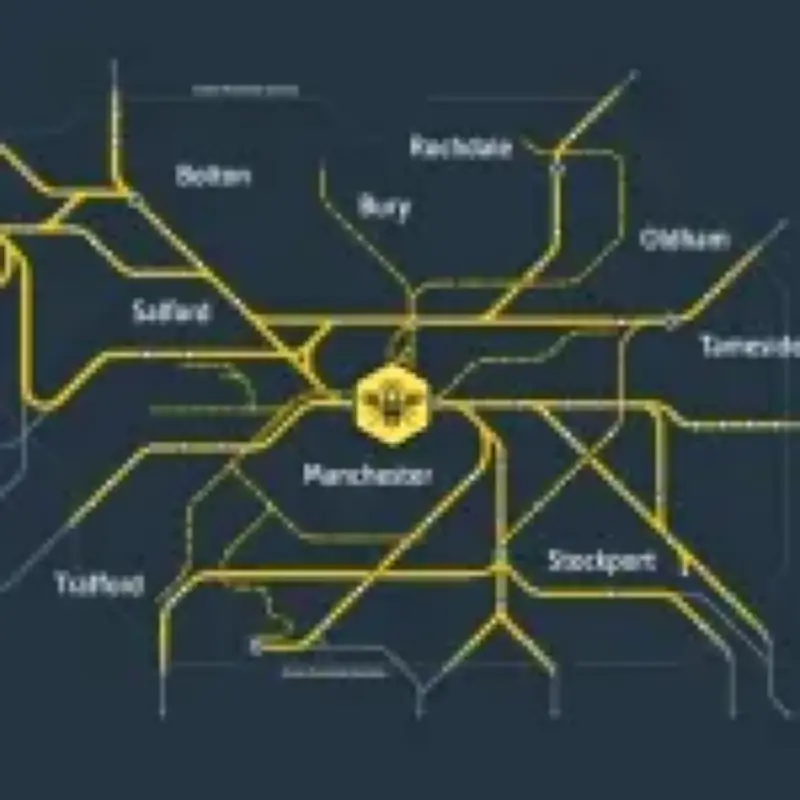
Officials have revealed what an underground metro system could look like in Manchester, the UK's third largest city, with plans to dig deep by 2050 to meet growing demand on the transport network.
The proposals follow former Mayor of Greater Manchester Andy Burnham's ambitious vision, unveiled during his final year in office, to take the city's transport underground. The now-PM's Number 10 North unit has given a glimpse of how the subterranean system could take shape.
Three proposals on the table
Transport for Greater Manchester (TfGM) is considering three possible proposals to extend the network, which could potentially complement each other. The most ambitious is a standalone underground line, with estimated costs running into the tens of billions, linking the University of Manchester campus, just south of the city centre, with the city's northern suburbs.
A second idea involves a new north-south Network Rail route from Bolton and Wigan to Manchester Airport. A third option is a relief line running under the current tram route from Altrincham, with underground tubes beneath several landmarks including Deansgate and Piccadilly Gardens.
The city's tram network, the Metrolink, is described as 'creaking', with more capacity desperately needed. Back in the 1970s, metro systems were constructed in northern cities including Liverpool and Newcastle, but plans to dig deep in Manchester never materialised.
Geology and depth
One factor in planners' favour is the reddish sandstone underneath the city once known as Cottonopolis, a material that is a tunnellers' dream, a source told the Times. This contrasts with the clay architects in London contended with when they first bore Tube tunnels under the capital in the 1880s.
While London's deep tube lines reach an average depth of 80ft below surface, engineers believe Manchester's network would be even deeper, at around 100ft below ground. Unlike the characteristic cylindrical tubes which carry the Northern and Piccadilly lines, Manchester's could be box-shaped.
A feasibility study found only one set of existing tunnels beneath the city: the Guardian Underground Telephone Exchange complex, a network built to keep phone lines running in the event of a nuclear attack during the Cold War.
Political support and next steps
Burnham first announced he had asked TfGM to look into the feasibility of an underground system in July 2025. He said at the time: 'If we achieve our economic ambitions, we will be struggling to manage. I am going to ask Transport for Greater Manchester (TfGM) to look at options for underground services. We will work with the government to look at financing it.'
His successor, Bev Craig, has picked up the mantle, expressing hope the new network will free up space above ground for more housing and a million square feet of office space. Top of the priority list are new underground platforms for the city's primary terminus, Piccadilly, which would integrate with Northern Powerhouse Rail (NPR), if and when it is built.
Craig said the plans were the 'only option that's fit for a world-class city region', adding the city had been making the case for such a project for a generation. Vernon Everitt, transport commissioner for Greater Manchester, said the new network was necessary to meet growing demand in a city with a fast rising population. 'If we don't think big and act boldly, we risk holding ourselves back', he said.
A spokesperson for the Department for Transport said it would work with TfGM to improve connectivity across the north and was exploring several proposals, including an underground expansion at Manchester Piccadilly.