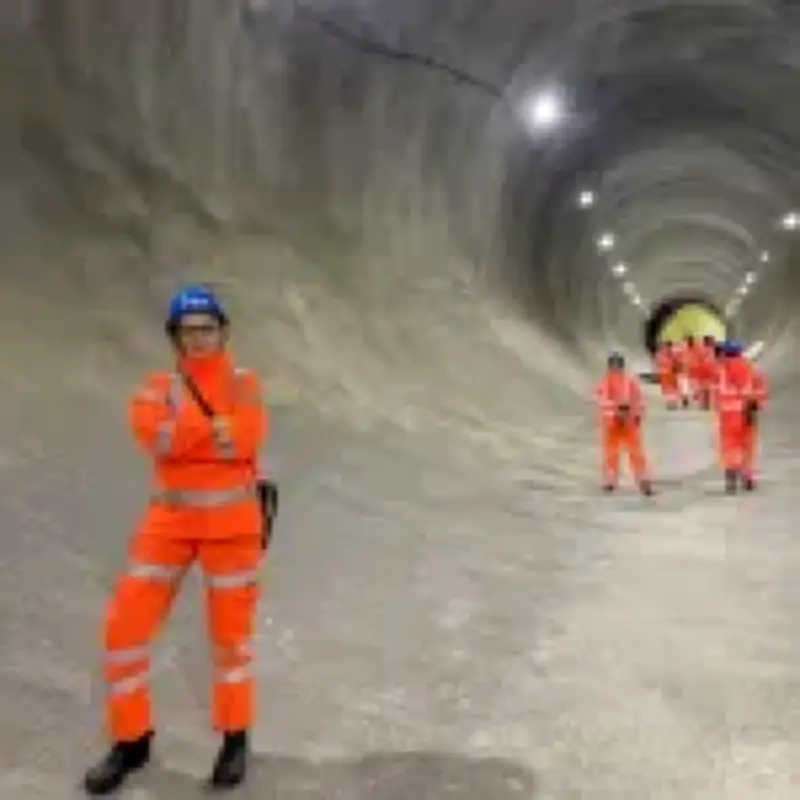
Metro has gone behind the scenes at HS2's newly completed tunnel near Old Oak Common, a 100ft-deep excavation that will carry high-speed trains into London's new mega rail hub before the final leg to Euston.
The breakthrough between Old Oak Common and the 1,181 ft (360m) tunnels from the crossover box has created an 8.8-mile connection to the West Ruislip tunnel, with the final blocks pushed out last month. Metro toured the London-bound tunnel with Rail Minister Lord Hendy, located a stone's throw from the upcoming hub, which will combine high-speed, Elizabeth line, Great Western Railway and Heathrow Express services under one roof.
Inside the tunnel and its traditions
Entering through an unassuming shaft on Victoria Road in North Acton, the first tunnel box opens up. At around 98 feet underground, visitors are greeted not by a digger but by the figure of St Barbara, the patron saint of tunnelling, perched on the wall inside a small wooden house. One HS2 worker told Metro that unless a blessing ceremony is held before works, tunnellers will refuse to start. While the saint stems from Christian tradition, workers from all backgrounds 'demand a ceremony happens before any tunnelling,' he said.
Everything at the multi-billion-pound worksite is immaculately organised, with the biggest danger coming from tripping while looking at your phone, and reminders for that. All work in the tunnel was paused for the tour, giving outsiders a rare opportunity to see the scale of the engineering that will transport millions of people by 2039.
Engineering scale and materials
Walking through the echoing structure not designed for pedestrians is a dizzying experience before reaching the light at the end of the tunnel, Old Oak Common. In this final stretch before the platforms, HS2 trains will have slowed down to a fraction of the 200mph top speed they can reach in places like the Colne Valley Viaduct. The walls have been covered with waterproofing and sprayed concrete before the rail and cables are laid in the coming years, plus an emergency cut-through from the tunnel.
'No one else will be walking down here in normal circumstances,' HS2's senior communications manager Clive Green said. The Rail Minister, on his first visit to the freshly excavated tunnel, said he is struggling to take in the scale of the 2,788 ft (850m) underground section of the mega-station stretching behind him. The Old Oak Common station alone could fit the world's tallest building, Burj Khalifa.
Minister's view and construction impact
Lord Hendy told Metro: 'The scale of it is so great. It is a station that is nearly one kilometre long. All of us are having real difficulty getting our heads around it. When we looked at the Cross Rail tunnels when they were built, we thought they were big, but these are enormous and the trains are going to carry loads of people. The scale of it is unimaginable. This will be the largest station built in Britain at least for 100 years.'
He continued: 'These works are extraordinary. It's been a long time coming and it has been a difficult project, and this government has had to reset it. But if you look at the scale of what is being delivered here, you can perhaps see that it is well worth doing. We are going to finish it, and when we've finished it, it is going to transform travel to Birmingham, to the north of England and Scotland, and it is going to transform this area of London to create growth, jobs and homes.'
To make space for the six high-speed rail platforms at Old Oak Common, more than 1 million tonnes of London clay was removed on a conveyor belt and loaded into trains, a process that removed 75,000 lorries from roads. Dave Lock, HS2's project director, told Metro: 'The material was transported via rail to other beneficial use around the country.' He said all the materials used in the tunnels are a far cry from what was used during the 1920s when many Tube lines were built, when no waterproofing was available. 'Without the waterproofing, the concrete would crumble over time,' he explained. With the current materials, the tunnels are set to last beyond 120 years.