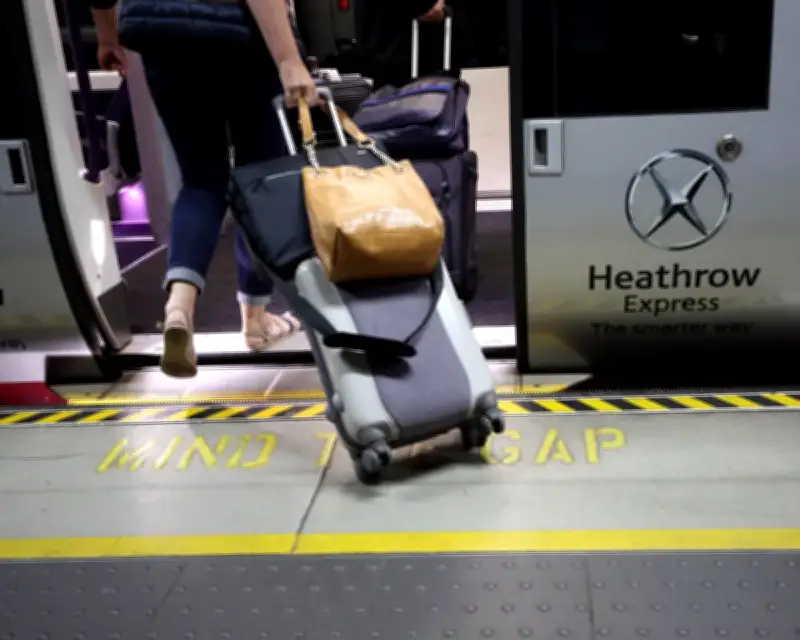
With fares high and passenger numbers low, plans for a third runway could bring the train’s future into question. The Heathrow Express was used by only 4.5 million passengers last year, a figure that represents, at best, less than 6% of Heathrow’s air passengers.
Expansion plans and rail capacity
If Heathrow finally builds its third runway, Londoners can expect hundreds more planes flying overhead each day. But greater congestion on the ground will be a problem too. Under Heathrow’s £33bn expansion plan, 100,000-200,000 more passengers would eventually be travelling to or from the airport each day.
The most eye-catching problem has been moving part of the UK’s busiest motorway, the M25, to make space for a new 2.2-mile (3.5km) runway. A thornier one may be getting motorists out of their cars, and finding more sustainable ways for the extra passengers – and thousands of staff – to travel to and from Heathrow.
Although ride-sharing, coaches and buses can play a part, scaling up rail is the clear alternative. Space on the existing line is, however, at a premium, and the Elizabeth line, built with a promise of connecting business travellers swiftly and directly from Heathrow to the City and Canary Wharf, only has limited paths.
Heathrow Express usage and cost
The Heathrow Express, which charges a whopping £26 for a 15- to 21-minute one-way hop, was long one of the most expensive airport connections around (at least until it was overtaken by the Luton Dart). It is, as advertised, technically the fastest way to central London, though passengers travelling beyond Paddington may reach their destination more quickly on the Elizabeth line or even the tube on a direct route.
For those who value the speed – in addition to TV news, a toilet and a luggage rack – it may be the perfect service. But the Heathrow Express was only used by 4.5 million passengers last year, a figure that represents, at best, less than 6% of Heathrow’s air passengers, with the number bolstered by airport staff on heavily discounted tickets.
Transport for London (TfL) has signalled its belief that the service’s time is up, as the government consults on its Heathrow expansion national policy statement. MPs must approve the statement for the runway to go ahead. That no longer seems automatic: Andy Burnham’s long-term scepticism over a third runway, along with the loss of Rachel Reeves in No 11 as a champion of expansion, makes Downing Street support look ambivalent at best – even given the new chancellor’s belated assertion that the “economic case stacks up”.
The Sunday Times reported this weekend that airport bosses have told ministers the third runway will not now be operational until 2039, a four year delay.
TfL's position and alternatives
However many runways the airport has, TfL said it was “worth reviewing [the Heathrow Express’s] future in the context of determining the optimal mix of services on the Great Western mainline to make the most effective use of the limited capacity available”.
For TfL, the Elizabeth line, going deeper and cheaper into the heart of London, is “a more compelling service”. At the moment, only two Elizabeth line trains an hour serve Heathrow’s Terminal 5, which handles about 40% of the airport’s passengers. That means a passenger who does not carefully judge the timing may face a journey from the City or Canary Wharf to T5 of more than an hour. The frequency is due to double next year but more space into Heathrow could still be freed up.
Alex Williams, the chief customer and strategy officer at TfL, told MPs at a select committee hearing this month that the Heathrow Express was “taking up valuable paths that aren’t actually well used. There’s a way of repurposing that to be more affordable, more attractive, and carry more public transport users.”
Surface access, or getting people between central London and Britain’s biggest airport, underwent a step change with the Elizabeth line. Previously, the little-advertised offering Heathrow Connect joined the dots at the likes of Hayes & Harlington on a slower train to Paddington, serving many airport workers, if not international travellers. Fares were then about a third of the price of the Heathrow Express – a gap that is now less significant given that the Elizabeth line charges £15.50 to reach any of its central London stations. And for those who are able to book and plan a month ahead, the Express advance tickets can prove less expensive at £10.
TfL’s cheaper but slower alternative, the Piccadilly line (£5.90 into central London), is also due to get an upgrade of signalling and trains, increasing capacity.
Two additional rail schemes have been mooted – Heathrow Southern Railway and a Western Rail link – as ways to connect into the wider national rail network, and the Elizabeth line itself could be extended to Staines – all of which would encourage many more from the suburban commuter belt to take the train rather than drive to the airport.
Future of the service and funding concerns
Rebooting the railway now would coincide with the end of Heathrow Express’s operating agreement with the Department for Transport, which gives the service access rights to the national railway until June 2028. The DfT says no decision has yet been made on the future operation.
It’s complicated: the actual operator, the FirstGroup-owned Great Western Railway, is due to be nationalised this December and become part of Great British Railways next year. Meanwhile, Heathrow owns the stations and five miles of railway from the airport to the mainline, part of its original £1bn investment in the Express in the 1990s.
The service brought in revenue of £48m for the first six months of 2026, according to a Heathrow spokesperson. They said: “It operates without taxpayer funding and helps keep airport charges down. Passengers don’t want fewer choices – Heathrow Express remains an important part of the competitive connectivity, convenience and flexibility they expect.”
But many question whether enough is being done – or if there will be enough pressure on Heathrow to avoid gridlock on the roads. The mayor of London, Sadiq Khan, warned that the taxpayer could be left picking up the bill for public transport improvements “left undefined and unfunded in the current proposals” for expansion – estimated at up to £9bn by TfL, a figure Heathrow said it did not recognise.
Most passengers go to the airport by car. And while Heathrow is funding new car parks – with plans to boost its parking space capacity from 21,000 to 36,000 – and its rerouting of the M25, it has not pledged any of its £33bn expenditure on improving the trains, Williams told the select committee, adding: “If you make it easier for people to park very near the terminal, how will you encourage them to get on the train?”
Without clear demands for a mode shift to public transport – as existed in the previous expansion plan, as well as in the planning permission for Gatwick’s recently approved second runway – the policy statement was “a step backwards”, Williams said, adding that in 2017 “there was a commitment or an aspiration from Heathrow to get no extra traffic. That is gone.”
A DfT spokesperson said: “We are carefully considering responses to the consultation, which sets out the key requirements any future planning application for expansion would have to meet, including public transport targets.”
A legal mandate could happen, a source said. But so far these are just targets: at the most stringent, 55% of airport passengers using public transport, and only when Heathrow’s third runway is fully operational.
For Anthony Smith, the former passenger watchdog who now chairs the Heathrow Area Transport Forum, it seems a curious timetable. He told MPs: “If you’re trying to shift people out of cars in 20 years’ time, when you’ve got 130 million passengers, it’s just harder, harder, harder.”