
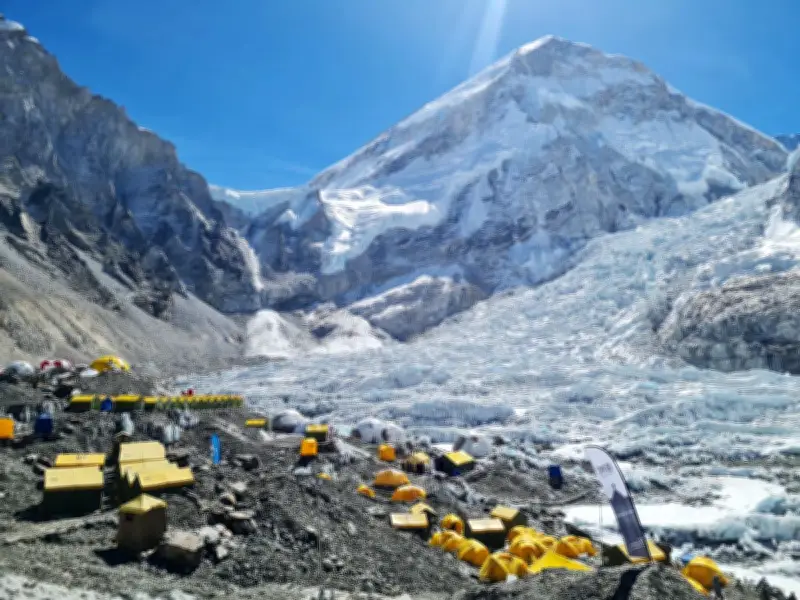
The frozen body of a man who perished on Mount Everest is set to be brought home after over 30 years. Dorje Morup died 27,890ft high up the mountain while on an expedition with the Indo-Tibetan Border Police (ITBP) in May 1996. For 30 years his body has remained in the same spot ever since, in full view of a main route, known to climbers as 'green boots'.
Macabre landmark
He is one of around 200 people whose remains are left on the mountain in what is known as the "death zone", where temperatures can drop as low as -40C and oxygen levels are just a third of what they are at sea level. Their bodies act as macabre markers for climbers attempting to reach the summit.
The man was only identified as 48-year-old Dorje Morup, from Ladakh, India, earlier this year, with his body having previously assumed to be that of a different soldier who went missing on Everest. Now, his remains are set to be returned to his family after Indian authorities began a search for a specialist high-altitude recovery team.
Recovery mission
The Indo-Tibetan Border Police said it hopes to bring the remains back to India by September, after which DNA testing would be carried out to firmly establish his identity. Nearly 350 people have died while climbing Mount Everest since it was first scaled by Sir Edmund Hillary and Tenzing Norgay in 1953.
Reacting to the news of the expedition to bring her husband's body, his wife Konchak Yangskit told the BBC: "On some days, before I went to sleep, I would think that there'd be a knock on the door tonight and that when I opened, he would be there. When he comes home, I will ask him: 'Where were you all these years?'"
Challenges in retrieval
One barrier to the retrieval of the remains has come in its location on Everest's Tibetan side, where access is controlled by Chinese authorities and climbing permits are rarely issued with most climbers choosing to ascend from the Nepalese side. China closed the mountain to foreign climbers during this year's spring climbing season, providing no explanation.
Pemba Sherpa, founder of the Kathmandu-based Xtreme Climbers Treks and Expedition, said of the recovery mission last month: "It is not impossible to retrieve the body from Everest, but the first challenge is getting permission from the Chinese officials and then only can they proceed to bring the body down."
The Chinese side of the peak is also steeper and lacks the same level of support structures as the southern slope. Pemba Ongchu Sherpa explained: "It's really tough to get that body down even in [the] popular spring season, let alone the autumn [when weather is more unpredictable]. That's the simple reason it is still there for so many years. There would need to be 10 to 12 climbers who are capable of making summits, just to fix [support] ropes to reach that point."
Then there's the logistics of transporting a body down a mountainside. Green Boots would have to be physically carried down until climbers reached an altitude where the remains can be collected by helicopter or yaks and transported back to an airport. According to sherpas, bodies in iced covered climbing gear often weigh several times the average man and are often frozen into awkward positions. There's also a risk the remains begin defrosting and decomposing as they descend.
Final expedition
Dorje Morup's team was part of a 1996 expedition organized by the Indo-Tibetan Border Police (ITBP), who aimed to become the first Indian crew to successfully reach the summit via the treacherous North Col route. The night before his historic expedition, Dorje promised his wife he would return a hero and make his country proud.
"He asked me to take care of the kids and come to the airport to greet him on his return," Konchak said. Despite Dorje's experience with Himalayan trekking, his wife said she had a strange sense of foreboding that night, admitting: "I wondered if I was ever going to see him again."
As they made their way to the peak, three of the six members of Dorje's expedition group turned back due to a snowstorm but he and two others, Tsewang Smanla and Tsewang Paljor kept going. But disaster struck as they descended as a blizzard hit, killing all three.
Only the body which became known as 'Green Boots' has ever been found. For years it was assumed that this was the body of Tsewang Paljor, but testimony from survivors of the 1996 expedition and the location of the climbers last radio contact has led authorities to believe the remains are Dorje's. An ITBP official, speaking anonymously, told BBC News Hindi that the clothes and climbing gear had been key to identifying the body. They added: "We never forgot him. It was only a matter of time."
Today, all that remains of Dorje are his medals and trophies, along with a few old photos from his mountain adventures and, most importantly, a certificate from the Chinese government stating that at 5.30pm on May 10, 1995, Dorje reached the summit of Everest. To go alongside this, the family plan to keep a symbol of Dorje's legacy at their home when he is returned, his eldest son Punchok Dorjai explained: "We are planning to keep the Green Boots."




