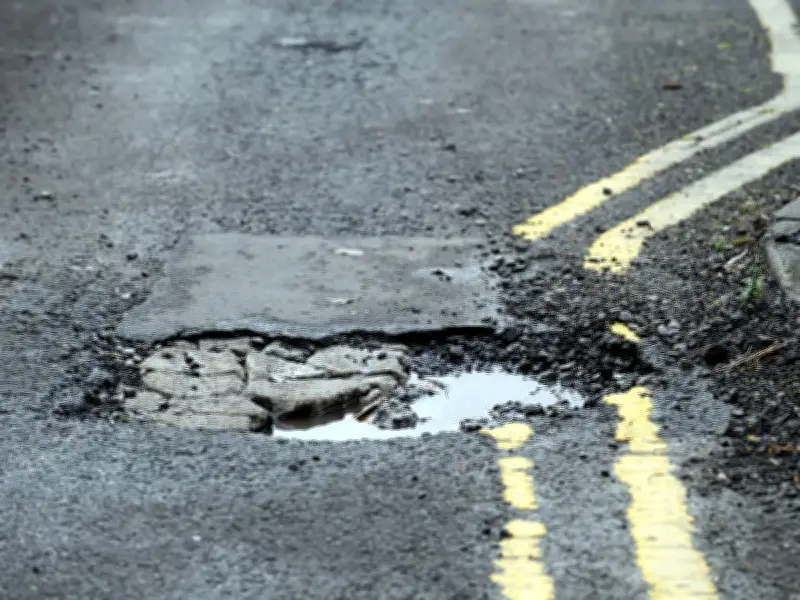
Carmarthenshire council is increasingly having to repair roads rather than preventing deterioration in the first place, according to auditors, with an estimated maintenance backlog of at least £77m.
Audit Wales said the council’s real-terms expenditure on roads has fallen by 40% since 2008-09 and that its approach had become more reactive and wasn’t sustainable in the long term.
Preventative maintenance more cost-effective
“This is significant because preventative maintenance is generally more cost-effective,” said Audit Wales’ Gareth Jones at a council committee meeting. “There is a risk that road conditions might continue to deteriorate and costs might increase in future years.”
Audit Wales’ report about Carmarthenshire’s roads said the authority was focusing on main routes – except trunk roads managed by the Welsh Government – at the expense of unclassified roads, which comprise 47% of the county’s 3,541km highway network.
Sharp rise in pothole reports
The number of unclassified roads in need of urgent work was rising, it said, and across the whole network the number of reported potholes soared from 1,978 in 2020 to 11,014 in 2024 – an increase of 456%. The report made four recommendations which council chiefs are addressing.
Members of the audit and governance committee discussed the findings while thanking highways staff for their efforts maintaining the network given the financial pressures.
Budget pressures and future plans
Carmarthenshire has the second-largest and third-busiest road network of Wales’ 22 councils and Chris Moore, the council’s director of corporate services, said the highways budget had had “quite a significant hit” in the early years after 2008-09 as the impact was less than cutting the social services budget for example.
“It’s a very difficult choice for elected members but as a consequence now there is a bigger expenditure needed to try to bring the roads back up to scratch,” he said.
Audit Wales’ report said the council allocated £9.5m to roads in 2025-26 and 2026-27 – £6.5m less than what was needed to prevent the network getting any worse.
Cllr Alex Evans called for more communication between the highways department and councillors and the public and said he’d noticed the difference in the condition of the roads on the Welsh side of the border compared to the English side while on leave.
Some committee members said a longer-term funding arrangement with the Welsh Government was needed while Cllr Kim Broom asked for assurance that capital funding proposals would be brought forward by the council for roads.
“That’s probably something we will be talking about in the next couple of months when we talk about priorities,” replied Mr Moore.
Audit Wales made four recommendations to the council, including setting out a clear long-term approach to managing the road network and strengthening its delivery of work.
Dan John, the council’s head of environment and infrastructure, said he welcomed the report and added that other councils were facing similar challenges. He listed the measures Carmarthenshire was taking in response to the recommendations. These include developing a more comprehensive long-term evidence base for investment decisions and a review of workforce and skills capacity.
The council will also use a residents’ survey which takes place every year to gather feedback of public perceptions of roads and the findings will be incorporated into the council’s annual highways management plan.