More than 235,700 people in Scotland use a Blue Badge to access disabled parking spaces, but the permit can also unlock a range of extra support and concessions. Depending on individual circumstances, Blue Badge holders may qualify for help with vehicle tax, Low Emission Zone rules, parking arrangements near home and free or discounted travel costs on public transport.
The Blue Badge scheme is designed to help people with severe mobility difficulties park closer to where they need to go, either as a driver or passenger. Guidance from Citizens Advice Scotland explains how some badge holders may also be entitled to additional support.
Vehicle tax reductions or exemptions
Some disabled people who receive qualifying disability benefits may be able to get free vehicle tax or a 50 per cent reduction. Eligibility depends on the type of benefit received, such as certain rates of Adult Disability Payment (ADP), Personal Independence Payment (PIP) or Disability Living Allowance (DLA).
A Blue Badge alone does not automatically qualify someone for free road tax, but many badge holders may also receive the benefits linked to the scheme. More information about getting free vehicle tax if you're disabled is available on GOV.UK.
Low Emission Zone exemptions and parking bays near home
Blue Badge holders can apply for an exemption from Low Emission Zone (LEZ) rules in Scotland if they meet certain conditions. This can allow drivers to continue using vehicles that would otherwise face penalties in LEZ areas. If the vehicle someone is travelling in is registered with a disabled or disabled passenger vehicle tax class, they will automatically be exempt. Scotland's LEZ restrictions currently apply in Glasgow, Edinburgh, Aberdeen and Dundee.
People with mobility difficulties may also be able to apply for a disabled parking bay outside or close to their home through their local council. Rules differ depending on where someone lives, but many councils consider applications from Blue Badge holders who struggle to park nearby. Conditions include having a valid Blue Badge, having a permanent medical condition which affects mobility, and having difficulty in getting a parking space on the public road. Some councils may also assess whether off-street parking is available before approving requests.
Parking concessions and travel discounts
Blue Badge holders can usually park for free in disabled bays and pay-and-display spaces, and may also be allowed to park on single or double yellow lines where it is safe to do so. Parking concessions available to badge holders in Scotland include parking free of charge and without time limit at on-street parking meter spaces, pay-and-display spaces, and disabled person's parking spaces, as well as on single or double yellow lines unless there are loading restrictions in place.
Local parking rules can vary, so drivers should always check signs and restrictions before leaving a vehicle. The badge must also be displayed correctly to avoid fines. Some Blue Badge holders may qualify for concessions on toll roads, bridges or transport schemes depending on where they live and the benefits they receive. Separate schemes are also available in Scotland to help disabled people with public transport costs, including the National Entitlement Card for free bus travel.
Blue Badge holders can now qualify for a Disabled Person's Railcard which provides one-third off train fares. If you have a Blue Badge or a Disabled Persons Bus Pass or you can't drive for medical reasons, that now counts as a way of being eligible. The Disabled Persons Railcard costs £20 for one year, or £54 for three and could save travellers around £126 a year along with access to partner discounts, including days out, hotels and restaurants.
How to apply
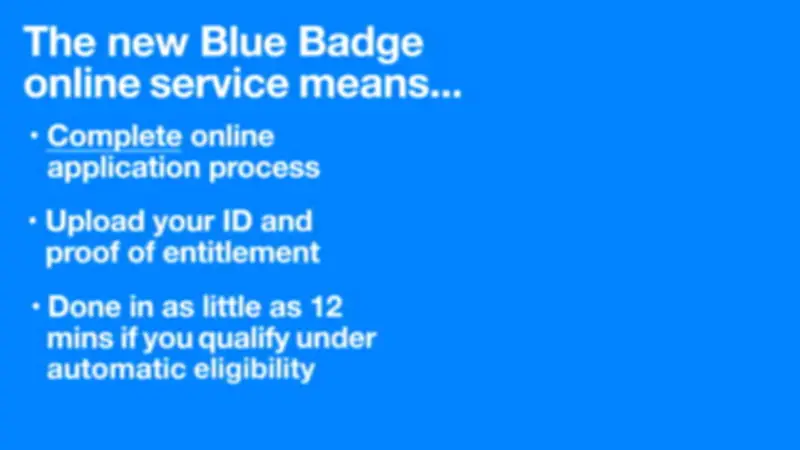
People can check eligibility and apply for a Blue Badge through their local council or on the Scottish Government website. Applications are made online to your local council and you'll need a recent digital photo showing your head and shoulders - you can take this picture yourself.
You will also need a photo or scan of your proof of identity (such as a birth certificate, passport or driving licence), proof of address such as a Council Tax bill or government letter, and proof of benefits if you get any. You will also need to know your National Insurance number and the details of your current Blue Badge if you're reapplying. Once you apply, your local council will process your application and give you a decision.