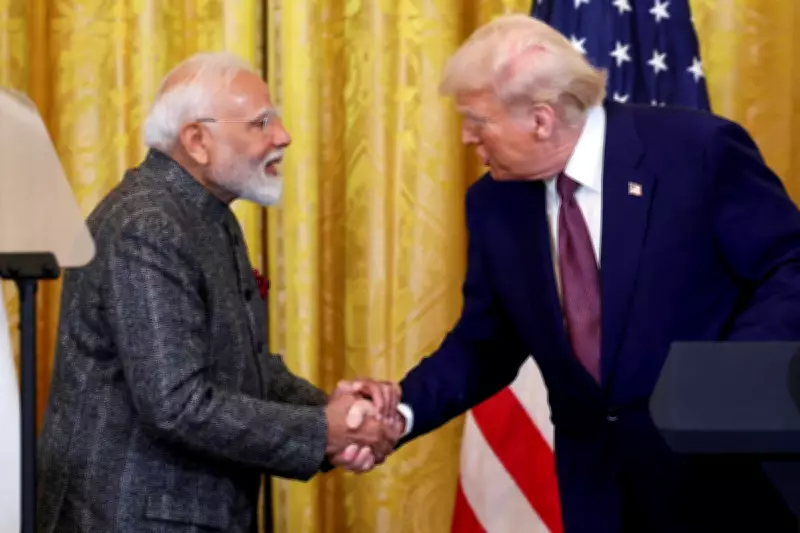
The United States has significantly softened the language in a fact sheet detailing an interim trade agreement with India, notably removing "pulses" from a list of agricultural products eligible for tariff reductions. This revision comes amid widespread protests by thousands of Indian farmers, who accuse the Narendra Modi government of compromising their interests and livelihoods through the deal.
Trade Deal Announcement Sparks Confusion and Outcry
US President Donald Trump and Indian Prime Minister Narendra Modi announced last week that the two nations had finalised a long-delayed trade agreement following a phone call. While details were sparse, Mr Trump stated he would reduce reciprocal tariffs on Indian goods to 18 percent from 25 percent and eliminate a separate 25 percent punitive duty imposed over India's purchases of Russian oil.
However, this announcement triggered immediate confusion and concern across India among opposition parties, trade experts, and farmer groups. A key point of contention was whether Delhi had agreed to open its heavily protected agricultural sector to US exports, a historically contentious issue in bilateral trade talks.

Revised Fact Sheet Removes Key Agricultural References
The original version of the fact sheet, released on Monday, stated that India would "eliminate or reduce tariffs" on a wide range of US food and agricultural products, including "certain pulses" such as lentils and chickpeas, which are dietary staples for millions. The revised version, however, removed any reference to pulses entirely.
This shifting language has intensified criticism from opposition lawmakers, who argue the government made excessive concessions to the US while failing to provide clarity domestically. Initial silence and ambiguity from Delhi over Mr Trump's claim that India would halt Russian oil purchases further deepened political unease.
Nationwide Protests Erupt Over Farmers' Livelihoods
On Thursday, a coalition of major trade unions and farmers' groups mounted a nationwide strike to protest the deal, asserting it undermines the interests of farmers, small businesses, and workers. Farmers burned symbolic copies of the trade pact in their fields and at protest meetings, condemning the government for moving ahead without consultation.
The one-day strike partially disrupted public services and manufacturing activities, highlighting resistance to the reform agenda set by Mr Modi, leader of the ruling Bharatiya Janata Party. It also underscored the political risks of pushing market-oriented policies ahead of key state elections later this year.
Farmers Warn of Unfair Competition and Economic Threat
Farmers' unions have repeatedly warned that lowering barriers to American agricultural goods, many of which benefit from heavy subsidies, would threaten the livelihoods of millions of small-scale Indian farmers. Pulses, dairy, and other staples have long been politically sensitive areas for successive governments.
Union leaders argue that opening the agricultural sector to US imports would expose Indian farmers to unfair competition. "Cheap American farm produce will be dumped in India, making it difficult for our farmers and small businesses to compete," said Amarjeet Kaur, general secretary of the All India Trade Union Congress, a prominent union participating in the strike.
Prominent farm leader Rakesh Tikait noted that protests were held in states including Bihar, Haryana, Odisha, Karnataka, and Tamil Nadu, where farmers asserted their rights over their land and pledged not to cede their fields to market forces.
Political Backlash and Historical Echoes
Opposition parties, led by Congress lawmakers, staged protests outside the parliament complex, holding placards with slogans such as "Trap Deal" and "US deal will destroy farmers." They accused the government of "surrendering" the interests of farmers and domestic industries.
This agreement has revived memories of the massive protests in 2020-21, which forced the government to back down and repeal three laws aimed at deregulating agricultural markets, illustrating the enduring power of farmer movements in Indian politics.

Government Response and Further Revisions
Trade Minister Piyush Goyal responded by stating that most of India's farm products were kept out of the trade arrangement with the US and that farmers' interests had been protected. He accused opposition parties of misleading farmers, noting that key items such as dairy, poultry, rice, wheat, and several fruits and vegetables were excluded from the deal.
External Affairs Ministry spokesperson Randhir Jaiswal emphasised that "the joint statement is the framework and remains the basis of our mutual understanding in the matter. Both sides will now work towards implementing this framework and finalising the interim agreement." He added that "the amendments in the US fact sheet reflect the shared understandings contained in the joint statement."
Beyond agricultural changes, the US government also altered language regarding India's purchase commitments. The updated fact sheet toned down wording from "committed" to "intends" in reference to India purchasing over $500 billion of US energy, information and communication technology, coal, and other products.
Additionally, the revised factsheet dropped a section on digital services taxes. Previously, it stated that India would "remove its digital services taxes and commit to negotiate a robust set of bilateral digital trade rules." Now, it only says that India is "committed to negotiate a robust set of bilateral digital trade rules," removing specifics on customs duties and discriminatory practices.
Path Forward for US-India Trade Relations
The United States and India are now working towards finalising a detailed agreement, which is expected to be signed by March. As negotiations continue, the protests and political fallout underscore the delicate balance between international trade ambitions and domestic agricultural protections in India.
The ongoing farmer demonstrations serve as a potent reminder of the social and economic stakes involved, ensuring that this trade deal will remain a focal point of national debate and scrutiny in the coming months.