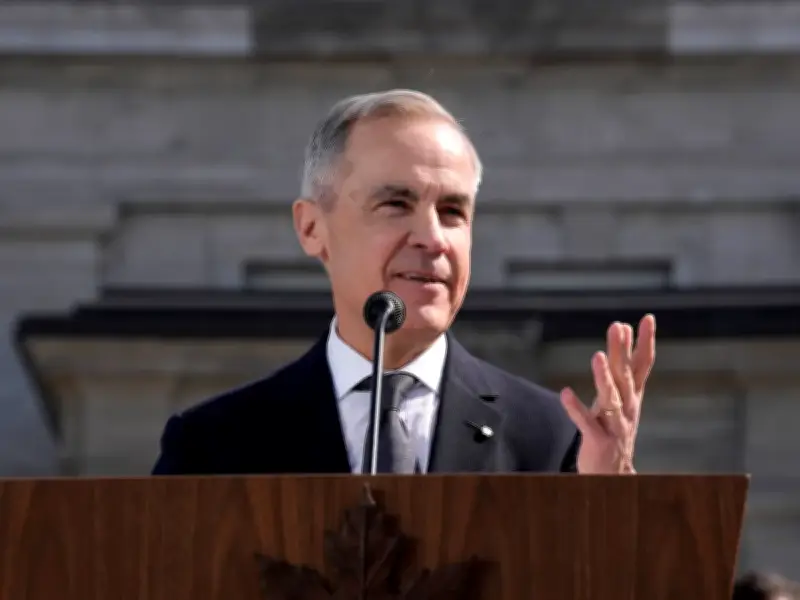
Canada has unveiled retaliatory tariffs on around 20 billion US dollars (£15 billion) of American goods as its trade dispute with Donald Trump’s administration escalates.
The measures will affect more than 700 products imported from the United States, ranging from steel and aluminium to dairy products, seafood, clothing, cosmetics, appliances and toilet paper. Some goods will face tariffs of up to 50% when the new measures come into force on September 8.
The move follows the breakdown of trade talks between the two countries and the Trump administration's decision to impose 50% tariffs on Canadian goods over the weekend.

Carney accuses US of seeking to undermine Canadian industries
Canadian Prime Minister Mark Carney accused the US of attempting to force Canada into an unequal relationship, saying the demands made during negotiations were unacceptable. He said Canada had learned during the talks that American negotiators wanted to undermine some of the country's biggest industries, including its automotive, steel and aluminium sectors.
Mr Carney said Canada would not accept an approach to negotiations based on the idea that the country was a "subsidiary of the United States". In French, he went further, saying: "We learned during the negotiations that the Americans want to destroy our major industries, including autos, steel and aluminium. That was one of the main reasons we said no. It was a bad deal."
Tariff rates and scope of the Canadian measures
Under the Canadian plans, some tariffs currently set at 25% will rise to 50%, with steel and aluminium expected to account for the largest proportion of the new measures. Certain furniture and clothing products will also face 50% tariffs.
A 25% rate will apply to a range of other American imports, including household appliances, cheese and other dairy products, fish and seafood, as well as some derivatives of steel and aluminium. Canada will also match the equivalent US tariff rate on a number of products, including pulp, paper and electronics.
Existing counter-tariffs on American vehicles will remain in place. Canadian officials said the measures were designed to protect domestic businesses and reduce reliance on imports from the United States rather than generate additional government revenue.
Impact on trade and political tensions
They said American steel imports had already fallen by around 30% after Canada imposed an earlier 25% tariff and expected the increase to 50% to reduce imports further. The Canadian government has also announced a 7.5 billion Canadian dollar (£4 billion) package to support workers and businesses affected by the trade dispute.
Officials acknowledged that the tariffs could increase costs for some companies and consumers, but said they expected the overall impact on the Canadian economy to be moderate. Canada has provided more than 30 billion Canadian dollars (£16 billion) in tariff-related support since the start of 2025, according to officials, significantly more than it has raised through retaliatory duties.
The dispute threatens to cause further disruption to the closely linked economies of Canada and the United States, whose supply chains are heavily integrated across sectors including manufacturing, agriculture, energy and the motor industry.
Mr Carney suggested on Monday that Canada may eventually move away from responding to US measures on a dollar-for-dollar basis, instead focusing retaliation on areas where it could offer greater protection to Canadian businesses and workers.
The increasingly bitter dispute has also spilled into a public war of words between Mr Trump and Canadian leaders. On Monday, the US president told Canada to "fall in line" or face consequences he said would be "far worse" than the tariffs already imposed, while threatening further 50% duties on Canadian vehicles, car parts and steel.
Mr Trump also raised the prospect on Tuesday of renaming Lake Ontario "Lake America", adding another unusual twist to his dispute with Ontario Premier Doug Ford. Such a move would echo his executive order last year renaming the Gulf of Mexico as the Gulf of America.

Mr Carney also said US negotiators had raised Canada's rules around French-language content and labelling during trade talks, including the prominence of French-language material on streaming platforms. He rejected any suggestion that those protections could be traded away, saying: "For the Americans, questions about the French language, Quebec culture, francophone culture and Canadian culture are irritants. Here in Quebec, here in Canada, they are rights."
Mr Trump responded in a social media post early on Tuesday, insisting he had never sought to interfere with Canadians speaking French. "I would never interfere with Canadians speaking French. In fact, I have never even thought of doing such a stupid thing," he wrote. The president accused Mr Carney of making up the claim in an attempt to win political support in Quebec, adding: "I love French Canadians."