Five travel writers share their favourite holidays at home, from gravel biking in Scotland and a steam train ride in Yorkshire to rowing all the way from Oxford to London.
Three men in a boat on the Thames
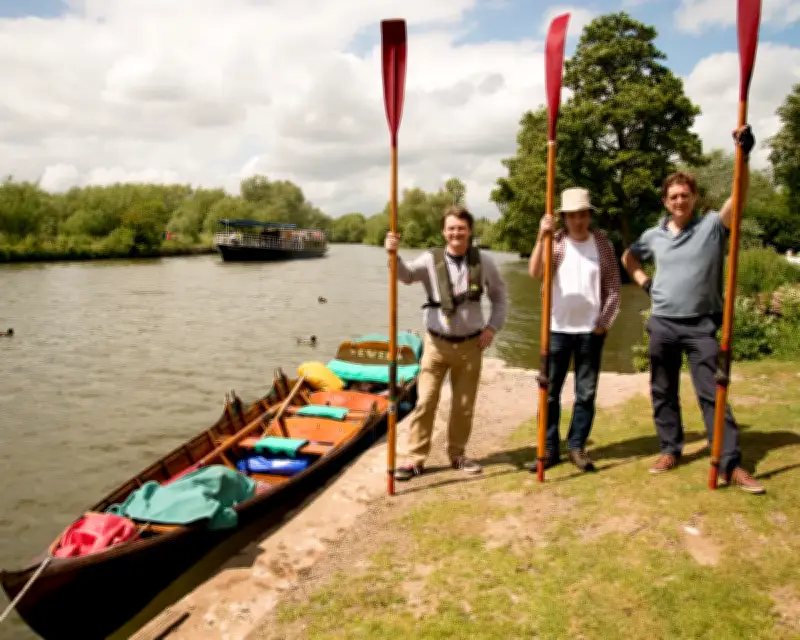
One of my best UK holidays was the week I spent in June 2013 rowing from Oxford to London with two friends, James and Tom. We hired the boat from a company called Thames Skiff Hire that mainly caters to people recreating the fictional adventure of the characters in Jerome K Jerome’s Three Men in a Boat. Our boat – Ewen – was a 26ft, 130-year-old mahogany skiff. It came with two pairs of oars, a rudder, a cooking stove, a boat hook, and iron hoops that supported a green canvas roof over the hull.
After an hour’s briefing at a slipway by Donnington Bridge, we were off, piloting the boat 80 or so miles downstream to London. That June was blustery and wet. The first day was deceptively fine, but on the second, we got soaked on the stretch of water between Abingdon and Day’s Lock, and came close to packing it in. Even with the current helping us, the miles ahead seemed like folly. It’s not generally remembered that Jerome K Jerome’s Three Men in a Boat ends in disappointment and recrimination as the companions abandon their sodden skiff at The Swan in Pangbourne.

But we kept going. And, over the subsequent days, the weather improved, we got better at rowing and it turned into an extraordinary and memorable adventure. Looking back, the trip appears to have been packed with incident. We visited lovely riverside pubs, brewed tea on uninhabited midstream islands, and popped into a meditation centre run by an ascetic Hindu sect. We passed Medmenham Abbey, the headquarters of Francis Dashwood’s Hellfire Club; Monkey Island, where the doomed romance in Rebecca West’s The Return of the Soldier unfolds; and we moored for lunch one day at the luxurious faux-gothic hotel Oakley Court, immortalised as Frank-N-Furter’s castle in The Rocky Horror Picture Show.
Challenges and rewards of the river
Logistically, the trip was never entirely straightforward. Although the Thames skiff was designed to be slept in, it was not big enough for three and the rules around wild camping made things more complicated. I also remember feeling a certain anxiety when mooring the boat to go to the pub. We had been instructed to hammer iron spikes into the riverbank and fasten the skiff to them. But it always seemed weird to walk away from this precious antique and assume it would be there when we got back.
Negotiating the locks that regulate the water level of the river was also tricky. Someone had to remain in the skiff with a boat hook and keep it from bumping against the sides as the water poured out of the sluices. And, of course, rowing that distance, even with the current, requires a certain stick-to-it-ness. Paradoxically, the minor hardships of the trip probably made it more relaxing than a holiday whose explicit goal is relaxation. The overall pace was slow and reflective. And even within commuting distance of our own beds, it always felt as if we were very far from the daily grind. There were stretches of extraordinary tranquillity, deep silences, wonderful birdlife; I still remember the flash of a kingfisher in the willows outside Abingdon.
Other river-users took kindly to us and our venerable skiff. One evening, we were invited for drinks onboard a beautiful narrowboat whose owner we met as we were queueing at a lock. Our final destination was Walton-on-Thames, but by the time we reached it, we were enjoying ourselves so much we pushed on to Hampton Court before turning the boat round and heading back upriver to return the skiff. It’s a trip I’ve always meant to repeat. I’ve travelled much further, at much greater expense and had nothing like as much fun.

A birthday break in the Trossachs
“Gravelfoyle,” my cycle-mad partner, Gary, replied instantly when asked where he’d like to go for his birthday. Gravelfoyle is the nickname of the village of Aberfoyle – gateway to the Trossachs, about 50 miles north-west of Edinburgh, and even closer to Glasgow – which claims to have “the UK’s finest gravel riding” and the waymarked trails to prove it. Growing up in Edinburgh, I spent many happy summers camping in the Cairngorms and roving around Perthshire. This instilled a habit of going north rather than west, so I didn’t know Scotland’s first national park, Loch Lomond and the Trossachs, as well.
Off we set, bikes strapped to the car, passing Falkirk’s Kelpies, whose steel heads reared up alongside the M9, imposing Stirling Castle and the Mordor-esque Wallace Monument in the distance. The drive was only 75 minutes, but we stopped en route at The Smiddy farm shop in Blair Drummond (close to the safari park my brother and I went to as kids) to pick up cheese and chorizo scotch eggs, “the best thing we sell”, according to the butcher. I’d booked a snug-looking glamping pod on the Cardross Estate near Port of Menteith, not far from Aberfoyle. Tucked away down a single-track road flanked by farmland, where kites soar overhead, it’s a slick operation, from the easy self-check-in to the trolleys for wheeling stuff from the car park. Inside the curved, wooden pod was a sofa, pull-down double bed, shower and fridge, with picture windows framing fields speckled with cattle and crops rolling towards Ben Lomond. We could have chosen one of the estate’s self-catering cottages or a B&B stay in Cardross House, but the pod felt like the most decadent way to enjoy the outdoors, especially once the fire pit was roaring and fizz was in hand.
Later that day, we embarked on our first ride, the 18.2-mile (29.2km) Lomond View, one of three Gravelfoyle routes plotted for gravel biking, and a wet and muddy affair after recent rain. Afterwards, at Aberfoyle Bike Co (where you can hire bikes if you don’t bring your own), the owner, Liam, was ready with a hose and hot drinks. The next day, we hiked out of the nearby town of Callander on the 3.5-mile (5.3km) circular Bracklinn Falls hiking route. Crossing the bridge over the thundering waterfall, we pressed on through thick forest before returning to baguettes oozing generous fillings at Mhor Bread. The afternoon’s downpour gave us a great excuse to nest in our cosy pod, read and, in my case, nap – the indulgence!
That evening, the sun sprang loose, and we chinked glasses in the flower-strewn garden of Scottish chef Nick Nairn’s namesake restaurant, Nick’s at Port of Menteith. Swallows and housemartins swooped as we ate fish and chips and seafood linguine. Over three days, we biked and hiked various routes alongside lochs and through yawning, forest-clad valleys, ate fabulous, locally produced food, and soaked up the nurturing goodness of being immersed in the wilderness of the national park.
At the edge of north Wales
I’ve lost count of the number of times I’ve passed through Ynys Môn (Anglesey) over the years, but until recently I’d never actually been there. Ghosting through the darkness to catch the night ferry from Holyhead to Dublin, I had no idea what the island looked like until our daughter suggested an outing while we were visiting her at her student digs in Bangor, across the Menai Strait. That first time, she took us to Newborough Forest, a nature reserve on the south-west coast of the island made up of Corsican pines, sand dunes and a sweep of beach that offers panoramic views of the peaks of Eryri (Snowdonia) across the bay. We spent the afternoon walking over to the small tidal island of Ynys Llanddwyn, with its lighthouse and the ruined remains of Saint Dwynwen’s church. Saint Dwynwen is the Welsh patron saint of lovers, the equivalent of Saint Valentine. It was love at first sight for us, and we hatched a plan to come back for a longer visit.
On that next visit, we rented a cottage with floor-to-ceiling windows that framed the mountains on the road out of Llanfair – or Llanfairpwllgwyngyllgogerychwyrndrobwllllantysiliogogogoch to give it its proper majestic name – well, how could we not? What we discovered on that stay pretty much chimed with what I had read in HV Morton’s book In Search of Wales, published in 1932: “The long roads run through flat, green country, linking quiet, stone-built little market towns together.” But it’s at the edges that Ynys Môn comes into its own. On the first day, we walked the Wales Coast Path along the cliffs at Rhoscolyn on Ynys Gybi (Holy Island) in the north – an island off an island with dramatic sea arches – and enjoyed a feeling of apartness, of almost floating out to sea.
On another day, we parked up at the beach at Rhosneigr and again followed the signs for the coast path, walking through the marram grass and gorse on the dunes until we found a sheltered cove to go swimming. Then we drove across the island that at one time was called Môn, Mam Cymru (Anglesey, the Mother of Wales) because it was said to grow all the corn needed to feed the country, to Red Wharf Bay and another sweeping beach at the bottom of a single-track lane. There was no corn on the menu at the Boathouse cafe, but we made do with crab meat crumpets and mussels.
Leafing through HV Morton’s book back at the cottage that night, I came across a line that made me rue the fact that I had rattled through this glorious little island on the boat train on so many occasions, simply seeing it as an embarkation point without ever having had the imagination to jump off and spend a bit of time here: “Holyhead is an excellent place for a holiday … you have bathing, fine cliff scenery, and all round you is excellent flat walking country with a supreme view of the whole Snowdon range.”
North Yorkshire with 42 pals
Twelve years ago, I was sitting in my son Ned’s primary school playground when I said to my friend Vicky, “I’m thinking of taking a few friends up to Yorkshire.” “I’m in,” she said. Word got out, and before I knew it 42 of us were heading to lovely Cote Ghyll Mill, on the edge of the pretty village of Osmotherley. It was a youth hostel in those days, before its recent transformation into a B&B. Ned and I made a giant Welcome to Yorkshire banner and Blu-Tacked handwritten names on to the bedroom doors. None of us realised that week would become our June tradition, until Covid brought it to a halt.
Brilliantly, my mum and dad took charge one day, leading us on a six-mile circular walk from Grosmont through the fairytale hamlet of Beck Hole, a centre for the traditional game of quoits, and back across the North York Moors. I remember Mum, ever the feeder in our family, opening the boot of their car to reveal her homemade fruit cake alongside a stack of enormous sandwiches they had collected from Danby Bakery. Dad brought a few short thumbsticks (traditional walking sticks) he’d made for the kids from hazel branches. Florence, now 19, still has hers, and Julie, her mum, now uses it to reach an awkward light switch. Halfway round was Dad’s favourite pub, the Birch Hall Inn, where his drink of choice was always the same: a bitter shandy. The pub doubles as a sweet shop and we came away clutching paper bags of lemon sherbets, cola cubes and pear drops, all bought by the ounce, while Ned carefully chose Barratt’s liquorice sticks for his grandad, as is tradition.
Part of our walk crossed the North Yorkshire Moors Railway line to Whitby, and, after watching a train steaming past us, we all wanted to take a ride. It is a magical way to see the moors. Every carriage told its own story. Couples were more romantic, kids chatted around the tables, and happy heads hung out of the windows to catch the smell of coal and steam. Eleven-year-old Eleanor caught far too much coal dust in her eye and ended up in A&E in Northallerton. Thankfully, she was fine. In Whitby, Ned’s pals buried him in the sand on Tate Hill beach. Although we brushed him down and emptied his shoes, he still left a little trail of Whitby all the way back to the station and on to the train.
Our trip wouldn’t have been complete without a visit to my own boozer of choice, the Sun Inn, or Spout House, in Bilsdale. Its infamous cricket field, with a dramatic slope where fielders on the boundary can disappear from view, is where my dad and brother played. Spike W, AKA Prince Harry, is also recorded in the score book. My old primary school friend Audrey is the landlady now. I used to ride her ponies, her dad was the village milkman, and she somehow makes everyone who walks through the door feel as if they’ve come home. Audrey laid on a domino tournament and the most amazing Yorkshire platter, with cakes worthy of victory at any country show. Competition was fierce, with some local diehard domino players, mainly farmers, joining in. Harriet, aged just six, beat the lot of them. She burst into tears, while her mum, Steph, cried with laughter.
This year, I casually asked Ned, now 21, “Do you think anyone might fancy going back to Yorkshire?” “Absolutely, Mum,” he replied. So we’re going back to Cote Ghyll Mill this month. I’ve dug out the original Welcome to Yorkshire banner and Harriet, now 18, is fiercely ready to defend her domino title.
A quick dip into Bristol
Travelling by train from Kent to Bristol on one of the hottest days of the year might have been pretty close to madness. In sweltering heat and amid cancellations and delays, I arrived in the city hot, broken and miserable. Less than an hour later, I was gliding through the water at the city’s lido, smugly thanking myself for booking what may be one of the best summer city hotels in the country. I was in Bristol for the opening of an exhibition – Polly Braden: Against the Tide – at the brilliant Arnolfini arts centre, which seemed the perfect excuse to visit a city that had somehow eluded me. The Arnolfini is a leading hub for the contemporary arts, housed in a 19th-century warehouse on Narrow Quay beside the harbour, a vibrant area packed with restaurants, cafes and bars, as well as some of the city’s leading tourist attractions, including the aquarium and Brunel’s SS Great Britain.
My base was the Lido Townhouse, a six-bedroom hotel in a Georgian building that opened in 2024 in the city’s sought-after Clifton neighbourhood. Each of the rooms has been done out simply but with fabulous taste, featuring colourful throws, sparkling white bedlinen and jauntily tiled bathrooms. The real attraction is the lido itself, which dates back to Victorian times and has been restored after falling into disrepair. Open year-round, with the water heated to 20-24C, the pool is flanked by old-fashioned changing cabins on one side and a bar and restaurant on the other, with windows and a terrace that look out over the action. Booking directly with the hotel grants you full access to the lido, which is just a few steps across a (very quiet) road in the hotel’s robes and slippers. In 24 hours, I managed to squeeze in three swims, including one at 9.30pm (it closes at 10pm), emerging to sit in my robe at the bar nursing a glass of amaro. Breakfast the next day out on the deck was equally enjoyable, with coffee and a generous plate of Turkish eggs and coffee.
A colleague and I paid £210 for two double rooms and a shared bathroom on the top floor of the hotel, which, with unlimited swims thrown in and 10% off our food bill, seemed like an excellent deal. The harbour is a 25-minute stroll from the hotel along shop-lined Georgian streets, past picturesque College Green and the cathedral. So, though it was a lightning visit, the city showed its best side. A return trip is on the cards.