

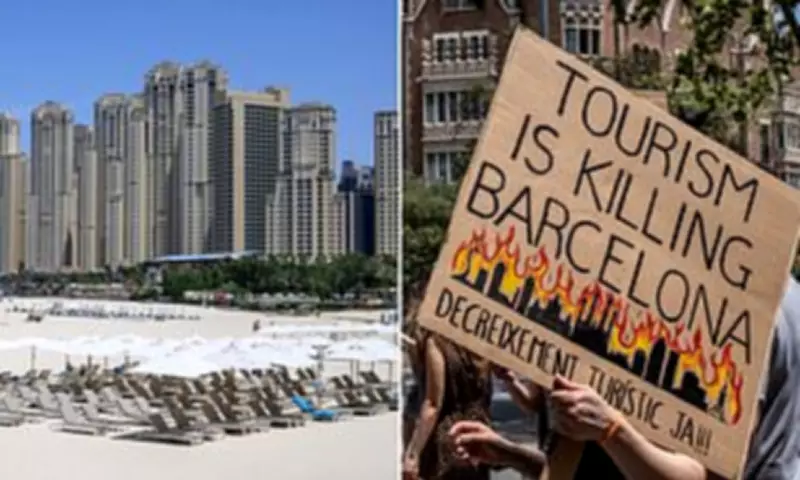
Spain's tourism industry is experiencing record-breaking numbers as holidaymakers shift away from Middle Eastern destinations due to the Iran conflict, flocking to safer European alternatives. The first quarter of 2026 saw 17.5 million tourists arrive in Spain, a 2.6 percent increase from the same period last year. While this has generated an economic impact of €25.017 billion for the country, locals in cities across Spain are expressing discontent as hotspots become overcrowded and rent prices continue to rise.
Anti-Tourist Sentiment Intensifies
Last month, residents in Seville launched an anti-tourist 'guerrilla campaign' after accommodation in the city reached 100 percent capacity. Buildings used for temporary stays were graffitied with slogans such as 'Airbnb out' and 'Guiris go home'—'Guiri' being Spanish slang for English-speaking tourists from the UK and Australia. One woman told Spanish media that bakeries and cafes had been overtaken by endless queues of tourists. 'If we don't cover the walls, it looks like nothing's happening. But what's really happening is that we're being pushed out,' she said.
Summer Boom Expected
Spain is preparing for an even larger tourism surge as summer flight bookings have soared 32 percent year-on-year, with hotel searches up 28 percent, according to digital travel marketing platform Sojern. Travel data firm Mabrian reported a notable shift away from Middle Eastern destinations toward the southern Mediterranean. If current trends continue, Spain could surpass 100 million visitors for the first time in its history this year, as reported by El Pais.

Local Backlash and Protests
Last year, thousands of demonstrators took to the streets in Barcelona, Mallorca, and Tenerife, accusing mass tourism of driving up rents, pricing residents out of their neighborhoods, and overwhelming city centers. In Barcelona, activists marched through tourist zones holding placards and squirting sightseers with water pistols. In Seville, housing costs have risen by 12 to 13 percent, with the average apartment price jumping from €2,000 per square meter in 2022 to over €2,700 in 2026. Authorities have introduced tougher enforcement measures, including cutting off utilities to illegal flats and restricting new licenses in overcrowded areas.
More Protests on the Horizon
Further protests are expected in the coming months, particularly in the Balearic and Canary Islands, which will see a massive influx of beachgoers this summer. A spokesman for the campaign group Menys Turisme, Mes Vida (Less Tourism, More Life) in Majorca told GB News that tensions are rising ahead of the summer season, with local communities becoming increasingly 'combative' as they feel ignored by authorities.
Benidorm: More Brits Than Spaniards
In Benidorm, there are now more British visitors than Spaniards for the first time in seven years. According to HOSBEC, the Valencian Community's Hotel and Tourism Business Association, UK visitors made up 42.5 percent of all hotel stays in the Costa town last year, compared to 38.6 percent national visitors—a return to pre-Brexit levels not seen since 2016. Valencian politician Alberto Ibáñez commented that neighborhoods across Spain are being transformed into 'sets for tourists.' He stated, 'We don't need more tourists, we can't accommodate any more... We can keep denying it until the day comes when there are no residents left.'
Middle East Conflict Drives Tourists to Spain
The shift comes as hundreds of British expats and tourists in the UAE scrambled to flee after the Iran war began in late February. Tourists rushed to rebook holidays away from Dubai and nearby countries, increasing demand for trips to western Europe. Once a tax-free haven attracting social media stars and Brits seeking warm weather, Dubai's image has been shattered, with some residents believing it is 'finished.' The city, which had hoped to welcome 20 million visitors this year, is now facing ruinous losses estimated at £450 million per day. Beach clubs, high-end restaurants, and five-star resorts are nearly deserted, and many hotels have closed. In the past week alone, seven five-star hotels announced closures, including the St Regis on the Palm and the Amani Hotel in the Burj Khalifa, leading to thousands of hospitality staff being let go or placed on indefinite unpaid leave.






