

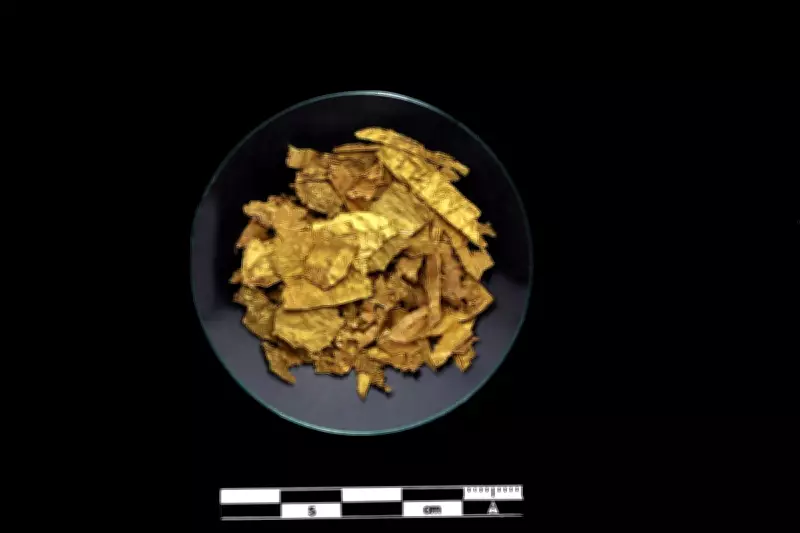
Physicists Accidentally Create Gold from Lead in Big Bang Simulation
In a stunning twist that echoes the dreams of medieval alchemists, physicists conducting experiments to mimic the conditions immediately following the Big Bang have inadvertently transformed lead into gold. This unexpected breakthrough occurred at the ALICE experiment within the Large Hadron Collider in Switzerland, where scientists were smashing lead atoms together at velocities approaching the speed of light.
The Alchemical Dream Realised Through Modern Physics
For centuries, alchemists pursued the mythical goal of transmuting base metals like lead into precious gold. Contemporary science has long established that lead and gold are distinct elements, with chemical processes incapable of achieving such a transformation. The fundamental distinction lies in their atomic structures: a lead atom contains precisely three more protons than a gold atom. This raises the intriguing possibility of creating gold by simply removing three protons from a lead nucleus.
As it turns out, this is theoretically feasible, but the practical execution is extraordinarily challenging. Protons reside within the atomic nucleus and are bound by the immensely powerful strong nuclear force. To extract them requires an electric field of staggering intensity—approximately one million times stronger than the fields that generate atmospheric lightning bolts.

The Mechanism of Accidental Transmutation
The researchers generated this colossal electric field by accelerating beams of lead nuclei to nearly the speed of light and directing them toward each other. In most collisions, the nuclei merely graze past one another, interacting solely through electromagnetic forces rather than undergoing direct, destructive impacts.
At these minuscule distances, even a slight electric charge can produce an exceptionally powerful field. As one lead nucleus skims past another, the rapidly fluctuating electric field induces vibrations that occasionally cause the ejection of protons. When exactly three protons are expelled, the lead nucleus transmutes into gold.
Detection and Quantification of the Phenomenon
To confirm this alchemical transformation, the ALICE team employs sophisticated detectors known as zero-degree calorimeters. These instruments count the protons stripped from the lead nuclei during collisions. Since the gold nuclei themselves cannot be directly observed, their presence is inferred indirectly through this proton counting method.
The scientists have calculated that during lead nucleus collisions, approximately 89,000 gold nuclei are produced every second. Additionally, they have observed the creation of other elements: thallium, resulting from the removal of one proton from lead, and mercury, formed by the loss of two protons.
An Unintended Consequence with Practical Implications
Despite its historical allure, the production of gold in this context presents more of a hindrance than a benefit for the researchers. Once a lead nucleus loses protons and transforms into gold, it deviates from its optimal trajectory within the Large Hadron Collider's vacuum beam pipe. Within microseconds, it collides with the walls, gradually diminishing the beam's intensity over time.
Nevertheless, comprehending this accidental alchemy is crucial for interpreting experimental data and designing future, more advanced particle physics experiments. This discovery not only bridges ancient aspirations with cutting-edge science but also enhances our understanding of fundamental nuclear processes.
The total quantity of gold generated remains minuscule—amounting to roughly 29 trillionths of a gram—far from practical application but symbolically significant. This research underscores how pioneering scientific endeavours can yield unforeseen results, merging the mystical quests of the past with the empirical rigor of modern physics.






