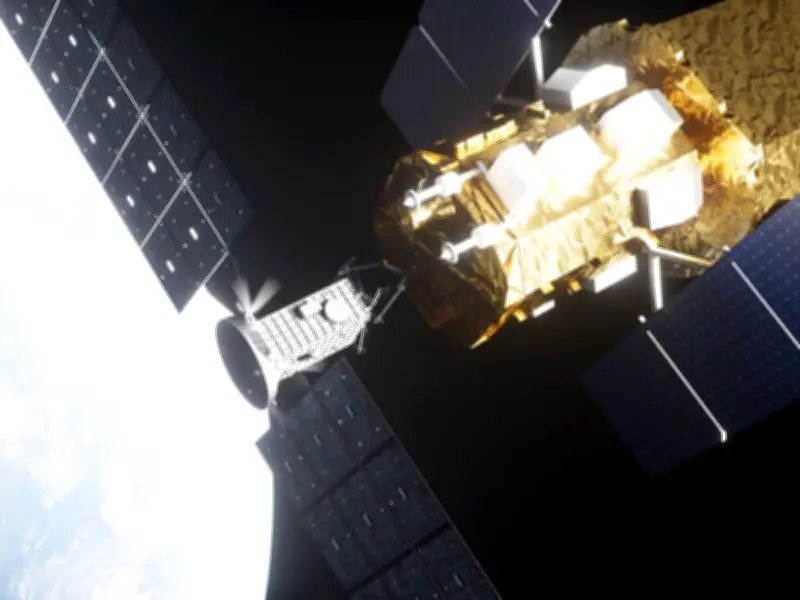
NASA has launched a never-before-attempted mission to prevent its Swift telescope from crashing back to Earth, using a flying robot the size of a refrigerator. The mission, carried out by private firm Katalyst Space Technologies, aims to catch the car-sized observatory before it burns up upon re-entry into Earth's atmosphere. If successful, the telescope will be dragged back up to its safe orbit at 373 miles.
Swift's Unique Role in Astrophysics
Swift is unique in that it can detect some of the most powerful explosions in the Universe, dating back to the dawn of the cosmos. Without intervention, the telescope would explode upon re-entry. The rescue spacecraft, called LINK, is a three-armed robot about the size of a fridge, powered by small thrusters. It was launched on Friday from the Marshall Islands in the Pacific using a Pegasus rocket blasted from the belly of a modified airplane. It is on course to reach and take hold of Swift in about a month.
High-Risk, High-Reward Mission
NASA commissioned Katalyst Space Technologies to build the spacecraft and carry out the mission. Its chief executive, Ghonhee Lee, said: "This is a high-risk, high-reward mission. The biggest danger was always we don't launch anything and we let Swift burn up in the atmosphere." Increased solar activity has pushed out Earth's atmosphere, causing it to grab at Swift, slowing it down and gradually lowering its altitude. The last two years have seen its descent speed up, and it now orbits at around 220 miles. Without action, it will explode in October.
Potential for Future Satellite Rescues
If the LINK spacecraft can successfully grab Swift, it opens up the possibility of rescuing other key satellites, such as the iconic Hubble Space Telescope, potentially saving hundreds of billions of pounds. Dr. Simeon Barber, a space scientist at the Open University, told the BBC: "The science community is hopeful about this because it's an important telescope that enables us to study super high-energy phenomena that we have no other means to study."
Swift's Legacy and Rescue Cost
Swift, which hosts three agile telescopes, was launched in 2004 at a cost of £220 million to study huge explosions like gamma-ray bursts and the violent deaths of stars. The rescue mission has cost NASA £22 million. Prof. Barber added: "LINK will fire its engines to slowly raise the orbit of the telescope again to an altitude where it becomes stable for a long period of time. It will be a very slow, graceful lift, not a sudden boost to a higher orbit." If successful, the next rescue mission could be to save the Hubble Space Telescope, which is the size of a large bus.
Changing Perspectives on Satellite Lifespans
John Nousek, a professor of astronomy and astrophysics at Penn State University, said: "The new ability to retrieve a satellite which was never planned to be serviced in orbit will give NASA or other customers the capability to reuse, extend or add functions to existing spacecraft at a small fraction of the cost of a new mission." Kieran Wilson, vice president of technology at Katalyst Space Technologies, said he hopes the Swift Boost mission will change how astronomers think about satellites' lifespans.