

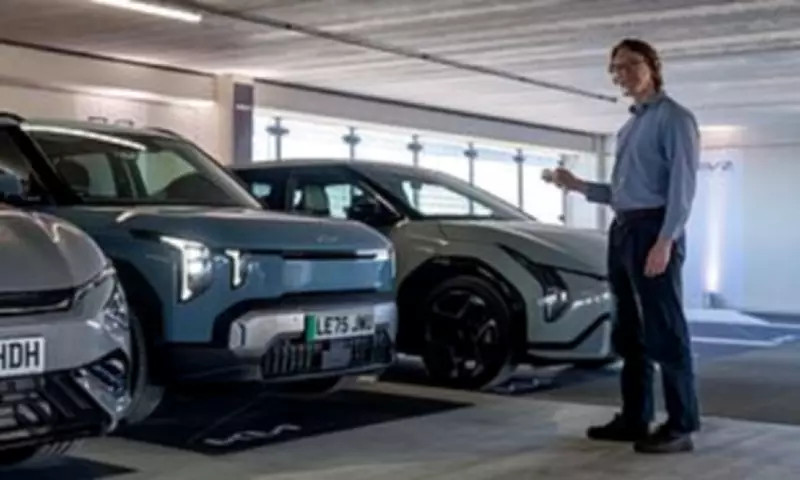
Kia EV2's Remote Smart Parking Assist: A Solution to Modern Parking Woes
For many drivers, parallel parking represents a significant source of anxiety, with the mere thought of navigating into a confined space inducing dread. Kia's forthcoming automotive innovation, however, promises to render such concerns obsolete. The soon-to-be-launched Kia EV2 electric vehicle incorporates a groundbreaking feature named 'Remote Smart Parking Assist', designed to assist motorists in entering and exiting tight parking spots with unprecedented ease. This raises a compelling question: does this technology herald the future of urban parking, or is it merely another high-tech novelty?
How Kia's Innovative Parking System Operates
Diverging from conventional self-parking mechanisms that autonomously guide vehicles into bays, Kia's system employs a distinctive methodology. Utilising a straightforward button on the key fob, drivers can activate the EV2 and manoeuvre it in and out of parking spaces, akin to operating a sophisticated remote-controlled car. To evaluate its efficacy firsthand, I visited a multi-storey car park in Southampton to rigorously test the Kia EV2 and its advanced parking capabilities.
Initially sceptical about this flashy new feature, my practical experience transformed my perspective, leading me to believe it could revolutionise city parking. The EV2, Kia's latest electric offering slated for UK release in the coming months at under £30,000, boasts a compact length of 4.06 metres and is equipped with an extensive array of sensors, cameras, and guidance systems, making parking appear effortless.

The UK's Parking Crisis: Outdated Standards and Expanding Vehicles
According to Kia's proprietary 'Parking Index', Southampton ranks as the most challenging city for parking in the United Kingdom. This index assesses factors such as drivers' self-rated parking skills, local parking standards, space availability, bay dimensions, average search times for spots, and incidents of vehicle damage during parking attempts. Despite Southampton's bottom-tier ranking, I encountered no difficulties navigating bays during my test.
Nevertheless, the Remote Smart Parking Assist addresses a genuine and pressing issue. The standard parking bay size in the UK has remained unchanged for half a century, with the last revision occurring in 1976. Concurrently, the average family car has expanded substantially, with new models growing larger annually. For instance, the Mini Cooper has widened from 141 cm in 1959 to 197 cm in the 2025 Mini Hatch. Recent studies indicate that new cars have increased in width by approximately one centimetre every two years since 2020, while parking bays have stagnated.
This discrepancy creates widespread frustration, particularly when drivers return to their vehicles only to find themselves hemmed in by bulky SUVs. The struggle to exit a cramped space is not merely inconvenient; it poses significant challenges for pregnant women, individuals with disabilities, and elderly drivers. Kia's survey reveals that 56% of motorists have been so severely blocked in that they resorted to climbing over seats or awaiting other vehicles' departure.
Practical Testing: Simulating Real-World Parking Scenarios
To replicate a typical supermarket parking predicament, the Kia team positioned the EV2 in an exceptionally tight spot, triggering proximity alerts on all sides. The space was so confined that entering the driver's seat seemed nearly impossible without resorting to extreme measures. However, the Remote Smart Parking Assist eliminated the need for such acrobatics.
By standing near the rear of the vehicle, users can lock the car, press the 'hold' button to activate the system, and then select 'back'. The EV2 then gracefully reverses out of the bay, as if guided by an invisible valet, freeing the door for easy access. Conversely, if parked but unable to exit a narrow space, drivers can reverse, alight, and use the key fob to guide the car back into the bay.
The movement is deliberately measured for safety, yet remarkably controllable, permitting minor adjustments. Importantly, onboard sensors partially govern the operation, preventing accidental collisions. During testing, the vehicle consistently halted promptly when obstacles were detected, ensuring safety.

Expert and Celebrity Endorsements
Kia Parking Expert Francesca Reid emphasises that while the technology doesn't entirely eliminate human involvement, this may be advantageous. "Sometimes I do think that people become a bit reliant on technology," Reid notes. "I always encourage using a blend of personal judgement and environmental awareness, as it pays to be cognisant of your surroundings."
Comedian and Task Master contestant Maisie Adams, an advocate of Kia's innovation, highlights its practical benefits. "Driving for work, arriving with minutes to spare before a gig, and parking without incurring passive-aggressive notes is stressful," Adams explains. "Removing yourself from the vehicle while retaining control makes perfect sense. This technology can assist parents managing buggies and shopping, or elderly individuals with reduced mobility."
In summary, Kia's Remote Smart Parking Assist may not entirely transform parking, but it offers a pragmatic solution to contemporary urban challenges, blending technological advancement with practical utility.





