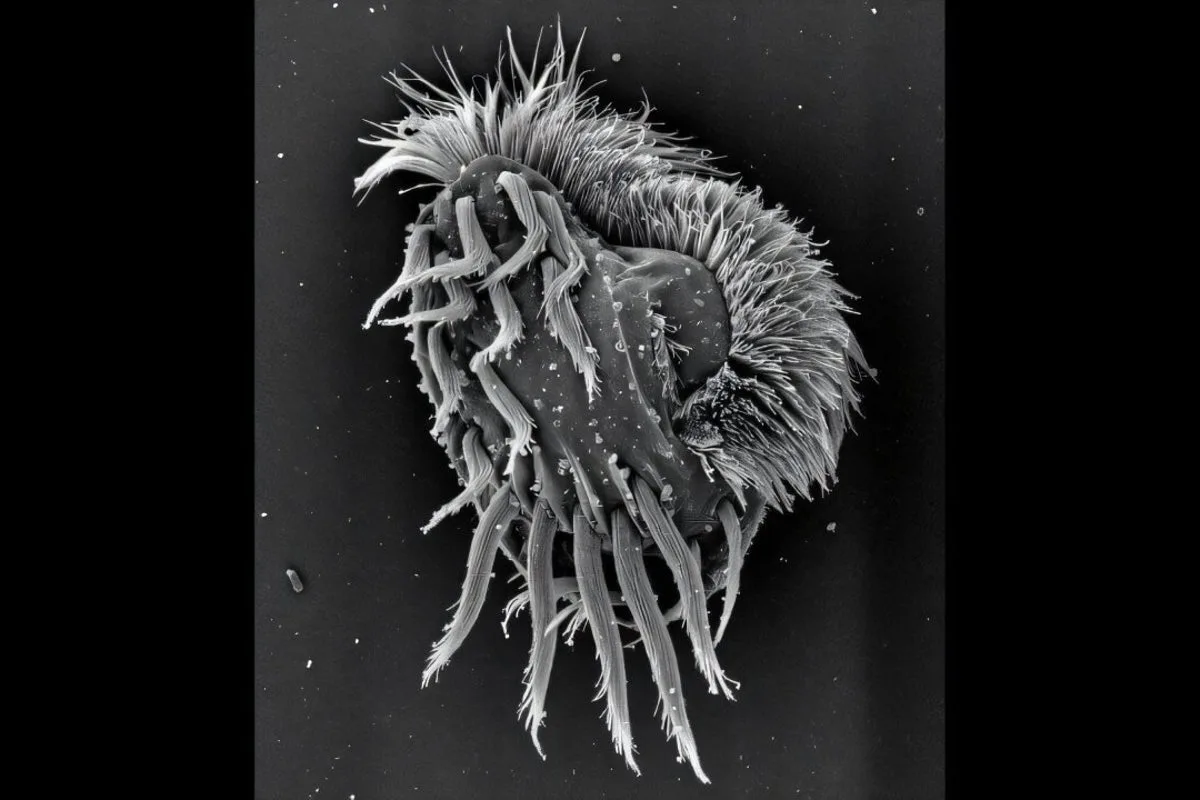
Scientists have documented for the first time a microbe that drastically transforms its size, shape, and behaviour into a cannibalistic 'supergiant' that hunts and devours members of its own species. The findings, published in the journal PNAS, demonstrate how single-celled organisms are capable of complex behaviours, and could transform how we understand development in such life forms.
The new protozoan species, named Euplotes gigatrox, was identified from the inside of a seawater filtration system in the Caribbean island of Curaçao. Researchers observed that clones of these microbes living together can spontaneously develop into supergiants more than twice the length of normal cells, with a broader body shape and a larger mouth.
When they exist as single cells, they filter-feed on bacteria. But once transformed into supergiants, they become raptorial predators, running over their clonal relatives to capture and swallow them whole at a rate of roughly one prey every 10 minutes. 'This is a single cell doing something we usually associate with the development of animals,' said biologist Ben Larson from Rensselaer Polytechnic Institute (RPI), a co-author of the study.
As single cells, the protozoan walks across surfaces and swims gracefully along helical trajectories in fluid. In their supergiant form, they move in circular paths suited to hunting surface-crawling prey, and tumble clumsily rather than swim when displaced from a surface. 'Supergiant formation represents a tradeoff. These cells become better hunters but worse swimmers, shifting their trophic niche from feeding on bacteria to exploiting a completely different type of prey,' Dr Larson said.
In the study, scientists sequenced the genome and proteins from the protozoan in different states, finding that supergiants are a distinct developmental stage with widespread differences in gene activity. Cells that revert from being supergiants carry a distinct set of molecules that seem to temporarily suppress transformation back into the giant state. Supergiants never appeared to exceed five per cent of the population.
'Most of what we know about development comes from animals,' Dr Larson said. 'We now have a system where we can study those same fundamental questions, as analogous developmental processes play out in a single-celled organism on a completely different branch of the tree of life.'