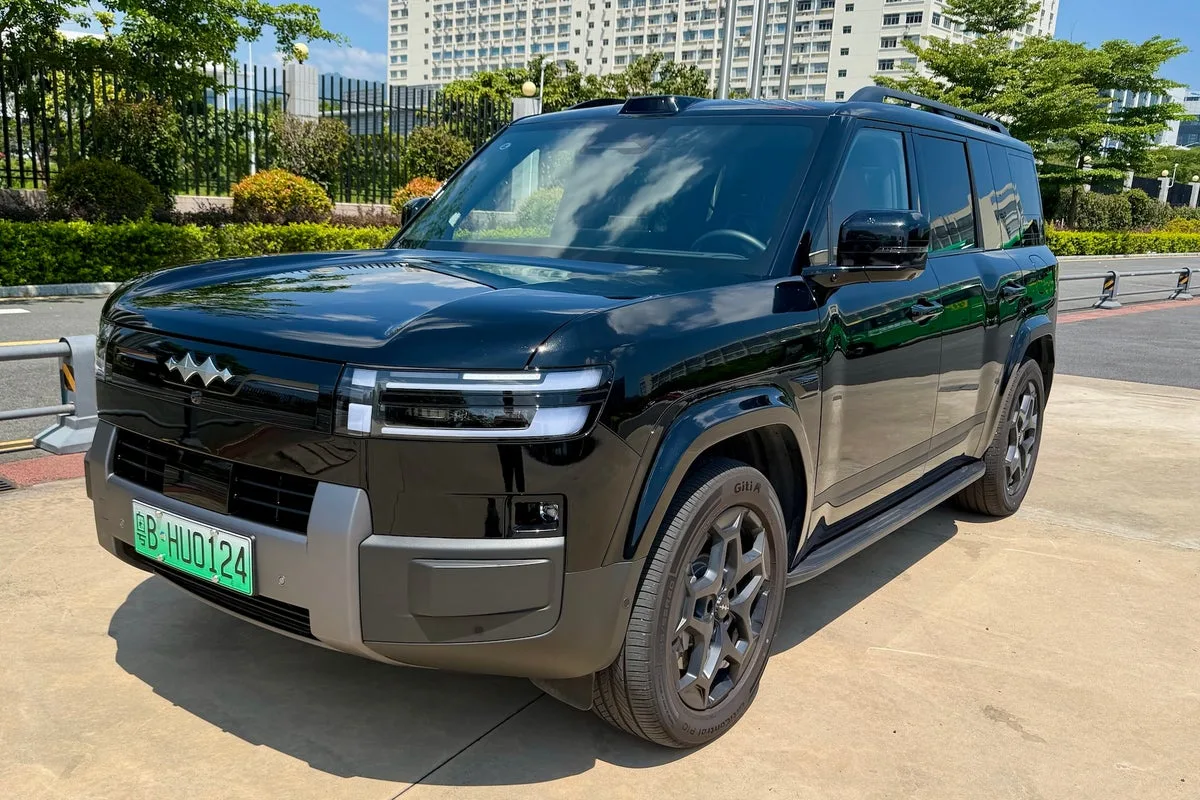
The BYD Ti7 is not the sort of car that sneaks quietly into a car park. It is big, boxy, square-shouldered and very clearly has Land Rover somewhere in its sights. On paper, it looks like a rival for the Land Rover Discovery – and at just under five metres long, it’s pretty much the same size. It will have seven seats for the UK market, four-wheel drive, a big family-friendly body and enough space to make it feel like a proper large SUV. But just look at it and the target becomes a bit more obvious: with its bluff nose, upright stance, chunky wheel arches and side-opening rear door, the Ti7 looks more like BYD’s answer to the newer, bigger-selling Land Rover Defender.
The car I drove was a Chinese-spec FangChengBao Ti7 on a short and controlled drive around BYD’s headquarters in Shenzhen, China. FangChengBao is one of BYD’s brands in China, but the car coming to Britain will be sold as the BYD Ti7, pronounced Tie-seven. There are likely to be specification changes before it reaches UK customers, so this is not a full final UK road test. Think of it more as an early taste of a car that could become one of BYD’s most interesting British arrivals yet.
And there is plenty to be interested in. BYD is already growing fast in the UK, but the Ti7 takes it into a different part of the market. This is not a small electric hatchback, a sensible family SUV or a slightly left-field plug-in hybrid estate. It is a big, tough-looking seven-seat SUV with an expected price under £50,000, which would put it well below the cars it appears to be chasing and more aligned with the Hyundai Santa Fe and Kia Sorento. The Ti7 is already a big deal in China, too. BYD says it’s the best-selling full-size Chinese SUV, with around 15,000 sold per month.
The early signs are promising. The quality is seriously impressive inside and out, the technology is easy to use, the performance is strong and there is loads of space in the back. There are caveats, of course. The drive was limited, UK specification is not locked down and there are still some details to confirm. But as a first taste, the Ti7 feels like a car worth taking seriously.
The BYD Ti7 heading to the UK uses BYD’s DM-p plug-in hybrid system. That means a 1.5-litre turbocharged petrol engine, electric motors at the front and rear, and four-wheel drive as standard for Britain. The headline numbers are strong. BYD says the Ti7 can travel up to 79 miles on electric power alone, which is enough for a lot of daily driving without the petrol engine needing to wake up at all. The 35.6kWh battery can be charged from 30 to 80 per cent in 17.5 minutes on a DC rapid charger, while the full hybrid system gives the Ti7 the long-distance flexibility that still appeals to plenty of family SUV buyers. Performance is good, too. The combined system produces 483bhp and gives a 0–62mph time of 4.8 seconds, which is quick by any normal family SUV standard.
There was a slight hesitation at times, as the drivetrain switched between power sources, but nothing that felt worrying on this short drive. It was more of a brief pause while the car decided exactly how it wanted to deliver the power I requested, rather than anything that made the car feel rough or poorly calibrated. There are four main drive modes: Eco, Normal, Sport and Snow. Normal will be absolutely fine for most people most of the time. Eco relaxes things a little for maximum efficiency, while Sport seems mostly to add a touch more weight to the steering rather than sudden changes in throttle response.