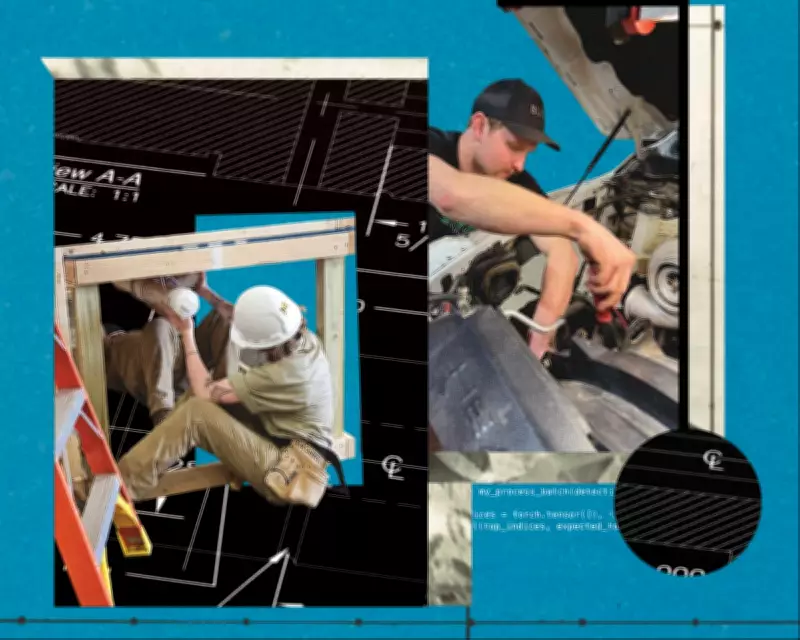
AI Will Not Replace the Skilled Trades, Young Experts Assert
For many young people entering the workforce, the stigma surrounding hands-on jobs is rapidly fading. There is a growing competitive appeal to these roles, and they all demand human expertise that artificial intelligence cannot replicate.
Gib and Michelle Mouser are immensely proud of their son's career, though it diverges from their initial expectations. At just 23 years old, Cale Mouser already earns well over six figures, with prospects for even higher income. He is a recognized expert in a highly specialized field, spending hours in deep thought solving complex problems. While he uses a computer, he is not confined to a desk.
Cale Mouser repairs diesel engines. Hailing from Minnesota, he began working with medium- and heavy-duty trucks only five years ago. His natural aptitude led him to pursue a diesel technology degree at North Dakota State College of Science, followed by a faculty position at the same institution.

His family background offered no obvious path into this field—his mother is a nurse and his father a veterinarian—but he now teaches the next generation how to diagnose and repair heavy equipment, ranging from tractors to 53-foot semis.
"It's very exciting. I get to go do some sleuthing, like Sherlock and Watson," he chuckles. "There's a lot of awe and wonder involved."
"Awe and wonder" is an uncommon description for a hands-on job, the kind many still view as a fallback at best, anticipating only a tough daily grind. Vocational education once carried a punch-the-clock stigma.
However, for numerous young people on the verge of entering the workforce, that stigma is diminishing. For some, the appeal is competitive: these trades now feature contests, rankings, and national titles. This is how Mouser became a national champion.
Pathways Through Competition
Mouser's journey began with a competition he did not even enter. One morning, a teacher instructed him to appear at a cavernous industrial hall in Wahpeton, North Dakota, where the non-profit SkillsUSA had filled the floor with parked diesel trucks.
Students had 25 minutes to rotate through 14 truck stations, diagnosing built-in faults and fixing what they could on the fly. It was a long and challenging 10-hour day, with the added pressure of judges recording every minor error.
Somehow, with no prior competition experience, Mouser emerged victorious. "I had an absolute blast, just working my way through the stations and enjoying my time. I loved the challenge and the thought process behind it," he recalls.
Suddenly, he had his first state gold medal, hundreds of dollars' worth of sponsored tools, and a ticket to compete in the SkillsUSA Championships, held annually in Atlanta. Soon, he would add another gold medal to his collection—this time as a national champion.
From welders to skilled robotics technicians, auto repair experts to EMTs, numerous industries are struggling to find and hire individuals with Mouser's level of complex cognitive skills, speed, and determination—all qualities he honed through competitions, education, and on-the-job experience.
Fix a broken tractor or combine quickly in the real world, and you help save a farmer's crops or ensure medicine reaches its destination. Competitions often serve as the first access point for young talent, according to Chelle Travis, executive director of SkillsUSA, the largest nationwide workforce development organization for students.
"Everyone is after skilled talent," she says. "We see employers asking to increase competitions."
The Human Expertise Advantage
Witnessing a skills competition reveals the curiosity and drive that students bring to "middle-skill" jobs—roles requiring training and credentials beyond high school but not a four-year bachelor's degree.
These fields, while diverse, share two critical commonalities, as noted by Professor David Autor, associate department head of the MIT Department of Economics.
First, they all over-index on what he terms human expertise, defined as applying learned proficiency to problem-solving and making one-off, high-stakes decisions. Second, they are poised to benefit optimally in a robotics- and AI-integrated economy, where humans collaborate with technologies to develop new expertise on emerging work processes.

These hands-on jobs "are an area where there's tremendous specialized knowledge. It's often acquired in the field. And it's not easily automateable because it requires lots and lots of judgment, combined with a level of dexterity and adaptability in an ever-changing environment. That's very, very challenging for robotics," he explains.
AI excels at knowledge tasks performed on computers, leaving so-called "knowledge workers," especially entry-level graduates, highly exposed. Yet Autor believes predictions of an impending "AI robocalypse" lack nuance.
In his analysis, general-purpose AI models could transform certain middle-skill fields like cybersecurity or IT, making them higher-paid but potentially less numerous. Those remaining in these roles will be more specialized, with their human oversight and judgment becoming essential.
Diverse Success Stories
Regarding skilled trades, Travis notes that in her 20 years with SkillsUSA, she has never witnessed such concentrated interest from policymakers and CEOs in developing work-based learning programs for students, sometimes starting in elementary school. SkillsUSA's membership now exceeds 440,000 students nationwide, with its annual championships attracting thousands of competitors.
Eva Carroll discovered the trades almost by accident. Her high school offered electives in construction, electrical work, and building technology. No one in her family worked with their hands. However, during her first electrical project, a teacher demonstrated how to generate a charge using merely a potato sliced in half and a pair of wires. She was instantly hooked.
Last year, Carroll proudly stood out as the only national female medalist in her division when she and her team secured silver at SkillsUSA. She traveled to Atlanta from Columbia, North Carolina, to compete in the TeamWorks competition, renowned for its high-pressure environment and attracting only the most dedicated construction enthusiasts.
Students must frame and build an eight-foot by ten-foot mini home in exactly 16 hours, complete with a roof, working electrical systems, and plumbing, making it one of the most arduous challenges at the convention.
In Atlanta, judges provided just enough materials for the build, which Carroll, 20, undertook with her team of three male students from Midlands Technical College in South Carolina. They knew they had no margin for error—one misplaced stud or incorrect cut could cost them valuable points.
Carroll's primary passion is electrical installation, but she handles all aspects. Even amid panic and accidentally hammering a finger, she enjoyed herself immensely. "I'd look around and everyone's freaking out. And I'm just doing my own thing, singing to myself," she says. "I'm in my own world when I'm out there."
Carroll initially faced alarmed pushback from her parents when she excitedly discussed her high school electives. "Me being a girl in this, they were kind of scared that I might get hurt," she admits. They now support her, though they first wanted her to understand she was choosing a field involving significant hard labor.
Carroll is uncertain which trade elements she will pursue. She enjoys construction math and teamwork, potentially leading to a career as a construction manager or estimator, with starting salaries well above $90,000 per year.
She acknowledges that being a woman on a construction site presents challenges, but competing and training have bolstered her self-confidence. "Plus, it's cool that I get to beat a bunch of dudes that do this all the time," she laughs.
Forensic Fascination
A stray conversation about a criminal justice class piqued Aydrie Ruff's interest, prompting her to enroll at Meridian Technology Center, a trade school in Stillwater, Oklahoma, at age 16.
The most intriguing part of the class focused on crime scene investigation and forensics. When her teacher asked if she would like to compete as part of a crime scene team through SkillsUSA, her heart leapt. "That sounds like the most interesting thing ever," she recalls thinking.
In competitions, students confront the staged aftermath of a violent crime, requiring quick thinking to decide on actions. "We photograph the evidence, we draw the scene. One person will swab for blood. One person will lift a fingerprint and another will package evidence and find fibers and stuff," she explains.
Ruff's team—three girls from her school—reached nationals on their first attempt. It was extremely nerve-wracking, she remembers. In Atlanta, her CSI team had 15 minutes to process a simulated hotel robbery scene, complete with overturned furniture, broken glass, synthetic blood, and a gun with prints under a mattress. They had to capture everything without contaminating the scene, with every move judged by real-life forensics experts.
Back in Oklahoma, Ruff's classroom work ranges from detailed to grisly. She has practiced redirecting traffic from crime scenes and visited the local jail with her class. She can calculate a suspect or victim's position based on blood spatter patterns using a special math equation ("it's very, very cool").
She has also learned extensively about bugs, particularly those that grow inside corpses. Listening to visiting entomologists lecture on the life cycles of maggots and flies was a highlight of her school year.
Ruff keeps her medals tacked on her bedroom wall. The soft-spoken 17-year-old was raised by her grandparents, with no family connection to criminal justice beyond watching Forensic Files with her grandfather as a child.
After completing her final year at Meridian Tech, Ruff will attend the University of Central Oklahoma to major in forensics. "You can be a forensic scientist or a pathologist, or a toxicologist," she says happily. "There's work you can do with just bones or just fingerprints or bugs. There are hundreds of jobs out there."
Global Recognition and AI's Limits
Cale Mouser's passion for diesel technology took him to WorldSkills in 2024 in Lyon, France, where the then-21-year-old earned a fifth-place medallion of excellence for his high score.
"They always told us we were the best of the best, and I always doubted 'em until I got there and realized how big of a deal it really was," he says.
Critically, AI will not be stealing his Sherlock Holmes hat anytime soon. "I just diagnosed a transmission the other night, where the computer didn't even know anything was wrong," Mouser states. "AI will not replace the skilled trades."