

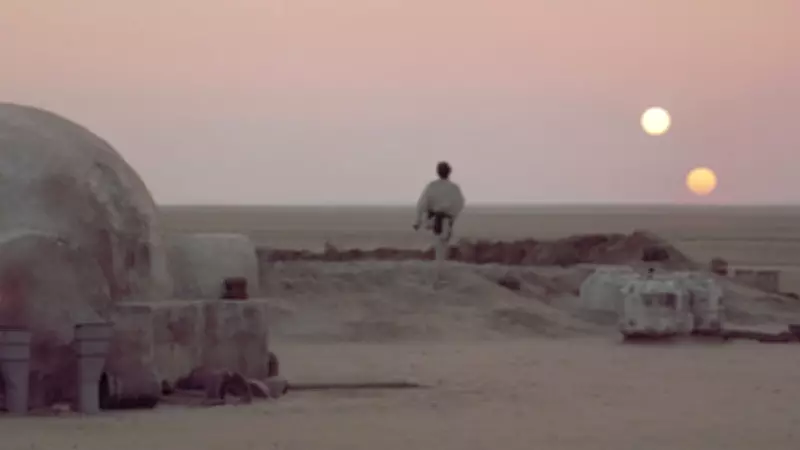
In a discovery fitting for Star Wars Day, astronomers have identified 27 new potential planets that orbit two stars, reminiscent of the fictional desert planet Tatooine from the Star Wars universe. Only about 18 circumbinary planets—those orbiting two stars—had been confirmed previously, compared to over 6,000 planets known to orbit single stars like our Sun.
New Technique Unveils Hidden Worlds
The research, led by scientists at the University of New South Wales (UNSW), used a method called apsidal precession to detect the planets. Instead of relying on transits, where a planet passes in front of its star and causes a dip in brightness, the team monitored the precise timing of eclipses between binary star systems. If the eclipses occur earlier or later than expected, it can indicate the gravitational influence of a third body, such as a planet.
“If we monitor the exact timing of these eclipses … that can tell us that there’s something else going on in the system,” said Margo Thornton, lead author and PhD candidate at UNSW. After ruling out other factors like stellar rotation and gravitational interactions, the team identified 36 star systems out of 1,590 with unexplained behavior. For 27 of these, the third body is likely planetary in mass.

Potential Planets Range from Neptune to Super-Jupiter
The candidate planets are estimated to range in size from Neptune-like to ten times the mass of Jupiter. They lie between 650 and 18,000 light-years from Earth. The data came from NASA’s Transiting Exoplanet Survey Satellite (TESS), a space telescope launched in 2018 to hunt for exoplanets.
“There are many things in astronomy that aren’t very tangible,” said Associate Prof Ben Montet of UNSW, senior author of the study. “But thanks to the famous Tatooine sunset scene in the first Star Wars film, everyone has a picture of what a circumbinary planet looks like and what it would mean to stand on a planet with two suns.”
Extreme Environments but Potential Habitability
Dr. Sara Webb, an astrophysicist at Swinburne University of Technology not involved in the study, noted that circumbinary planets likely have “very extreme environments” unlike anything in our solar system. However, she added, “a planet like Tatooine could potentially exist where there is that sweet spot between its orbit of the two stars—where it’s not too hot and it’s not too cold.”
More than half of the stars in the universe exist in binary or multiple star systems, suggesting many more such planets may await discovery. The team plans to conduct follow-up observations to confirm the masses of the candidates and determine whether they are planets, brown dwarfs, or small stars.
The research was published in the Monthly Notices of the Royal Astronomical Society.






