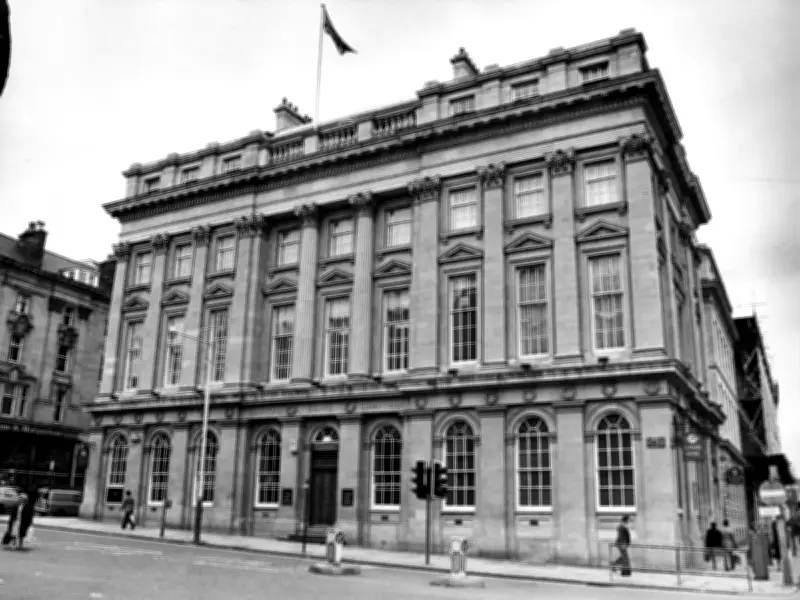
The Ivy is set to open at 102 Grey Street, Newcastle, a former Lloyds Bank branch that closed last summer after more than a century of trading. The building has a rich history, including serving as a prison for King Charles I during the English Civil War.
A change of occupants on Grey Street
Grey Street's fine architecture has remained intact even as much of wider Newcastle has been reshaped over time. What has changed, however, is the character of the occupants. Where banks, insurance firms and legal offices once dominated, the past couple of decades have seen bars, cafes and restaurants take over, as the city's 21st-century leisure economy has gone from strength to strength.
The Chronicle reported last week how luxury restaurant chain The Ivy is set to open in Newcastle and is currently recruiting staff. The famous eatery has 47 cafes and brasseries around the UK, with its London restaurants a magnet for A-list stars such as Tom Cruise, Nicole Kidman, Madonna and Joan Collins.

A building with a royal past
The Ivy will trade at 102 Grey Street, a former grand branch of Lloyds Bank which closed its doors last summer after operating there for more than a century. Lloyds moved into the impressive premises in 1908, replacing a Victorian bank called Lambton & Co, which itself had replaced the Northumberland & District Bank in around 1857.
The building, dating from around 1839, was part of Richard Grainger's sweeping transformation of central Newcastle. It is believed to have been designed by architect Benjamin Green who was responsible for the Theatre Royal and Grey's Monument among other notable developments.
Before the bank, the site was famous for a fascinating piece of Newcastle history. During the English Civil War that tore the country apart in the mid-17th century, King Charles I was held as an open prisoner there for eight months during 1646 and 1647.
From monastery to royal prison
Charles stayed at Anderson Place - also known as Newe House - the largest residence in Newcastle with extensive grounds on the west side of Pilgrim Street. It would survive until the 1830s when the Grainger Town redevelopments began. Further back in time, a Franciscan monastery stood on the site, before falling victim to Henry VIII's dissolution of the monasteries in the mid-1500s.
In 1646, King Charles had been captured after the Battle of Newark, the final major Royalist defeat of the Civil War, when Parliament's forces and its Scottish allies forced the besieged town's surrender. Rather than be taken by the Parliamentary army, Charles chose to give himself up to the Scots.
The king was taken 150 miles north to Newcastle which itself had been besieged for months by a Scottish army in 1644 and was eventually taken and occupied by the Scots for years afterwards.
Charles's time in Newcastle
One account recalled: “The townsfolk gave Charles a royal welcome. Bonfires blazed, the bells were rung, drums were beaten, and trumpets brayed. He was still nominally a king. He rode through a lane of pikes and muskets to his lodgings, escorted by 300 Scottish horsemen, those next to him bareheaded.”
Charles remained a prisoner in Newcastle between May 1646 and February 1647 when he was handed back to Parliament. It was noted: “He seems to have enjoyed for part of the time a great measure of liberty.” It was also observed: “The stately figure of the sad-faced king would be familiar to the people of the town as in his daily walks he perambulated the streets.”
Two years later, on a bitterly cold day in Whitehall, London, January 30, 1649, thousands gathered to watch the execution of Charles I, where he uttered the words “I go to where no disturbance can be”. With one swing of the blade, the executioner severed the king's head from his body, before it was held up to the huge crowd.
A plaque commemorating Charles's stay in Newcastle can be viewed on Market Street on the side of the former Lloyds building.