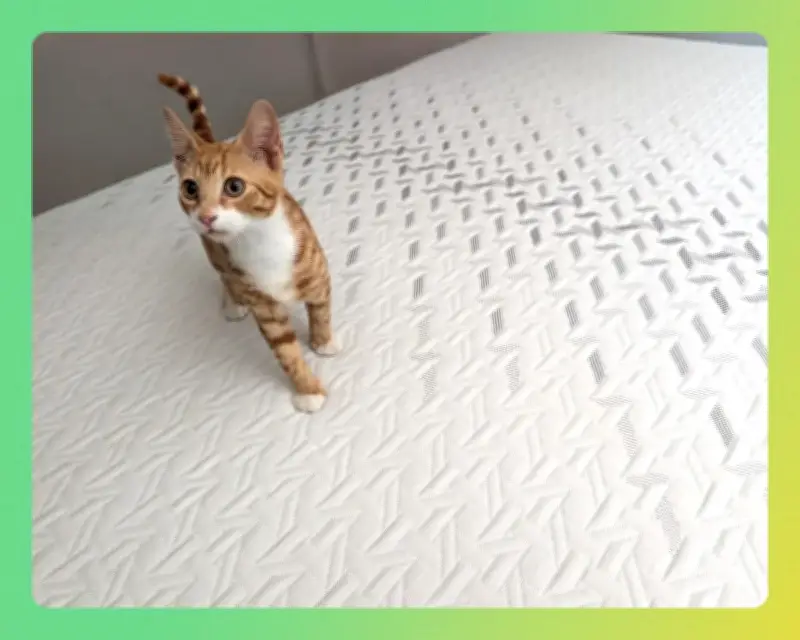
The Nectar Classic memory foam mattress is an outstanding budget buy, outperforming pricier rivals for comfort and motion isolation, with a lifetime guarantee that genuinely deserves to be called industry leading. At £449 for a double, it offers a lovely balance of comfort and firmness that feels more like a hybrid mattress, only without the bounce.
Testing the Nectar Classic
I was sent a double-size Nectar Classic memory foam mattress in May, just as temperatures first punched past the 30C mark. Once I’d given the mattress a couple of days to expand to its full size and firmness, my family testing panel came over to rate it out of 10 for comfort, aesthetics and other subjective factors. They also helped me run lab-style experiments with heat pads, weights and wobbly cups of water to measure its sinkage, motion isolation, heat retention and edge support.
My husband, Alan, and I slept on the Nectar for six weeks in June and July, after positioning it on a slatted Ikea base and covering it with a mattress protector and cotton bedding. It was the worst of times for sleeping. The room temperature occasionally dropped below 28C with the help of an electric fan, but for the most part it hovered around 32C. The fact that we managed to sleep on the Nectar, rather than just lie on it, shows how well it performed on temperature control.

Price and specifications
The Classic memory foam is Nectar’s most popular mattress, according to the brand, and part of a range that also includes another all-foam mattress (the Premier), two foam-and-spring hybrid mattresses, and a kids’ mattress. The Classic memory foam is the most affordable of Nectar’s adult mattresses: £199 for a single, rising to £649 for a super-king. The double I tested costs £449. That’s cheaper than the Tempur Ease – another all-foam mattress with a feel and performance similar to the Nectar.
Nectar rates the mattress as “6.5 out of 10 (medium-firm)”, but it feels firmer than that when you first sleep on it. My testing panel gave it an average 8/10, and then, after Alan and I had slept on it for a month, we rated it 7/10 (where 10 is firmest). This isn’t a fault: all foam mattresses soften after being slept on, then settle after a while to their intended tension level.
The fabric sleep surface is made from synthetic fabric (9.5% low-density polyethylene and 90.5% polyester), while the bottom cover is 100% polyester. Nectar says the fabric is woven with “cooling fibres” and describes it as “menopause-friendly”, explaining that it “wicks heat away and encourages airflow”.
What we loved and what we didn’t
The first thing I loved was how blissfully easy this mattress was to carry up the stairs and unpack. At 32kg for a double, the Nectar Classic is one of the lighter mattresses I’ve tested, and the box was small enough for me to lug upstairs by myself – a rare treat in my life as a mattress reviewer. Given the affordability and manoeuvrability of the Nectar Classic, I’d recommend buying the largest size your bedroom has space for.
When settling in for the sleep test, Alan and I also loved how flat, supportive and airy the mattress was. This is largely because the Nectar’s top layer is much less mouldable than the Tempur Pro Plus SmartCool and the Panda bamboo mattress topper. The middle layer is more “sinky” and helps with pressure relief, but its top layer springs back more quickly than pure memory foam when you press it, which makes it feel less cloying.
The Nectar Classic’s motion isolation is outstanding, as is often the case with foam. While the “non-sinky” upper layer made it easy to turn in bed, the lower layer of adaptive foam seemed to absorb our movements so we never disturbed each other while fidgeting.
The Nectar was more comfortable in the heatwave than I’d expected from a foam mattress with a polyester cover. That’s damning with faint praise, though. It only performed moderately well on temperature control, and I suspect that my electric fan, cotton bedsheets and bamboo duvet (the summer edition of the Panda Cloud, which topped my best duvets test) did a lot of heavy lifting to help me sleep.

There’s also no bounce, so this probably won’t be your first choice if you love a springy bed. Foam and hybrid mattresses usually have fabric covers that you can unzip to wash in the machine, but the Nectar doesn’t (remember, ignore the zip!). This helps to keep its price down because there’s no inner lining to protect the foam when the cover is off. However, it does mean that you have to buy a mattress protector and use it diligently to keep the mattress in good condition, especially during its one-year trial period.
Sustainability and should you buy it?
Memory foam (viscoelastic polyurethane foam) is one of the least sustainable materials used in furnishings. It’s made using petroleum-derived chemicals including polyols and diisocyanates, and emits volatile organic compounds (VOCs) when removed from its shrink-wrapping at home. That’s what the “off-gassing” smell is.
Nectar is working to limit the damage, though. It claims it has offset 43m kilograms of carbon to date, and has enlisted the help of ClimatePartner to cut its footprint rather than just offset it. Among its plans are a switch away from polyurethane foam to a “low-emission alternative”, and “updates on plastic packaging”. Meanwhile, all its foam is CertiPur and Oeko-Tex certified, and its mattresses are made in Manchester and delivered in FSC-certified cardboard.
The Nectar Classic memory foam mattress is an outstanding buy. It’s one of the lightest and easiest-to-manoeuvre mattresses I’ve tested, beaten only by the budget Ikea Valevåg. This makes it an excellent choice for anyone moving house or setting up home – or indeed, anyone blessed with a tight stairwell like mine.
It’s easy to sleep on, too. Side sleepers may initially find it too firm, but it adapts to cushion your pressure points and strike a lovely balance of comfort and support. Despite testing this mattress in a heatwave, I never woke up at 4am in a pool of sweat and misery, as I have with a few other memory foam products.
I wouldn’t call it a “cooling” mattress, though. If overheating is a problem for you, I’d recommend a sprung or hybrid mattress instead. Sprung mattresses also tend to be a more sustainable choice.
Those are the main reasons I gave this mattress four stars rather than five, although I’d give it four and a half if I could. It feels durable enough to last for many years, and its generous warranty backs this up.
The Nectar is no Marmite mattress. You may love it, but you’re highly unlikely to hate it. It’ll appeal to a wide range of people, including side sleepers, back sleepers and couples, and it’s well worth its price.