

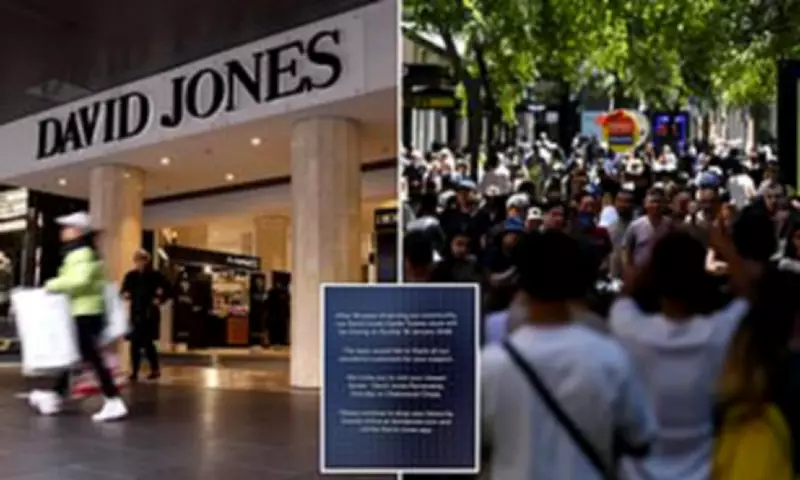
David Jones Faces Financial Scrutiny Over Extended Supplier Payment Times
One of Australia's oldest and most iconic department store chains, David Jones, is under the spotlight following a concerning report that reveals it is taking significantly longer than average to pay its suppliers. Founded in 1838, the retailer has been a staple of Australian shopping for nearly two centuries, but recent developments have cast doubt on its operational stability.
Alarming Payment Delays and Store Closures
According to data from commercial credit agency CreditorWatch, David Jones is currently taking 16 days to settle invoices with its suppliers. This figure is more than double the industry standard of seven days, raising eyebrows among analysts and stakeholders. While businesses often delay payments to manage cash flow, such a substantial deviation from the norm can signal underlying financial pressures.
The news comes on the heels of David Jones announcing the impending closure of two stores in Castle Hill and Tuggerah on the New South Wales Central Coast, scheduled for 2026. These closures mark the end of a 34-year presence in those locations, reflecting broader challenges in the retail sector. Despite operating more than 40 stores nationwide and employing up to 9,000 staff across Australia and New Zealand, the chain is grappling with significant headwinds.

Financial Performance and Loan Obligations
David Jones' most recent financial report to the Australian Securities and Investments Commission (ASIC), filed in March 2025, paints a grim picture. The document shows a net loss of $74.4 million from gross sales of $2.2 billion for the financial year ending June 30, 2024. This substantial loss underscores the difficulties facing the historic retailer in a competitive market.
Further complicating matters, the company recorded a 'bullet loan' of $26.3 million that matured in September 2024, requiring full repayment. Additionally, a $150 million loan designated for working capital is set to mature on March 27 of this year. The extension of payment times to suppliers has led to speculation about whether David Jones can resolve this $150 million obligation by the looming deadline.
Company Response and Strategic Initiatives
A spokesperson for David Jones has defended the delayed payments, describing them as part of a broader effort to streamline operational and financial processes. The goal, according to the company, is to build a stronger, more efficient, and sustainable business model. This initiative includes implementing a new supplier payment process within the Oracle finance system, enhancing purchase order procedures, and updating standard payment terms.
The spokesperson emphasized that David Jones' major partners have agreed to these changes, which are intended to support continued investment in growth and innovation. Private equity firm Anchorage Capital Partners, which acquired David Jones' operating business in 2022 for approximately $100 million, has backed a $250 million transformation program. This program focuses on store refurbishments, launching a mobile app, evolving the e-commerce platform, and introducing a new loyalty program.
Despite the challenges, David Jones reports strong trading conditions in the first half of the 2026 financial year, with growth compared to the previous period. The company remains committed to investing in the business, supported by its financial partners, to foster ongoing innovation and expansion.
Broader Retail Sector Challenges
The struggles at David Jones are not isolated. Months of high inflation have severely squeezed Australian retailers, forcing many to cut staff, scale back operations, or shut down entirely. A Business Conditions Survey released by Business NSW in December highlighted the tough lead-up to Christmas for companies in the state, driven by rising interest rates.
The survey, conducted from November 2 to 17, revealed that customers are spending less, demanding discounts, and delaying invoice payments compared to the previous year. Nearly half (42%) of businesses reported fewer purchases, while 37% noted a reduction in average order sizes. Only 18% experienced more frequent purchases, illustrating the widespread pressure on the retail economy.

While CreditorWatch has ranked David Jones as having a 'low' risk of default within the next year, the report cautions that unfavorable economic conditions could weaken its ability to meet financial commitments. As the retail landscape continues to evolve, the future of this historic department store remains a topic of keen interest and concern.





