
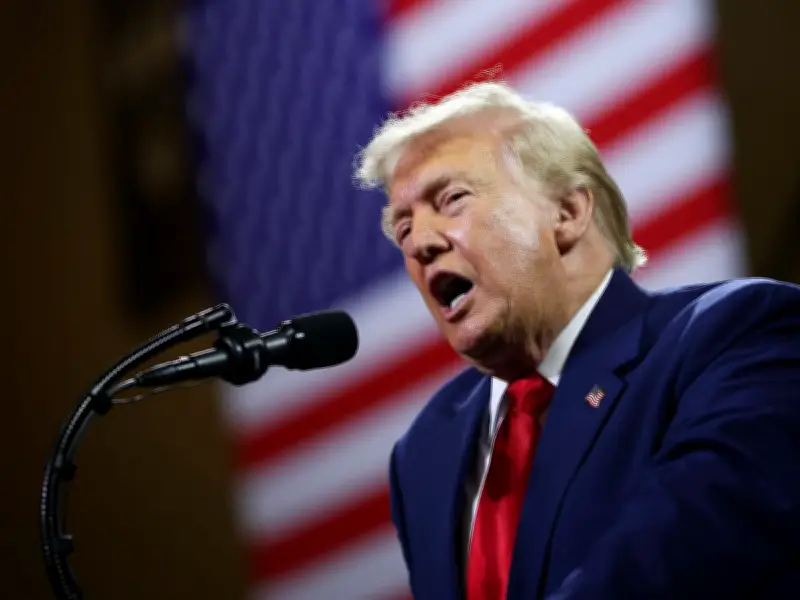
The UK has been hit with new 10% tariffs by Donald Trump, just as figures revealed an early "Burnham bounce" for the economy. The US President slapped duties on 60 countries, saying they had allowed goods produced using forced labour to be imported.
They replace a separate set of tariffs that ended on Friday after the US Supreme Court ruled them illegal. Trade experts said it largely meant "business as usual" for UK companies already selling to the US, although a setback for those hoping for a reprieve. The tariffs were also branded "ill-judged and potentially catastrophic for business" by the GMB union.
Positive economic data
The news came as positive economic data gave a boost to new PM Andy Burnham and Chancellor John Healey. Pollsters GfK said a combination of England's success in the World Cup, the run-up to Mr Burnham's appointment as PM and the fine weather had "lifted the mood" of the nation, as it revealed consumer confidence had seen a significant six-point increase - the largest increase since November 2023.
However the headline figure remained firmly in negative territory, at minus 17, while confidence in the country's general economic situation over the last year jumped by 10 points to minus 39 - five points higher than a year ago - while expectations for the economy over the coming 12 months rose by eight points to minus 28 - one point above last July.
Consumer insights director at GfK Neil Bellamy said: "Hot on the heels of the summer heatwaves, July has delivered a wave of optimism. The sense of a fresh start following the appointment of a new Prime Minister surely accounts for some of this bounce."
Separate Office for National Statistics data showed retail sales rose 1% last month, despite economists predicting a 0.1% fall. Sales of clothes and air conditioning were also boosted by the recent heatwave. It came days after the ONS said last month inflation fell to 2.6%.
Private sector growth
Further figures from S&P Global showed an increase in UK private sector output in July for the first time in three months. Its chief business economist Chris Williamson said: "UK businesses reported stronger activity in July, pointing to a faster pace of economic growth at the start of the third quarter. Hospitality companies saw demand boosted by good weather, the FIFA World Cup and more domestic holidays, as high costs and uncertainty continued to deter some foreign travel."
However, these benefits risk being undermined by a fresh spike in oil prices to $100 a barrel amid ongoing tensions in the Middle East. On Thursday the RAC warned fuel prices were "shooting up like a rocket", in a setback to Mr Burnham's crusade to drive down the cost of living for millions of families. Simon Williams, RAC head of policy, said: "The average price of diesel has gone up almost 8p (7.62p), or 5%, to 172.14p a litre in the last fortnight while petrol has risen by 5p in two and a half weeks to 155.57p, a 3% increase."
"All the cuts of the last few months are sadly being reversed, with the price of unleaded now heading back up towards 160p and diesel to a shocking 180p. If petrol was to climb to 160p, it would surpass its Iran war high of 159.53p, seen on 28 May. Unless the renewed conflict is brought to an abrupt end soon, it's looking like UK drivers are going to suffer some stinging summertime pump prices."
Retail and economic outlook
Referring to the retail sales data, Danni Hewson, head of financial analysis at investment platform AJ Bell, said: "Make no mistake, it’s been a tough few years for retailers dealing with a cost-of-living crisis that sapped consumer confidence (and their spare pennies) and increased costs from both domestic tax policies and a myriad of external factors including tariffs and shipping snarl-ups."
"The jump in retail sales over the month of June, and the second quarter as a whole, will be bittersweet for many businesses as they were fuelled in part by some significant discounting."
Thomas Pugh, chief economist at audit, tax and consulting firm RSM UK said: "The second half of the year looks more challenging. Oil prices are back around $100 a barrel and higher energy costs are likely to push inflation back up from June's low, squeezing household incomes. At the same time, the temporary boost from the World Cup and good weather will fade, leaving the economy to contend with a much tougher backdrop."
The new 10% import tariffs are the same as those already in place, rising to 12.5% for some other countries. The new levies don't include Scotch whisky following a state visit by King Charles and the Queen to the US in April, after Trump announced an exemption. John Swinney, Scotland's First Minister, told BBC Radio 4 it was a "significant benefit" to Scottish producers.
Experts say the new levies are likely to stick legally, and mark the latest move in a trade war sparked by Trump after his office for a second term. The President announced his first set of "Liberation Day" tariffs with great fanfare in April last year. The new set are based on measures set out in the Trade Act of 1974.
Business reaction
Head of trade policy at the British Chambers of Commerce, William Bain, said: "For most firms exporting goods to the US it will remain business as usual today, they will see no change in the costs they are facing. There is also some good news with the removal of tariffs on whisky, one of the UK’s global export success stories."
"The Economic Prosperity Deal with the US also means that automotives, pharmaceuticals, steel and aluminium are insulated from these changes and should not face further investigation. However, there will be concerns about the loss of the UK’s competitive advantage over the EU and other countries which have secured a more favourable deal in other goods sectors."
Charlotte Brumpton-Childs, GMB National Secretary, said: "Trump’s latest tariffs are ill-judged, potentially catastrophic for business and likely to utterly fail in their stated aim."
"Despite claiming they have been introduced to prevent forced labour, in fact they will lead to job losses and reduced earnings for workers across the world. The EU now has a better trading relationship with the US than we do - which undermines the so-called ‘special relationship’. Once again, the president’s knee-jerk actions will gain nothing, hurt US business and take dollars out of people’s pockets."




