
Manchester City have been found overwhelmingly guilty of incredibly serious charges by an independent three-man panel, which determined the club hid more than £900m across nearly a decade. The panel dismissed evidence City used to dispute the charges and classed some of their witnesses as dishonest.
The process is not over, and the club have made clear they will fight all the way to clear their name, but overturning the initial verdict looks incredibly difficult. However, whether it puts the club in a better or worse light, much is still missing from the 40-page summary 'case decision', making it hard to understand the evidence.
Broad arguments outlined, but no witness testimony
Some broad arguments from both the Premier League and City have been outlined, but there is no witness testimony and no documents to support the conclusions reached. For everyone involved, plenty of detail has yet to be revealed.
Here are some aspects of the case that remain in the dark despite the verdict, as we wait for the accompanying documents.
City's 'irrefutable' evidence and reasoning
City won't be able to submit new evidence for their appeal yet insist they have presented 'irrefutable' evidence proving their innocence. Nothing they offered was discussed in detail in the 40-page report aside from broad concepts, with only short sentences at the end of decisions such as 'none of the matters raised by the club provides a defence'.
That will be in an appendix the Premier League said would be released 'as soon as possible', but while it remains unpublished, it doesn't help anyone get a sense of the evidence City remain so convinced by. Nor is there evidence to support the Premier League argument. Thousands of pages of evidence and 30 witnesses were cross-examined, but condensing everything into a short summary means readers are left taking in that the panel believed the Premier League's argument over City's on the main financial charges without fully knowing why.
Witnesses, judges, and a key redacted figure
It is mentioned in the verdict that certain witnesses called by City were judged to have not been telling the truth, and known to not be telling the truth, so dishonest. This appears to have impacted how an opinion was formed on the most serious charges. Interestingly, a number of key witnesses for City were seen as credible at the Court of Arbitration for Sport, but the list of people who were witnesses and the evidence not believed remain confidential.
So too are the names of the three people who assessed the evidence over many months, with their names redacted. That is perhaps a sad reflection of the tribal nature of the case and the abuse that would inevitably head toward those in charge, yet given multiple City statements have questioned impartiality, this continued silence adds to the confusion. The three individuals are all thought to be highly respected in their fields, but their precise expertise remains unknown.
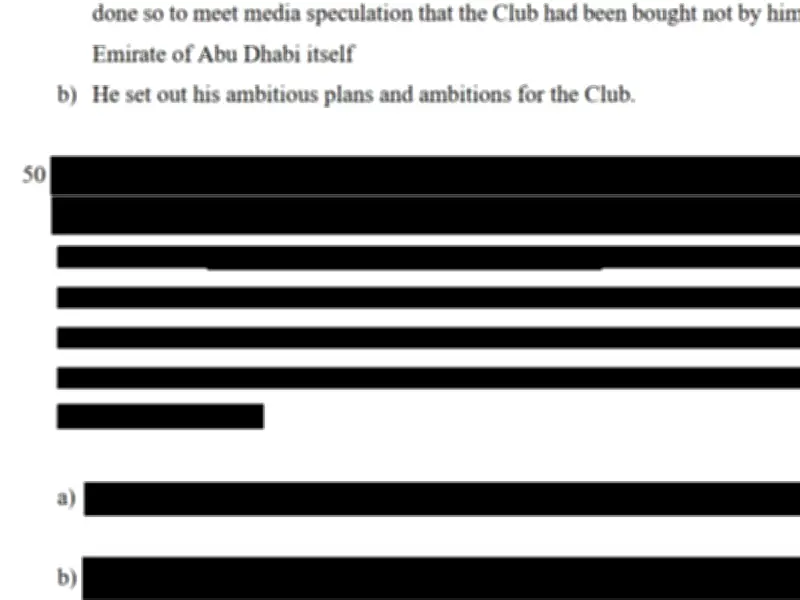
Large chunks of the 40-page document are redacted, hiding names of individuals or entities. One curious entry relates to the 'Disguised Funding Scheme' that essentially points to all of City's guilt, and it reads: "There was no direct evidence that [REDACTED] was aware of the Disguised Funding Scheme or authorised the operation of the Disguised Funding Scheme. We therefore concluded that the Disguised Funding Scheme was operated with [REDACTED] knowledge."
Football finance expert Stefan Borson has suggested it could be City owner Sheikh Mansour, which would be convenient for him in his roles not to have known anything even if it seems improbable that he would have been unaware that he was missing £900m. Equally, if it is somebody else, why has it been deemed significant to note? The role of Abu Dhabi is hinted as having been a major point of discussion during the hearing, but there feels like there is a lot more to come on it.




