
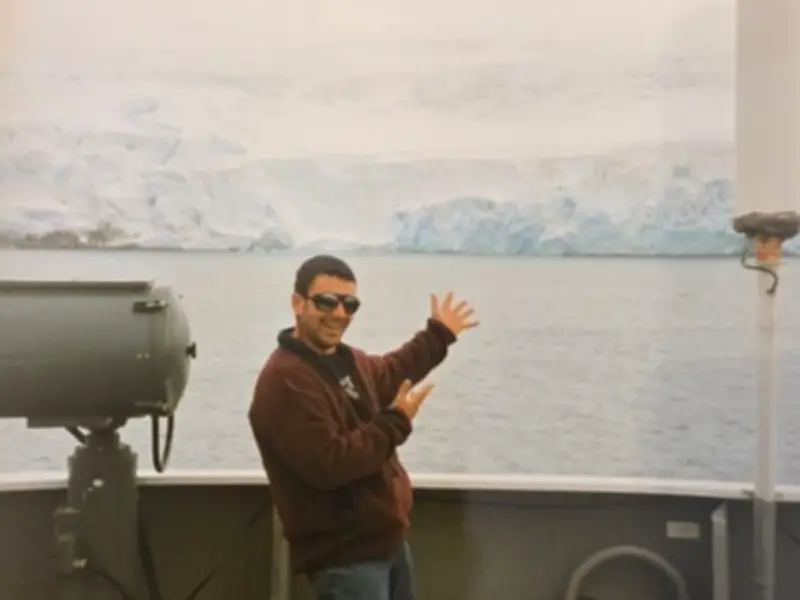
When Marc Reardon was offered a contract with construction company Tilbury Douglas, it came with a catch: the job was 10,000 miles from home on Antarctica, building a new laboratory, research station, dive tank and decompression chamber.
Reardon, originally from Newport and now 54, spent six months on the continent during the summer season, where daylight never faded. "It never got dark, which was the first of many strange things about this unique continent," he said.
A cold like no other
Despite the freezing climate, Reardon said the conditions were not what many might expect. Temperatures during the day hovered around minus 10 degrees, but the air was so dry that he often worked in a T-shirt. "It's so dry, there's no humidity. It's a strange cold, it gets into your bones but it's a totally different feeling of cold down there than at home," he explained.
At night, temperatures plummeted to minus 20 degrees. The landscape was a stark mix of white mountains, snow, ice and occasional patches of rock and shingle. He also pointed out that, despite popular misconceptions, there are no polar bears in Antarctica, although wildlife and birdlife are abundant.
Whiteouts and other dangers
Reardon witnessed two "wipe outs" - the term used for whiteout conditions when the world outside becomes a totally white box. "You can't tell what's the ground, what's the ceiling, what's the walls - it's all white. And that's how people get killed out there because they go outside into that and lose all sense of direction and orientation," he said. "I witnessed that twice, and that was quite frightening."
The construction itself was not the hardest part of the project. The site was run by an experienced global company with all supplies on board, so there was no chance of running out of materials, but also no opportunity to pop to a local hardware store for an extra packet of screws.
For Reardon, the toughest moments were thinking about family and friends 10,000 miles away, especially as the trip covered Christmas 1995. There was no mobile phone coverage at the time.
Life on the base
He was part of a team of around 30 workers. There was plenty of downtime, and though there was no football on TV or a local pub, the team found ways to enjoy themselves. "There was literally a shipping container, which was a refrigerator, full of beer, so you could have a drink, that wasn't a problem. We would go out to a skiway so we could do some skiing, do some ice climbing and travel on snowmobiles, so, yeah, it was good," he said.
Each worker had their own room with blackout blinds, and there was a food hall with a chef offering a choice of menu. It was, Reardon said, a totally unique way of living.
The continent is a haven for wildlife. Reardon remembers seeing his first colony of seals, with Weddell seals and leopard seals "literally in your back yard, just lying out on the ground," as well as a couple of varieties of penguin in their natural habitat. Although Antarctica covers 5.5 million square miles, the coastal regions were busier than expected even 30 years ago, with research bases from several countries. The US base, he said, was like a small town, complete with marked roads, traffic lights and a landing strip.
Stopover in the Falklands
Reardon and the construction team flew from RAF Brize Norton to the Falkland Islands on an RAF flight. Before they disembarked, they were given a briefing that was a sobering reminder of the 1982 conflict with Argentina, just 13 years earlier. "We were told to look out for ammunition and bombs and mines that you could see still lying around. There were still minefields there, so you had to be careful of where you went, especially on some of the beaches," he said.
Wreckage from the war was also still visible, including a downed helicopter that he later learned was still there, spotted by someone who visited more recently. "You also had to be very careful going cross country because there were minefields still out there too," he added.
Despite the reminders of conflict, Reardon found the islands had the feel of a small British town or a Valleys community. "Everybody knows each other and they are very British. They're proud to be British," he said. He was the only Welsh person on the trip and was well looked after, thanks to the strong Welsh community on the islands. He spent about a week there, visiting the Globe Hotel in Port Stanley, a pub made famous by photographs from the conflict. "We didn't ask any questions about the war because obviously we didn't want to pry," he said.
The Falklands also offered incredible wildlife sightings, including masses of king and emperor penguins packed so tightly that "you couldn't get a piece of paper between them even if you tried," Reardon recalled.
A new role in construction
Since then, Reardon has built a career in construction, running his own company, Pearwood Projects, which covers mainly Monmouthshire. He has just been appointed president of the Federation of Master Builders (FMB) Cymru.
In his new role, he plans to address the skills shortage in the trades by encouraging more young people to take up apprenticeships and helping retrain new entrants into the sector. He is also keen to attract more women, who he says are under-represented in construction. The FMB Cymru team is also pushing forward a strategy to identify rough traders and bad builders who con people out of money or deliver substandard workmanship.
Reardon, now 54, often thinks about his trip "down under" and would have welcomed the chance to go back, but family commitments made it unfeasible. "I would not want to be away from them for that amount of time and it's not exactly family friendly!" he said. He acknowledged the continent has changed a great deal since 1995 - mobile phones are now usable at research bases, more bases and research centres have been built, and more cruises visit the island - but he hopes it does not change too much. "It truly is an exceptional part of our planet," he said.




