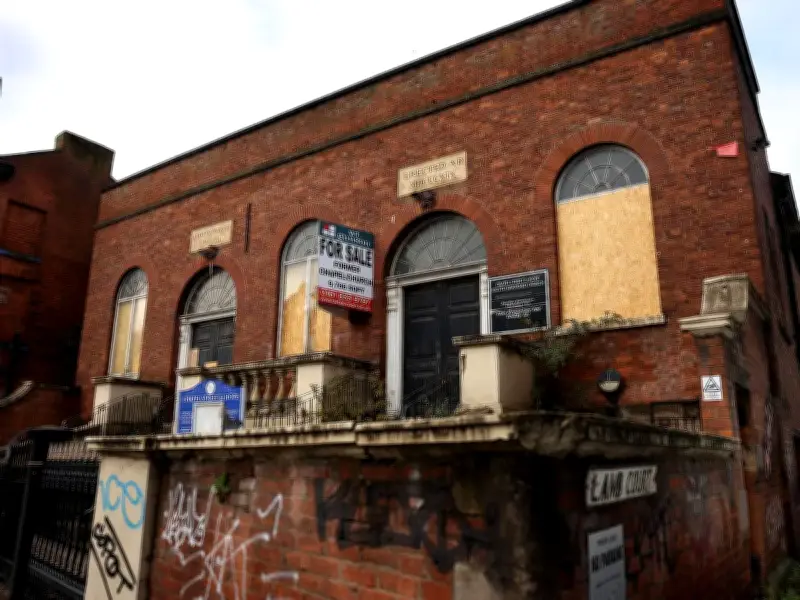
A Grade II-listed Georgian chapel in Salford, built in 1819, has been put up for sale with offers sought in excess of £1.4m. The former Hope United Reformed Church on Chapel Street, less than 100 yards from Salford Central railway station, ceased regular worship several years ago and held its final Sunday service in 2019.
The building, close to Manchester city centre, dates from a period of 'Christian fervour' after the Napoleonic Wars. It was first listed in January 1980 and is described by Historic England as brick-built with a hipped Welsh slate roof and stone dressings.
Mixed-use redevelopment plans
In 2023, plans were submitted to Salford City Council by Chapel Street Community Centre to convert the chapel into a 'mixed-use' development. The proposal included 15 apartments, flexible commercial and business use on the ground floor, community use with an upward extension, and storage in the basement.
A design and access statement from architect MCK Associates Ltd said the overall footprint of the chapel - the entrance, hall, northern vestries and basements - should be preserved, though potentially with 'internal reconfiguration'. The statement noted the basement 'has suffered from rot and a large portion of the floor has been removed together with most of the walls/partitions leaving an open plan space'.
The plan also proposed re-establishing the first floor, which was removed in the 1950s. The basement and ground floor would have provided a room for the chapel and new commercial space for local businesses, while additional upper floors and roof-level accommodation would offer residential units with more floor space than standard city-centre apartments.
Current sale and permissions
The property is now on the market with commercial agents W T Gunson, who say it has Full Listed Building Consent for refurbishment. The building falls under Use Class F, covering education, art display, cultural use, exhibition space, places of worship, community use, libraries, local community retail, recreational use, and sports and leisure facilities.
Gunson's add: "The property benefits from an existing premises licence, including alcohol permissions as well as a music and entertainments license. Licensed hours extend to 1:00am generally, with extended operation until 4:00am twice per month."
The chapel opened on July 28, 1819, as The Mission Hall, founded by members of the Independent Church of Grosvenor Street, Manchester, who were concerned about Salford areas with 'no provision... for the learning of the glorious Gospel of Christ'. A student, John Addison Coombs, preached there and led the church's growth from 18 members to 200 within four years and 600 over the next 15 years. Coombs resigned in 1838 amid 'rumours and whisperings'.
The building was substantially rebuilt in recent years except for the original façade. It was renamed the Independent Chapel in 1880, the Chapel Street Congregational Church in 1894, and became the Chapel Street and Hope United Reformed Church in 1972 after the Congregational Church combined with the English Presbyterian Church.
Historic surroundings
Chapel Street has seen historical firsts, including the country's first horse-drawn trams and, in 1806, the first use of gas lighting in the world. Nearby landmarks include Peel Park, opened in 1846, and the Working Class Movement Library on The Crescent. Salford Cathedral, a few hundred yards from the chapel, reopened in July after a three-year £20m refurbishment.