
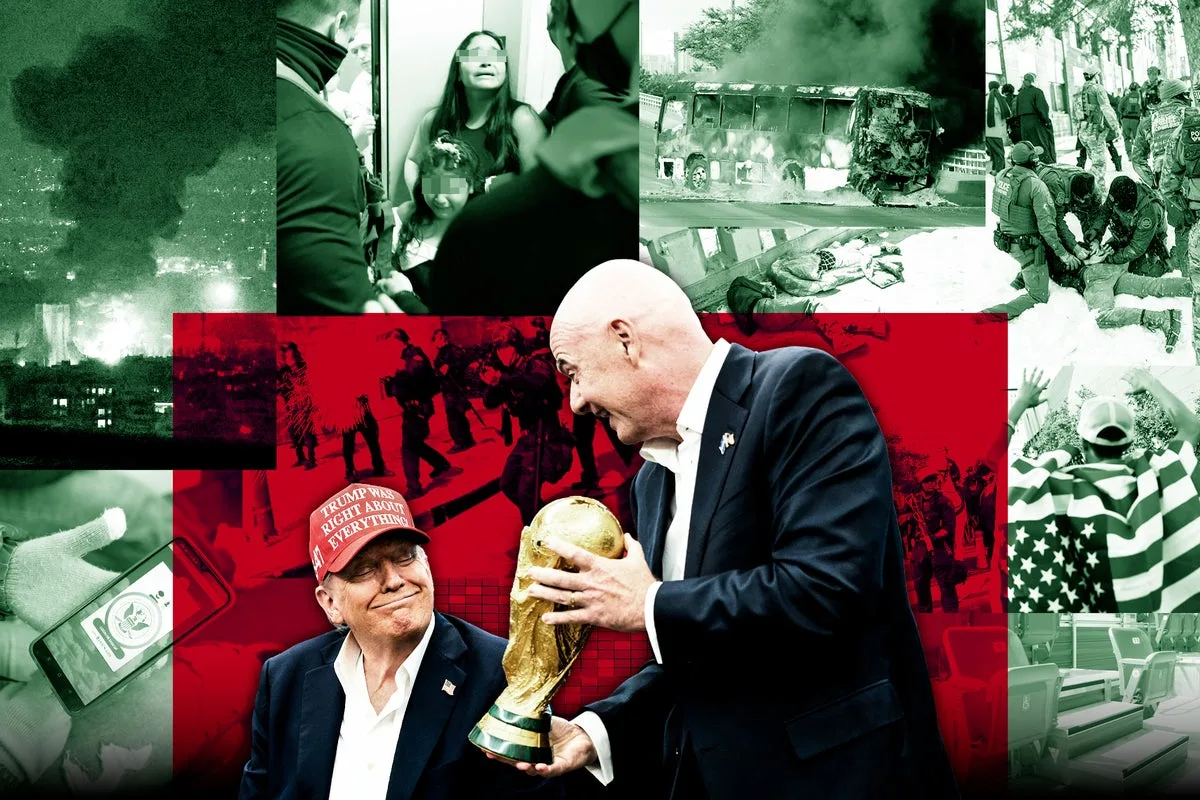
Months before the 2026 World Cup got underway, senior figures within Fifa already found the planning had not been going as expected. That is saying something, given that when the Canada-Mexico-USA hosting was confirmed in 2018, the widespread feeling in football circles was that it was a return to the familiar. Two of the countries had already hosted three of the most successful World Cups, and the bid-book promised low-risk and operational certainty, aided by record revenue projections of $14bn.
A first full tournament under Gianni Infantino's presidency was intended to move away from the inherited issues of Russia and Qatar, two of the most politicised World Cups. Instead, this tournament has arguably been even more politicised. Far from the familiar, the 2026 World Cup has thrown up more unprecedented problems than in the competition's entire 92-year history.
By far the most grave is a World Cup host starting a war against a participant nation, as happened with the USA's attack on Iran at the end of February. The tournament has never witnessed anything like that. If it were almost any other country, the debate would be about moving or boycotting it. Even before that conflict, tournament figures were grappling with far more issues than they knew how to handle.
While 2026 lacks a moral travesty central to staging like Qatar's use of slave labour, and is held in a liberal democracy unlike Russia, the unique nature of the US state and its relationship with co-hosts has created disparate problems. An Amnesty report described the USA as facing a human rights emergency around the World Cup, particularly regarding the chilling threat posed by US Immigration and Customs Enforcement (ICE) to fans and players.
The money Fifa craved is also cost-prohibitive to football's global support, and expanding the tournament to an obscene size may dilute the competition's essence. These are among the least of its issues. When news emerged that Iranian Supreme Leader Ayatollah Ali Khamenei had been killed in a US strike, Fifa leaders were at Hensol Castle in Wales, desperately scrolling for news. They knew this was the gravest issue, and Iran's very participation seemed trivial when 168 people, including 110 children, were killed after a missile hit a primary school in Minab.
The Iranian squad wore lapel pins highlighting the atrocity on landing in Mexico, having been denied a base in the US and visas for many staff. The conflict, now in its 102nd day, weighs over the entire World Cup, including a potential knockout meeting between Iran and the US. Geopolitical developments have made the Fifa Peace Prize a punchline; since Infantino handed it to Donald Trump, the US has carried out military operations in four different countries, taking the total to 12 since hosting was awarded in 2018.




