
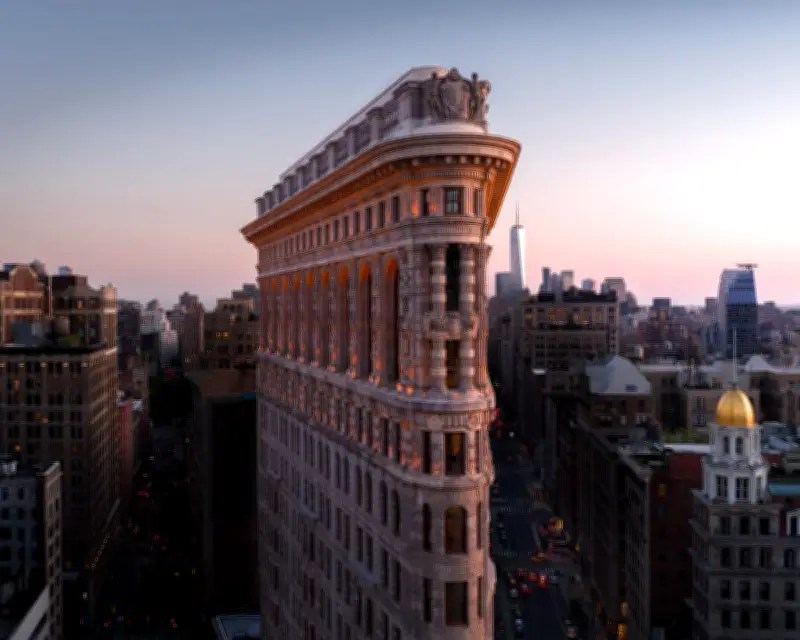
Over its storied years, the Flatiron has been seen as a deathtrap, considered a nuisance that created a deadly, petticoat-lifting wind, and used mainly as a commercial space. Now, the triangular Manhattan landmark is entering a new era: it will open later this fall as a residential building, with apartments costing up to $58.5m.
Completed in 1902, the Beaux-Arts building was once derided as a folly, but today it is one of New York’s most admired structures. Its ornamental brick and terracotta exterior has been hidden behind scaffolding for the best part of seven years. The reimagined Flatiron will soon welcome very wealthy residents, with 36 apartments, some of which span entire floors. Shared amenities include a double-height lobby, a pool, and a games room with a billiards table.
Inside the apartments
The apartments have been styled by a venerated New York design firm, which stripped back the interiors to expose the building’s “steel skeleton” – the interior steel frame that was cutting-edge technology at the time. Images released to the Guardian show one four-bedroom, four-bathroom apartment featuring a curved sofa in what press materials call the “prow”, the sharpest angle of the building. The bathroom offers a generous application of marble, while the kitchen uses brushed steel liberally.
Sales and prices
According to realtor Corcoran’s website, 14 of the apartments are already in contract. The cheapest, on the third floor, appears to have been bought for $10,950,000. That buyer gets a three-bedroom, three-bathroom apartment with an open-plan kitchen, a “great room”, and two dressing rooms.
The flagship apartment occupies the entirety of the top floor and is in contract for $58.5m. The five-bedroom, five-bathroom floorplan includes a sauna, two dressing rooms, a dining room, a breakfast room, and a 72ft “great room”. It is unclear who has bid on the apartment.
The developer’s vision
“There’s always hesitation taking on a landmark building like this. But there’s also an advantage. It has an incredibly special character that makes it worth the pain,” Daniel Brodsky, managing partner of the Brodsky Organization, which owns the building, told the Financial Times in an interview.
Brodsky also told the Times that Jeff Bezos, the billionaire Amazon founder, had spent more than $100m buying several properties three blocks north of the Flatiron. “There’s a group of wealthy people who want to be in a convenient place; good transportation, the best restaurants in the city, the park … it’s a very easy place to live. You’re surrounded by coolness,” Brodsky said, in what was possibly the first time Bezos’ name has been associated with “coolness”.
Architecture and naming
The Flatiron was designed by Daniel Burnham, arguably the hottest architect of its age, and was initially called the Fuller Building. That name failed to take off, and “Flatiron” stuck, although pedants might point out that the building’s floorplan is actually a scalene triangle, whereas an actual flatiron would typically be an isosceles.
One of New York’s tallest buildings when it was completed, the Flatiron’s terra-cotta and limestone facade, featuring lion heads and eagles, has been renovated for the reopening. The BBC reported that a specialist was employed to replicate and restore “thousands of terra-cotta pieces from the facade, reinstalling each by hand”.
A windy and controversial past
The Flatiron was not universally popular when it was completed, amid fears that the building was so narrow it could fall over. It didn’t help that its design inadvertently created a “Flatiron breeze” – a powerful, localised wind caused by the building’s shape. According to author Alice Alexiou, the breeze “blew total strangers into each other’s arms, causing much embarrassment”, and in a tragic incident, blew a 14-year-old messenger boy named John McTaggert into the middle of Fifth Avenue, where he was run over by a car and later died.
“It was long common knowledge that if you walked by the Flatiron on a windy day, at the very least your skirts were going to end up over your head, and your legs exposed. It was now all the rage for groups of men of a certain character to loiter at the foot of the Flatiron, expressly to catch a glimpse of feminine flesh,” Alexiou wrote in The Flatiron: The New York Landmark and the Incomparable City That Arose with It.
Despite the chaos at street level, the Flatiron defied predictions that it would topple. “During a 60-mile-an-hour windstorm that battered the city one morning soon after the first tenants moved in, you couldn’t feel the slightest vibration in the building,” Alexiou wrote.
It was built to last, and this latest iteration looks set to continue its legacy – even if its price tag puts it far beyond the reach of most New Yorkers.




