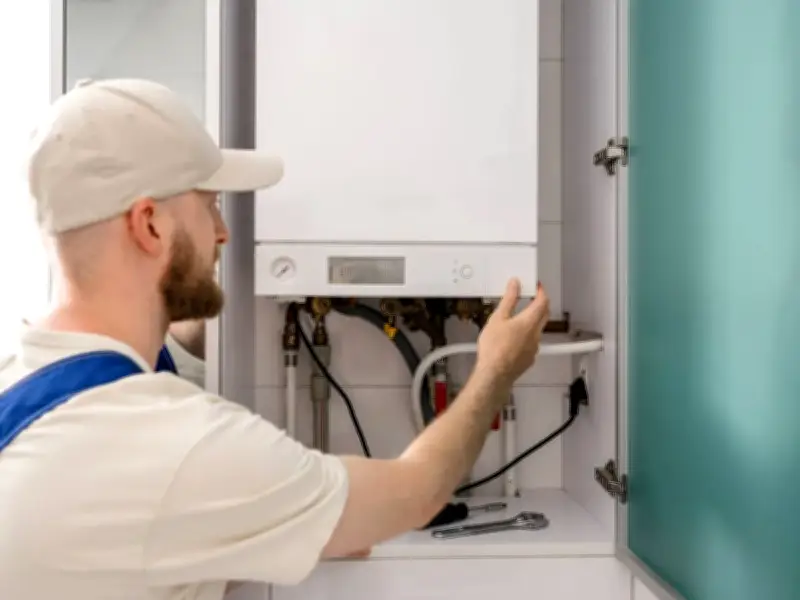
Households are being urged to inspect their boilers before turning on the heating this autumn, or they could face repair bills of up to £450. With temperatures dropping, millions of homes are preparing to switch on their heating, and experts say a few simple checks now could help spot problems before they become a winter breakdown.
Around 84% of UK households – equivalent to roughly 24 million homes – rely on gas central heating, according to figures from Ofgem and the ONS. With October 18 commonly known as "Boiler Switch On Day", heating specialists advise homeowners not to wait until the first frosty morning to discover their heating is not working.
Why early testing matters
Adam Knight, lead engineer at home heating and cooling specialists BOXT, said: "The worst time to discover a problem with your heating is when the temperature has suddenly dipped and everyone else is trying to book an engineer."
"Testing your heating early gives you time to spot the warning signs and get them dealt with before a small issue turns into a breakdown."
Homeowners should expect to pay around £300 based on current 2026 figures, while an emergency repair can average around £450.
The five checks to carry out
1. Check the boiler pressure – The pressure gauge should sit at around 1-1.5 bar when the heating is off and can rise to around 2 bar when on, though homeowners should check the manufacturer's instructions. If the reading falls outside this range, the system may not work correctly. If pressure keeps dropping, it could indicate a leak or another problem.
Knight said: "If the pressure is slightly low, repressurising your system is a quick and easy task that anyone can do. But if you find you're having to do it repeatedly, that's a sign something else may be going on and it should be checked by an engineer."
2. Give your heating a test run – Turn the system on briefly and check the boiler fires up and warmth reaches the radiators. Listen for banging, clanking or kettling sounds, or a boiler that keeps starting and stopping.
Knight added: "One of the biggest mistakes people make is waiting until they actually need their heating before checking that it works properly."
"Check that the boiler fires up, the radiators heat from top to bottom and there aren't any new or unusual noises."
"If there is a problem, it's much better to discover it now than when you wake up to a freezing house."
Unusual noises could mean a blockage such as an airlock, sludge build-up, or pump failure. Boiler kettling – a mix of whistling, bubbling, rumbling, popping, or low banging – could be caused by water circulation issues, a pump fault, or excess limescale or magnetite sludge in the heat exchangers.
3. Check for cold spots on radiators – Run your hand across the radiator once warm. Cold at the top but warm at the bottom suggests trapped air, which bleeding could solve. Cold at the bottom with a warm top may indicate sludge or poor circulation. If you bleed a radiator, check the boiler pressure afterwards as it can drop.
4. Check the thermostat – Verify the temperature setting, heating programme and batteries. A wrong schedule, wifi dropout or dead batteries can make it seem the heating has failed. Avoid cranking the thermostat all the way up – it won't make the boiler warm the room any quicker.
5. Know when a problem needs an engineer – Warning signs include the boiler repeatedly switching off, pressure that keeps falling, visible leaks, new noises, radiators not heating properly, hot water cutting in and out, unusual smells, or fault codes on the boiler.
Knight said: "The important thing is not to dismiss a change in how your heating is behaving just because it's still working."
"A new noise, recurring pressure loss or a radiator that suddenly isn't heating properly can all be reasons to get it checked. Acting on those signs early can help prevent a much bigger problem later."
What you can do yourself – and what you can't
Homeowners can safely check boiler pressure, radiators, thermostats, TRVs and look for visible leaks. Work involving the boiler casing, gas pipework, gas components, internal repairs, persistent leaks or pressure loss should be left to a Gas Safe registered engineer.
Knight said: "Homeowners can do lots of straightforward checks themselves, but there is a clear line when it comes to the boiler itself."
"Don't remove the casing or start working on gas components because you've found a tutorial online. If you're not sure what you're dealing with, get a qualified engineer to take a look."
A standard boiler service currently costs around £80-£120, with an average of around £100. BOXT offers boiler servicing from £8.99 a month, and boiler repair visits for £89, including a one-hour inspection and diagnosis by a Gas Safe registered engineer, with a fixed-price quote if further work is needed. For those replacing a boiler, BOXT allows customers to add up to 10 like-for-like radiators as part of an installation, with a TRV included on each one, saving up to £400.