

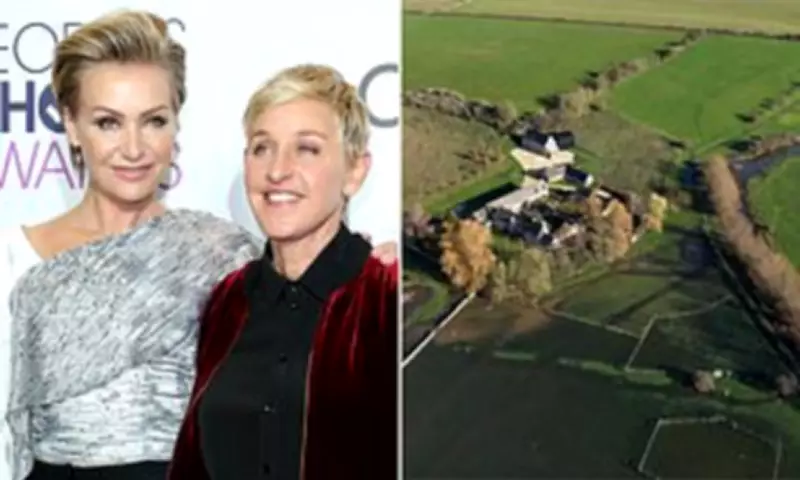
Ellen DeGeneres Seeks Approval for Horse Stables at Cotswolds Estate
Former American talk show host Ellen DeGeneres has formally submitted planning documents to construct horse stables at her £22 million Cotswolds residence, with the ambition of establishing it as a permanent home for herself and her partner Portia De Rossi. The application, filed with West Oxfordshire District Council, represents a significant shift from previous intentions to sell the flood-affected property.
Property History and Renovation Challenges
DeGeneres and De Rossi originally purchased Kitesbridge Farm near Burford for £15 million in 2024, subsequently investing approximately £7.5 million in comprehensive external and internal renovations. However, the couple vacated the premises after less than a month, seeking alternative accommodation better suited to accommodate De Rossi's equestrian passion.
The property was listed for sale in July of last year but failed to attract a buyer, partly due to persistent flooding from the River Windrush that flows through the 43-acre site. Reports emerged suggesting a potential sale was imminent after DeGeneres allegedly reduced the asking price by £4.5 million from the original £22 million valuation, with the property subsequently withdrawn from the market as a condition of the proposed transaction.

Planning Application Details and Design Considerations
The newly published planning documents reveal the couple's intention to transform the estate into their long-term residence, contingent upon approval for the stable construction. In a design and access statement submitted to council planners, their representatives emphasized: 'The applicants carried out a successful renovation of the house last year and wish to make this their long term home. One of their passions is horses and although the building group is large, there is no provision for horses or for their training and bringing up. This application seeks to address this in as sensitive a way as possible.'
The full application proposes demolishing an existing agricultural building and replacing it with a stable facility designed to house two loose boxes while providing storage space for equestrian equipment. Architectural drawings depict a vernacular structure constructed from stone with a pitched tile roof, intentionally designed to complement the existing building cluster aesthetically.
Design Rationale and Environmental Considerations
Planning documents detail how designers evaluated multiple architectural approaches, ultimately rejecting both larger American barn styles and U-shaped byre ranges in favor of a middle-ground solution. The application explains: 'Both are traditional per se, but the American barn was felt to be too large and might easily dominate the pleasing building cluster to the west; a U shaped byre range conversely not providing the cover and practicality required. Hence, the "in-between" option is proposed, a traditional stone building, single range, built in the local vernacular, so as to blend in to the existing building group.'
The proposed stable building has been strategically positioned to align centrally with the granary barn to the north and byre range to the south, creating what designers describe as 'a pleasing viewpoint on approach.' The structure includes a first-floor hayloft accessible via tallet steps, though planners note this storage area is not central to the application's primary purpose.
Community Impact and Planning Process
The application asserts there will be minimal impact on local residents, stating: 'There are no nearby neighbours and thus no impact on residential amenity that would result from the provision of stabling.' Representatives have urged council planners to expedite their decision, arguing the proposed building would represent an improvement over the existing agricultural shed scheduled for demolition.

In their concluding remarks, DeGeneres's representatives wrote: 'The stable building has been sensitively designed, sited and orientated, to reduce visual massing and tie the new stable building into the existing building group. Indeed when comparing the existing agricultural shed - which is to be demolished - against the proposed stable building, it is likely the traditionally designed stone building would sit better and belong more coherently to the adjacent building group.'
No public comments or representations have been received thus far, with West Oxfordshire Council expected to determine the application at a future date. The outcome will ultimately decide whether DeGeneres and De Rossi can realize their vision of establishing a permanent equestrian-friendly residence in the Cotswolds countryside.





