
Retired trawlerman Armand Toms runs his finger along a knee-high mark on the diesel tanks used to refill fishing and tripping boats in Looe’s harbour in south-east Cornwall. “The sea got up to here in 2014,” says the 65-year-old, before raising his hand towards the top of the tanks. “If we get a metre more by the end of the century – is anything going to survive here?” Toms, an independent councillor for Looe East on Cornwall council, has seen the town flood throughout his life. But now he fears for its very future because the frequency with which the sea spills over the harbour walls and bubbles up through its mine-waste foundations is increasing year-on-year.
Looe has the dubious accolade of being the most frequently flooded town in the country. According to the Environment Agency, the historic centre typically floods four to eight times a year, putting at risk more than 200 properties on every occasion. The agency estimates the town’s plight will worsen as rising global temperatures increase sea levels and whip up more devastating storms, with the centre expected to flood 14 times a year in 2020 and 60 times a year in 2050.
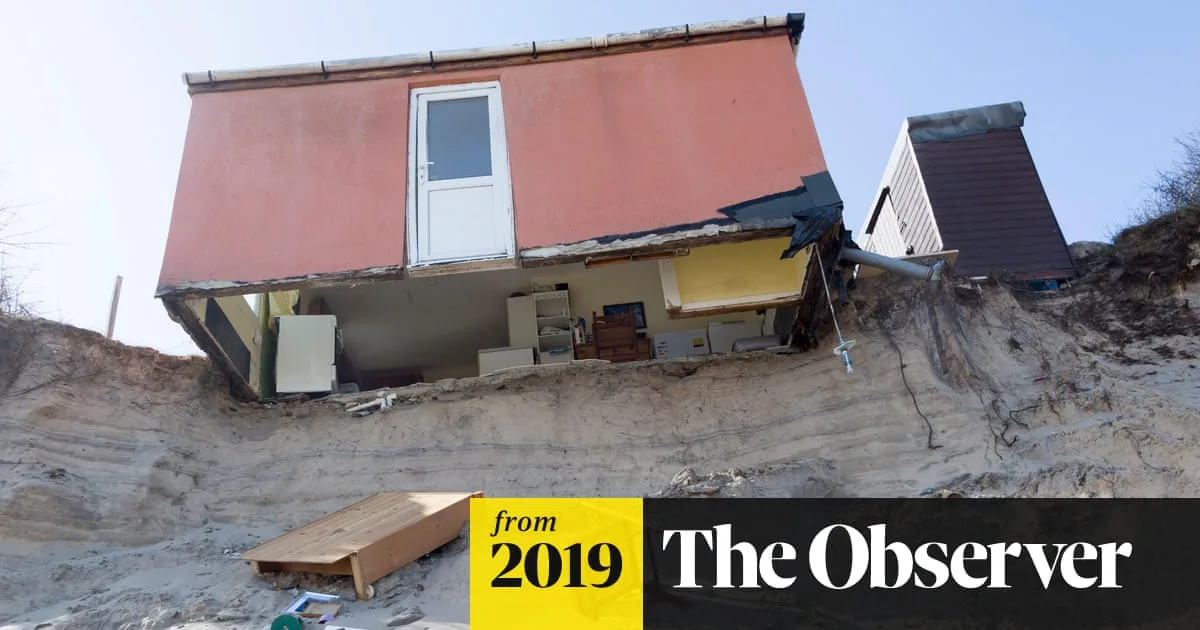
Steve Marks, who oversees much of the Environment Agency’s work in Looe, says the town runs the risk of flooding every time there is a spring tide, which happens twice a month. “The sea reaches the top of the quayside walls on a spring tide and when you get a storm as well, the water comes over,” he says. “And we know climate change is increasing the frequency and intensity of storms.” The British coast is crumbling into the sea at an accelerating rate, with huge chunks of cliffs and beaches being swept away in storms each winter. According to the Committee on Climate Change, sea levels around Britain could rise by at least a metre over the lifetimes of today’s children.
Smaller coastal communities such as Looe only qualify for limited government funding for flood defence, which is targeted at more densely populated areas. Councils are expected to look to private businesses to make up shortfalls. But the environmental food and rural affairs select committee found this year that it has become increasingly difficult to attract such contributions, with only £50 million secured from private sector sources since 2015. “The money that is available for schemes in small places like Looe falls quite far short of what is actually needed,” says Marks.
It is not just housing at risk when a place suffers from repeated flooding – the economic impact of a fast-changing coastline cannot be underestimated. Tina Hicks, Looe’s first female harbour master, says the floods disrupt the fish market, which sees more than £1.5m worth of fresh fish landed on the Cornish coast sold to restaurants in London and other cities every year. “We are getting dirty flood water coming up through the drains. I’ve got photos of people paddling to get to the market – it happens all the time,” she says. Hicks worries that flooding could eventually drive tourists and shops away, with 22% of businesses already considering their long-term future in the town, according to the council.
Environment Agency engineers have drawn up four schemes to protect the town over the last 20 years but none have been implemented due to lack of funds. This year Cornwall council backed a new plan to build a tidal gate but the £41m project would only be entitled to £3.7m of government funding. Up to 100 properties around the county’s rugged coastline are currently at imminent risk from coastal erosion.




