
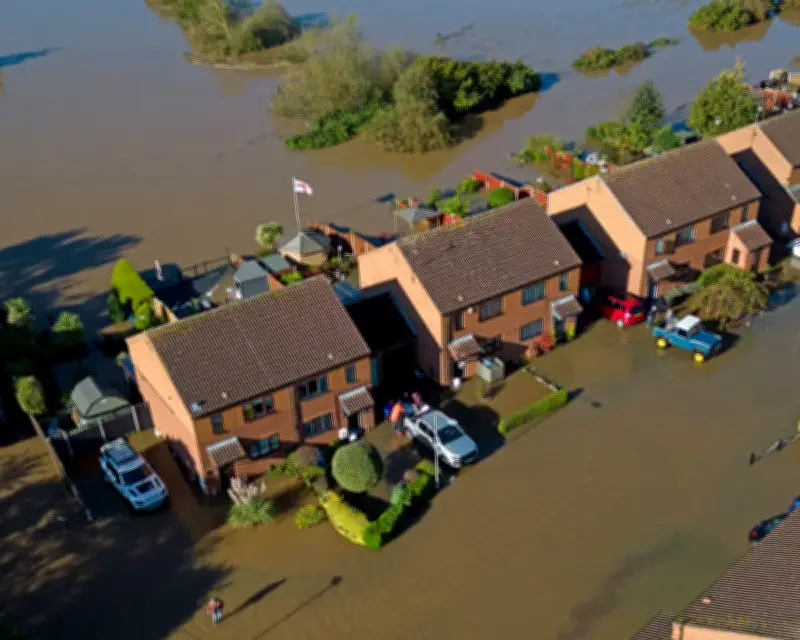
The boss of Britain’s biggest insurer has warned that new English homes built in flood-risk areas could become uninsurable in the future. Amanda Blanc, chief executive of Aviva, said the flooding threat was “absolutely increasing”.
Speaking to the BBC, Blanc explained that a dry summer followed by heavy rain on dry surfaces leads to more surface water flooding. She noted that 110,000 homes had been built in flood areas over the past 10 years, and if this trend continued, a further 115,000 new homes would be built in flood areas in the next decade. “That doesn’t seem to me to make sense. We need to think about where those homes are being built,” she said.
Insurance and inevitability
Blanc told the BBC’s Big Boss Interview podcast that England was “for sure” building properties that might become uninsurable in the future. She explained that insurance is a pool where risk exists for some people but not others, making it difficult to insure properties where flooding is inevitable.
“It’s very well known where these flooding areas are. Let’s think very carefully about homes that are being built,” she told planners and housebuilders. “It’s dangerous.”
Flood risk and mitigation
According to the Environment Agency, about 6.3m homes and businesses in England are at risk of flooding. This could increase to about 8m, or one in four properties, by mid-century as the climate crisis worsens. If a property cannot get insurance cover or it is too expensive to insure due to frequent flooding, the homeowner would have to bear the cost, affecting their ability to get a mortgage or sell the property. A Guardian investigation last year found that some towns may have to be abandoned as climate breakdown makes many areas uninsurable.
Blanc said a lot could be done to mitigate damage, such as using bricks with self-closing air vents, having stainless steel kitchens instead of wooden furniture, and creating plug points halfway up the wall rather than near the floor. “You can do all sorts of different things to your property to make it more or less vulnerable to flood.”
Aviva research and pensions warning
According to Aviva’s research, more than a quarter (26%), or 101,657 new homes, have some risk of flooding now, and one in seven will be at medium to high risk of flooding by 2050. After the very wet and stormy winter in the UK in 2023-24, the Met Office estimated that such winters had gone from once in 80-year events to once in 20-year events.
Blanc also called on the government to avoid policy “kite flying” before John Healey’s first budget as chancellor on 28 October. Aviva is a leading private pension provider, and speculation about changes to pensions led to a jump in withdrawals in the run-up to the budget in the last two years. “Effectively we saw in the last year 30 times the normal withdrawal from pensions that we would normally see, which is clearly something which customers may regret afterwards because once you take your tax-free lump sum out, you can’t put it back in,” she said.
Blanc has come under criticism over her role as BP’s senior independent director, in which she led the search for a new chair twice in a year after the controversial ousting of Albert Manifold. She will stand down next year after five years on the board. She said: “It’s been a tough gig, right? There’s no doubt about that, and there’s been a lot thrown at BP. But if I look at it today and the combination of a new chair, new CEO, I think that’s a good combination to take BP forward … it’s time for me to move away.”




