

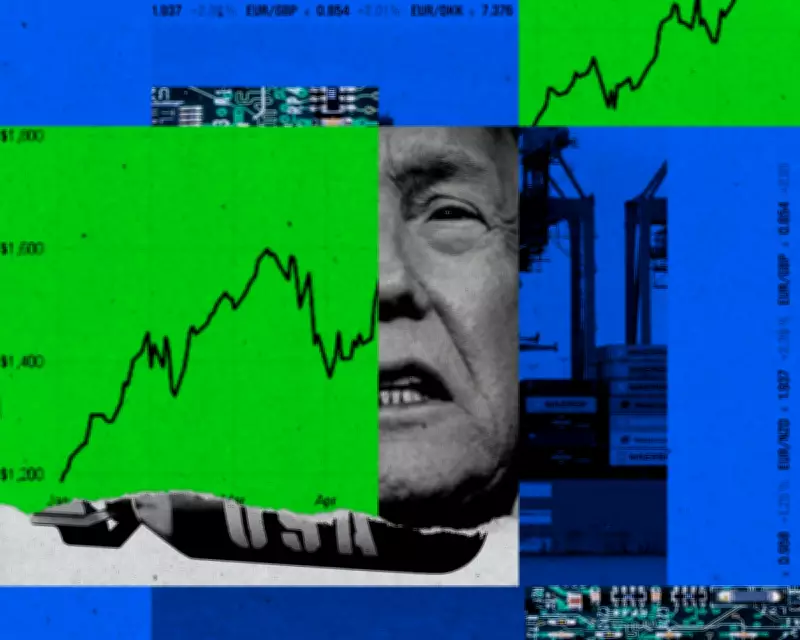
US stock markets have not just recovered from recent losses but are thriving, defying war, inflation, and political instability. Despite a sharp selloff in late March triggered by rising oil prices and conflict with Iran, the Dow and Nasdaq have rebounded strongly. By mid-May, markets had not only regained lost ground but reached new highs, with the tech-heavy Nasdaq up 11% since the start of the year.
Resilience Amid Turmoil
Wall Street has proven remarkably resilient to a series of shocks, including the Covid-19 recession, generational-high inflation, Russia's invasion of Ukraine, and Trump's tariff disputes. While consumer confidence has plummeted and everyday Americans struggle with an affordability crisis, stock indices continue to climb. The S&P 500 and Dow Jones Industrial Average hover near record levels, buoyed by sustained investment in artificial intelligence.
The 'Taco' Mindset
Some economists attribute this resilience to a belief that President Trump will ultimately back down from his most extreme policies—a pattern dubbed 'Trump Always Chickens Out' (Taco). For instance, Trump's 'liberation day' tariffs were delayed hours after announcement, and threatened tariffs on EU countries were called off. Even as the Iran ceasefire teeters, markets remain optimistic.

Eswar Prasad, a former IMF official and economist at Cornell University, notes that investor confidence also stems from expectations of federal intervention. 'Investors now have a clear view that if there is significant trouble, the Fed and the US government will step in,' he said. However, he warns that such intervention can hide risks, especially with weakening financial regulation.
The K-Shaped Economy
Inflation, which had eased from a 40-year high, is rising again amid the Iran war, reaching 3.8% in April. Higher prices typically reduce spending, but the impact is uneven. Wealthier Americans continue to spend freely, while lower-income households tighten budgets. A New York Federal Reserve report shows low-income Americans have cut gas usage due to high prices, while high-income consumers have not changed their habits.
Economists call this a 'K-shaped' economy, where the top 10% of income earners—who own 87.2% of stocks—benefit from rising markets, while the bottom 50% own just 1.1% of equities. Continued spending by the affluent has kept many companies profitable. Delta Air Lines CEO Ed Bastian noted that premium revenue doubled over the past year as top-tier consumers prioritize travel.
AI Investment Boom
The release of ChatGPT in 2022 sparked a race to build AI infrastructure. Tech companies are spending hundreds of billions on AI, with thousands of data centers under construction. Seven tech giants—Alphabet, Amazon, Apple, Meta, Microsoft, Nvidia, and Tesla—now account for 30% of the S&P 500's weight. Nvidia, which produces AI chips, saw its stock surge 1,450% over five years and became the first company to reach a $5 trillion valuation.
This massive spending has raised concerns about an AI bubble. AI investment outpaced consumer spending as a share of US economic growth in early 2025. Paul Kedrosky, an investor and MIT research fellow, calls it 'the largest private sector stimulus program in US history.' The White House is fully behind the boom, with Trump's Federal Reserve pick Kevin Warsh arguing AI is the most productivity-enhancing wave of our lifetimes.
Bubble Risks
Former Fed Chair Alan Greenspan famously warned of 'irrational exuberance' in 1996 before the dot-com bubble burst. The S&P 500 doubled after his warning but then halved by 2002. Kedrosky sees parallels with today's AI frenzy. Three AI startups—OpenAI, Anthropic, and SpaceX (parent of xAI)—are planning trillion-dollar IPOs this year, which would dwarf the entire dot-com bubble.
'That money has to come from somewhere,' Kedrosky said, predicting massive selling of other equities as institutions make room for these IPOs. He believes it's not a question of if the AI bubble will pop, but when. 'I would cheerfully be wrong, but history's on my side,' he added.






